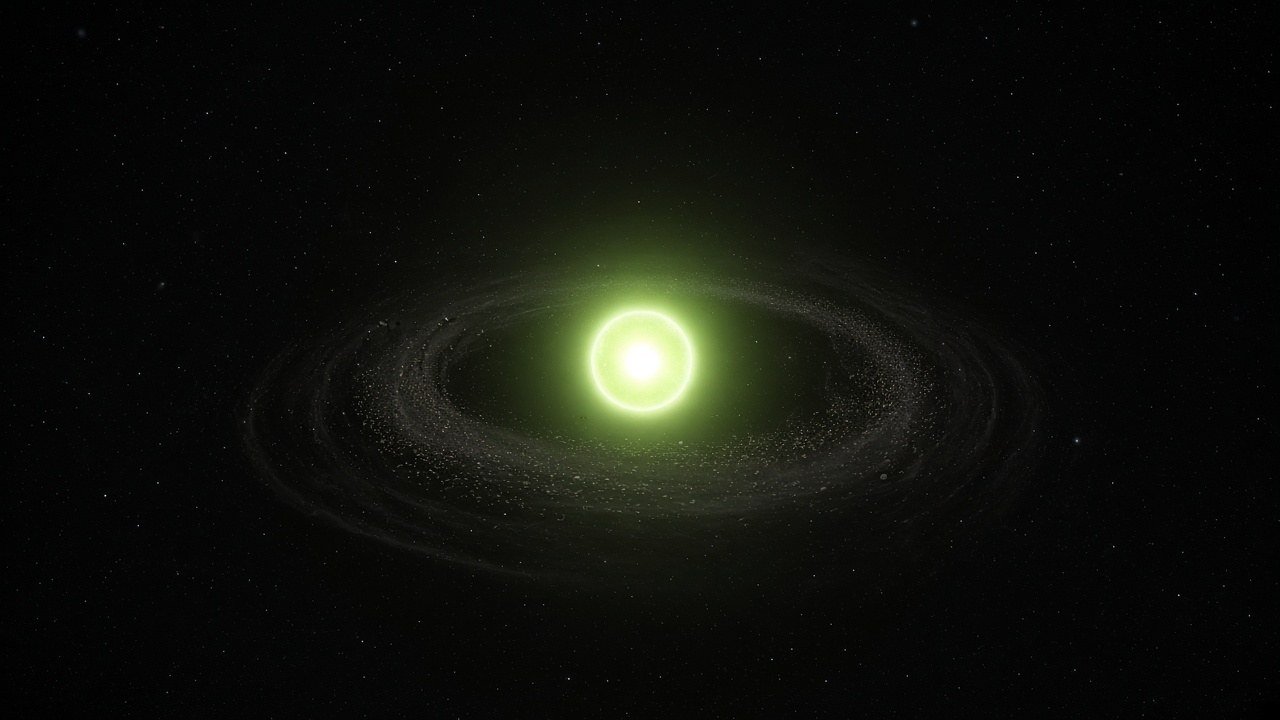
A dead star seems to shine a color that, by its discoverers’ account, no star had credibly shown before: green. Astronomers at the University of Warwick say the white dwarf WD J1330+6435 would appear chartreuse green to a human observer close enough to resolve its disc. The university’s release, posted to EurekAlert! on October 14, says that “no other star, living or dead, has ever been credibly reported as green, making this the first known genuinely green star in the Galaxy.” Reuters, in a Washington-datelined story on October 16 carried by CNA, puts it more flatly: “Astronomers for the first time have identified a green star.” The work appears in the journal RAS Techniques and Instruments under the title “Any colour you like: The diverse chromaticities of white dwarfs,” by Mark A. Hollands, Boris T. Gänsicke, Pier-Emmanuel Tremblay and Detlev Koester, according to the arXiv listing, which shows the preprint posted on Tuesday, October 13.
By the team’s own account, the claim rests on calculation, not sight. The Warwick release says no white dwarf sits near enough for anyone to judge its color by eye, so the team took each star’s spectrum, the light split by wavelength, and ran it through a model of human color vision. The paper’s abstract frames the result as stars that “would appear yellow, green, cyan, pink, or purple if viewed close enough for their stellar discs to be resolved.” Nature World News flags the same limit: “Nobody has seen this star glowing green through a telescope eyepiece.” BBC Sky at Night Magazine adds the qualifier “according to models” to its account of the green glow.
Why green? Hollands told Reuters, “We first became interested in this white dwarf because bits of planetary material have fallen onto its surface, enriching its outer layers in elements including calcium, lithium and, in particular, sodium.” In ordinary stars sodium absorbs one narrow band of orange, Reuters explains. “In this particular white dwarf, however, the density is so high that the sodium atoms are constantly being bombarded by surrounding helium atoms, which alters the sodium atomic energy levels,” Hollands said. “The end result is that the sodium atoms no longer absorb one very narrow wavelength of orange — they absorb the yellows, oranges and some of the red wavelengths. And what you’re left with is a star that has a beautiful chartreuse green glow, something that wouldn’t be possible for sun-like stars.” The release says the coolest white dwarf atmospheres reach around 1 gram per cubic centimeter, close to the density of water. The paper adds that calcium absorbs violet light while the broad sodium doublet absorbs orange, leaving peak light near 500 nanometres.
The paper itself carries caveats. The paper notes that the star’s spectrum “is somewhat noisy, and so it is conceivable that its chromaticity may differ slightly in reality,” though it says an older model from the same group produced a similar hue. The paper also says WD J1330+6435 does not stand alone: two other stars in its sample of 36 metal-rich white dwarfs, WD J0851+1543 and WD J1351+2645, also appear green but much paler, and it calls WD J1330+6435 the most vivid. On wording, Reuters describes debris “from planets that once had orbited it,” and Space.com casts the star as a planet-eating “cosmic zombie,” while Nature World News says the research “does not show that whole planets were swallowed in one event.” The release itself speaks of “accreted rocky material from its planetary system.”
Basic numbers vary by outlet. Reuters places the star about 280 light-years from Earth in Draco; Space.com says around 326 light-years, and Nature World News repeats 326 while citing Space.com, so this desk counts that as one source. The release and the paper’s abstract give no distance for WD J1330+6435, and this desk did not resolve the gap. For temperature, the release says roughly 4,000 degrees Celsius and BBC Sky at Night Magazine gives about 4,000°C (7,200°F); the paper lists an effective temperature of 4,240 kelvin. Space.com also dates publication to “Thursday (Oct. 14),” but October 14, 2026 fell on a Wednesday; EurekAlert dates the release October 14.
The wider study also covers a full local sample. Looking at the 151 white dwarfs within 20 parsecs, about 65 light-years, the team found five with unusual colors, two yellow and three pink, which the release says suggests “roughly one in thirty white dwarfs in the Universe will shine with an unusually coloured light.” For the other 146, the median color temperature came out at about 6,800 kelvin, which people perceive as white, and the release says this corrects a belief that white dwarfs typically look blue, since hotter, bluer ones shine brighter and turn up more often in surveys. Co-author Boris Gänsicke said in the release, “One in thirty might not sound like a huge fraction, but across the entire population of white dwarfs in the Universe, that is still a lot of oddly coloured stars out there.” He added, “Yet if we take the median across a representative population of white dwarfs, we found that the average white dwarf really is white.”
At the other end of the palette, the release names WD J1011+2845, a white dwarf 48 light-years away, as “what may be the reddest star ever recorded,” with carbon lifted from its core producing a “deep salmon-pink glow.” Reuters places it in Leo Minor and quotes Gänsicke: “Rather than something hitting the star, in this case the carbon comes out from its deep interior.” Reuters says the data included spectra from the Sloan Digital Sky Survey, gathered with a telescope in New Mexico, plus white dwarf models the team built, and that carbon-rich white dwarfs tended toward pink or purple, debris-enriched ones toward yellow, and cooler ones with mixed hydrogen and helium atmospheres toward cyan or pale blue. Hollands told Reuters, “It does show that the universe is sometimes just as weird as anything science fiction can conjure up.”
Reading note: this desk wrote from the University of Warwick release (and its EurekAlert! copy), the arXiv preprint of the paper, and outlet copies, not field reporting. The journal’s own page returned an access block to this desk, so the paper lines rest on the arXiv version posted October 13. Reuters lines come from CNA’s copy, checked against a Devdiscourse reprint. Colours here describe model predictions from spectra, and distances differ between outlets.