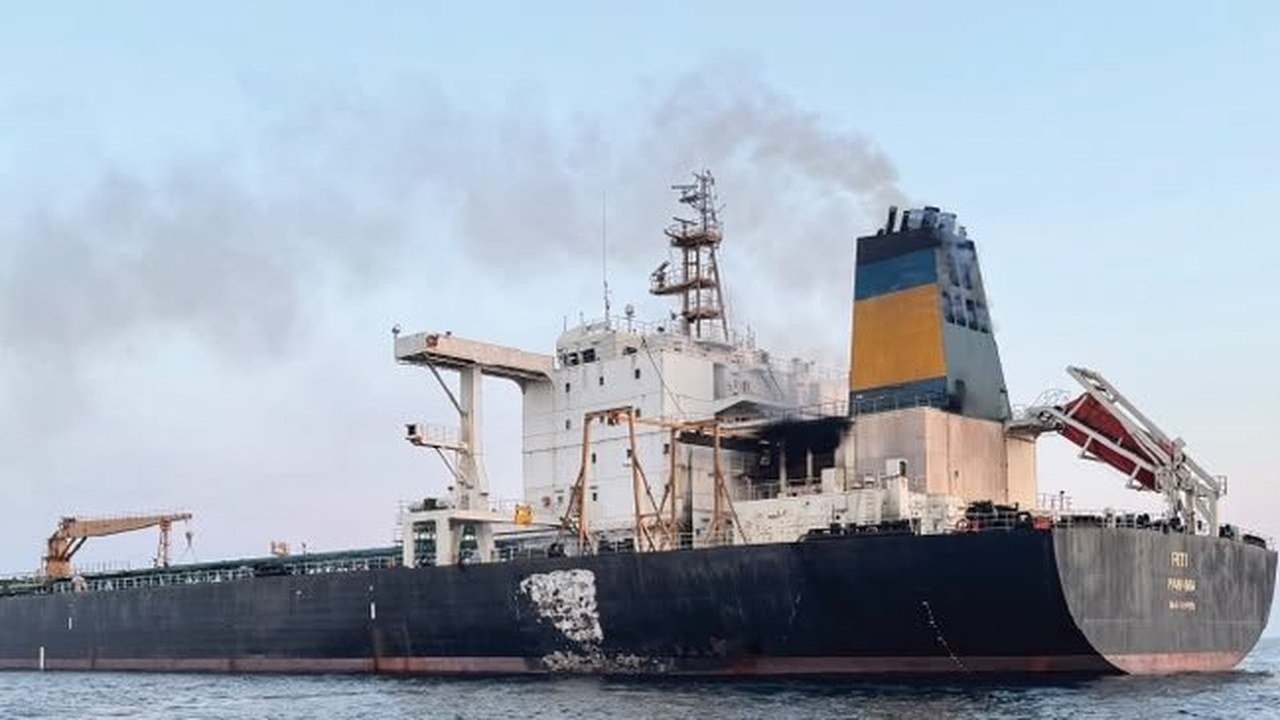
A tanker leaving the Strait of Hormuz caught fire on Thursday afternoon, Pacific time, after a small boat came alongside and fixed explosives to its hull, according to the UK Maritime Trade Operations centre (UKMTO), the British navy’s shipping-safety office. The incident happened at 22:12 UTC on Oct. 29 — 3:12 p.m. PT — about 25 nautical miles northeast of Khasab, the port town at the tip of Oman’s Musandam Peninsula. UKMTO’s first warning, posted on X at 4:54 p.m. PT, cited a third party reporting that “a tanker transiting outbound is on fire, the cause is unknown at time of report” (UKMTO on X). By 6:50 p.m. PT, the agency had what it called a verified report: “the tanker was approached on the port side by a small boat which attached two explosive devices to the hull above the waterline. The subsequent blasts resulted in a fire in the engine room which temporarily disabled the vessel” (UKMTO update on X).
UKMTO did not name the ship, and said the crew came through safely, with no environmental impact: “The fire is now reported as extinguished and vessel is continuing to its next port of call,” its update reads (UKMTO on X). Reuters filled in the name on Friday. “The tanker — the Panama-flagged Louise 1 — was targeted with limpet mines, according to assessments from three maritime security sources,” the news agency reported, in a story republished by the shipping site gCaptain at 5:36 a.m. PT (Reuters via gCaptain; Devdiscourse). Two of those sources described the strike as “the first known successful strike using limpet mines in the area since the beginning of the US war with Iran,” following an attempt in September with devices that failed to detonate, Reuters added.
Limpet mines get their name from the shellfish that clings to rocks: crews or divers fix them directly to a hull. Iran International, a London-based Persian-language broadcaster, explains the difference in its report: limpet mines “differ from sea mines placed in the water, which can detonate when vessels pass over or near them” (Iran International). That distinction matters here, because Iran’s own statements speak of sea mines on forbidden routes, while UKMTO describes a boat crew fixing explosives by hand. Marisks, a Greece-based maritime risk group, raised the alarm in a note quoted by Reuters: “The apparent ability of a small craft to approach a transiting tanker, deploy explosive devices and withdraw presents a significant security concern, particularly in the Strait’s congested shipping lanes.” The group added that “limpet mines are cheap and easily available” and that the approach looks “cheap, low tech and very efficient” (Reuters via gCaptain).
The Louise 1 has a history. Ukrainian forces hit the same tanker with naval drones in the Black Sea in July, over what Ukraine’s SBU security service described as its role in carrying Russian oil as part of Moscow’s so-called shadow fleet, Reuters reports. Its Panama-based operator, which shipping databases list as Aquarius Maritime Ventures, “could not be immediately reached for comment,” according to the same report (Reuters via gCaptain). India’s shipping minister, Sarbananda Sonowal, wrote on X at 6:43 a.m. PT Friday that the “Panama-flagged crude oil tanker MT LOUISE 1, carrying 27 Indian seafarers,” and the Liberia-flagged supertanker Arzanah, with two Indian nationals aboard, “were targeted in projectile attacks in the Strait of Hormuz.” He added: “All 29 Indian seafarers across both vessels are completely safe with no injuries” (@sarbanandsonwal on X). Sonowal dates the Louise 1 strike to Oct. 30, which matches India’s clock: 22:12 UTC on Thursday fell at 3:42 a.m. Friday in New Delhi.
A second ship ran into trouble a few hours later. Oman’s Maritime Security Centre posted an Arabic statement on X at 5:13 a.m. PT Friday saying that the Royal Navy of Oman, working with the centre, evacuated 25 crew members from the commercial vessel RITI, which flies the Panama flag, after an attack started a fire on board about 1.6 nautical miles off the Musandam governorate; the crew received the medical care they needed (@OMAN_MSC on X). The centre attached the photo that leads this story, showing smoke above the ship’s superstructure, scorching on the deckhouse and a blackened scar on the hull. Al Arabiya English relayed the notice at 5:31 a.m. PT, writing that the navy “has evacuated 25 crew members from a Panama-flagged commercial vessel after it was targeted and caught fire 1.6 nautical miles off the coast of Musandam” (@AlArabiya_Eng on X). Turkey’s Anadolu Agency, which spells the name RIT1, notes that “authorities did not say whether any had been injured” (Anadolu Agency; Ajel).
The Omani statement does not say who hit the RITI, what struck it or whether the case links to the Louise 1. It also leaves open whether the RITI counts among the ships Iran says it hit. Pakistan’s Dawn, citing the same centre, gives the distance as “approximately 106 nautical miles off the coast of Musandam Governorate” (Dawn); the centre’s own card on X reads 1.6, and Anadolu and Ajel both report 1.6 (Anadolu Agency; Ajel). This desk uses the figure on the official card.
The attacks came during a busy day for shipping alerts. Earlier on Thursday, at 9:00 a.m. PT, UKMTO said a company security officer reported that their tanker “has been struck by an unknown projectile whilst completing an outbound transit of the Strait of Hormuz,” with no injuries to the crew reported (UKMTO on X). That warning did not name the ship either. Singapore’s CNA adds that UKMTO also logged a dhow that caught fire and sank in the area (CNA).
Iran tells a different story. The Islamic Revolutionary Guard Corps (IRGC) Navy said on Thursday that “three violating oil tankers exploded and caught fire after striking mines while attempting to pass through the unauthorised southern route of the Strait of Hormuz,” and Iran’s army later reported a fourth tanker on fire east of the strait, CNA reports (CNA). On Friday, Iran’s Tasnim news agency carried a new IRGC Navy statement saying a supertanker carrying more than two million barrels of oil struck a sea mine on an unauthorized route and kept burning at the entrance to the strait (Tasnim). An earlier IRGC statement that day, also carried by Tasnim, said two other tankers had switched off their navigation systems and, “with the support of the US military,” tried to use forbidden routes; the IRGC Navy “attributed the incidents to hostile actions by the US military and the tankers’ disregard for Iranian regulations” (Tasnim). Iran also claimed it destroyed an unmanned US vessel in the eastern strait; Reuters said it “could not independently verify the report,” and the US military gave no immediate confirmation (Reuters via Al-Monitor).
Watch: footage released through Iranian media, via @IranIntl_En and @sentdefender on X
Two short video posts. Both clips come from Iranian state or IRGC-linked media; neither shows the Louise 1 or the RITI by name, and this desk could not confirm the place, date or ship. If an embed does not load, it shows as a plain link to the original post.
View the @IranIntl_En post on X: vessel ablaze near the Strait of Hormuz
View the @sentdefender post on X: IRGC-produced tanker video
The US side disputes the mine story. In recent weeks, US Central Command has insisted that it cleared all mines in the “primary transit routes,” and the IRGC spokesman Hossein Mohebi answered on X: “Prove your Hormuz mine-clearing claim with independent evidence, not statements!” CNA reports (CNA). No ship in Friday’s IRGC statements carries a name, and none of the sources this desk reviewed ties a specific named ship to the IRGC’s sea-mine claims.
Who planted the explosives on the Louise 1 remains formally unanswered. Reuters wrote that “It was not immediately clear who was behind the attack” in its early report (Devdiscourse). Others go further. The Maritime Executive, a US trade publication, writes in its own voice that “Iranian forces hit another tanker,” and cited Babak Taghvaee, a security analyst, who “reported that the assailants were members of the Islamic Revolutionary Guard Corps Navy special forces” (The Maritime Executive). Martin Kelly, a former UK regional maritime intelligence analyst, wrote on X that “An Iranian small boat came alongside the outbound tanker LOUISE 1,” and argued that Iran’s sea-mine framing “serves to deter traffic and blur responsibility” (@_MartinKelly_ on X). Iran has not claimed the Louise 1 strike by name, and none of the governments quoted in the sources this desk reviewed has publicly attributed it.
Kelly’s post also recalls the last limpet-mine wave in these waters: in May 2019, four ships took hits at anchor off Fujairah, and a month later the Kokuka Courageous and Front Altair came under attack in the Gulf of Oman after leaving the strait. He warns that ships waiting at anchor face a worse risk, because there “it can be placed below the waterline, often without the crew ever seeing the approach” (@_MartinKelly_ on X). UKMTO’s advice for now stays short: “Vessels are advised to transit with caution and report any suspicious activity to UKMTO, whilst authorities investigate” (UKMTO on X).