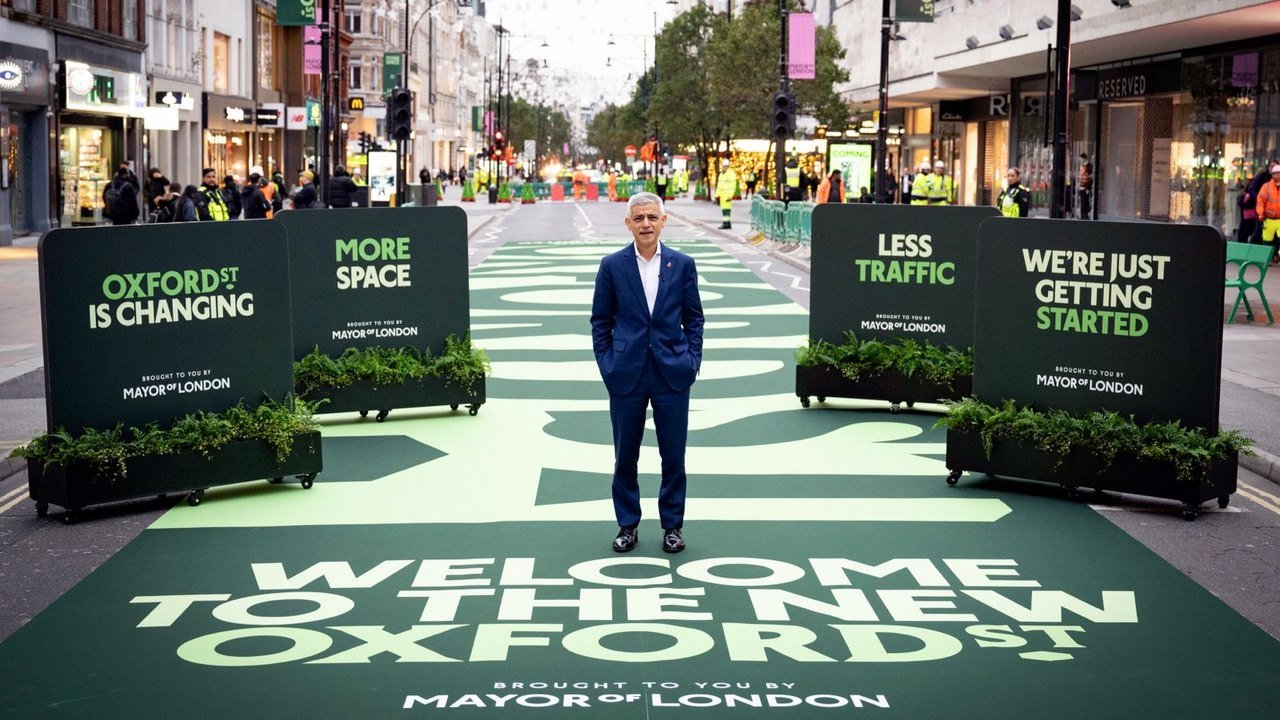
Almost a kilometre of Oxford Street, the London shopping road that City Hall calls the nation’s high street, closed to traffic on Monday, Oct. 26, according to Transport for London (TfL). The traffic-free section runs from Orchard Street, near Marble Arch, to Great Portland Street, east of Oxford Circus, and takes in the John Lewis and Selfridges department stores, according to The Guardian (The Guardian); Reuters describes it as running between the Selfridges and IKEA stores (Reuters via RTÉ). The Guardian reported that the closure would start at 7 a.m. London time, which by this desk’s conversion matches midnight on the U.S. West Coast now that the UK has returned to Greenwich Mean Time (The Guardian). The mayor’s office described the street as “permanently traffic-free for the first time” in a release on Monday (City Hall).
The rules, as TfL lists them, bar private vehicles, buses, taxis, private hire vehicles, cycles, scooters and pedicabs from the stretch around the clock (TfL rules). Delivery and servicing vehicles may enter between midnight and 7 a.m., only by approved routes, and emergency vehicles may enter at any time, TfL says (TfL rules; TfL works page). Mobility scooters keep access (TfL). A driver who enters the zone may receive a Penalty Charge Notice, according to TfL, which took over from Westminster City Council as the highway authority for Oxford Street in September 2025 (TfL). Seven north-south roads, including Duke Street, New Bond Street and Regent Street, stay open as crossings (TfL works page). The Guardian adds that private cars already faced a daytime ban on the street, and that unlike some other car-free areas of London, the strip stays closed to cycles, e-bikes and e-scooters at all hours (The Guardian).
Buses felt the change first. TfL says routes 7, N7, 94, N113 and N137 now finish at Marble Arch, while routes 98, 139, 390, N98 and N207 run on Wigmore Street, Henrietta Place and Cavendish Place, with replacement stops about 200 metres from the traffic-free area (TfL works page). TfL calls the current eastbound routing an interim one, because Henrietta Place still runs one-way, and says some of its own bus spider maps showed errors that it has started to fix (TfL; TfL works page). Taxi ranks sit within 100 metres of the zone, on Orchard Street, Duke Street and Great Portland Street among others, according to TfL (TfL works page). BBC London posted footage of what it called the last bus to travel down the street before the closure (@BBCLondonNews).
By midmorning, shoppers had begun to walk in the roadway. BBC News reported that more and more people walked on the road itself rather than keeping to the pavement as the day went on (BBC News). Lucia, who works nearby, told the BBC she took a detour to see the street: “It’s very joyful,” she said, adding that she expected Christmas to feel “more enjoyable” (BBC News). Claire Mann, TfL’s chief operating officer, told BBC Radio London that a bus stop sits within 200 metres of the street and taxi ranks within 100 metres, and that Bond Street station and the Elizabeth line offer step-free access, according to the BBC’s live page (BBC live page).
Watch: Oxford Street’s first traffic-free day
BBC London posted footage of the moment the street closed to traffic and of cyclists riding through after the ban began, and Sky News posted interviews with the mayor and shoppers. This desk has not frame-checked the clips. If an embed does not load, it shows as a plain link.
View the @BBCLondonNews post on X
View the @BBCLondonNews post on X
View the @SkyNews post on X
The first day also brought confusion. Many cyclists kept riding through the new barriers, and security staff shouted at some of them to “dismount”, BBC News reports (BBC News). BBC London said on X that about seven security staff near Oxford Circus called on cyclists to get off their bikes, “with mixed success” (@BBCLondonNews). A TfL spokesperson told the BBC that riders had an obligation to follow the rules and that TfL would use geo-fencing to cut or reduce power to dockless e-bikes that enter the zone (BBC News). The BBC also describes a police officer who asked a security worker, “How do I get my car down there?” (BBC News). Tom Faynes, chief executive of the London Cycling Campaign, told the BBC that “thousands of cyclists” use the street every day and called for new cycle routes to its north and south (BBC live page). Passengers also found an Oxford Circus Tube entrance shut while workers cleared street furniture, a closure a TfL worker expected to end within days, the BBC reports (BBC live page).
Not everyone welcomed the change. Waiting at a taxi rank on Regent Street, a cab driver the BBC identifies only as Gary said the closure would “cause chaos”: “The traffic is going to be pushed around the back of the West End,” he told the BBC (BBC live page). Another black-cab driver told BBC London he worried that access would “become a problem” for some disabled passengers (BBC News). Adam Gabsi, chair of the disability charity Inclusion London, said last week that “the proof will be in the pudding,” warning that difficult access to buses and taxis would cause problems “for people like me,” according to the BBC, which adds that disabled Londoners got consulted but did not co-produce the plan (BBC News). The sight-loss charity Guide Dogs welcomed the scheme, and the group Wheels for Wellbeing argued that the final design must build in accessibility, the BBC reports (BBC News; City Hall).
Residents of nearby streets voiced the sharpest worries. Michael Bolt of the Marylebone Association said he feared surrounding areas would get “ruined” as traffic moved onto other roads, and Karen Jones, a resident of 20 years, worried about what would happen to the area’s “beautiful garden neighbourhoods,” according to BBC News (BBC News). Tim Barnes, deputy leader of Westminster City Council, told the BBC that the council would monitor traffic, noise and pollution and hold TfL and the mayor responsible for fixing problems they create (BBC News). In a BBC London clip shared by a Conservative group on X, Barnes argued that a launch next year would have produced “a much better scheme” (@CLWCA). The Guardian describes the scheme as a political victory for the mayor, won with central government’s help to override local council objections (The Guardian).
City Hall and TfL say they expect the effects to stay manageable. Seb Dance, London’s deputy mayor for transport, told BBC London that “people will see very quickly the benefits” and that he felt “very confident” that the modelling would minimise the impact on surrounding streets (BBC live page). TfL had earlier told BBC London it expected “a manageable increase in traffic” on Wigmore Street, Cavendish Place, Henrietta Street, Marylebone Lane and Welbeck Street (BBC News). Andy Lord, London’s transport commissioner, said in the mayor’s release that TfL would “closely” monitor the changes (City Hall).
The mayor framed the day as a turning point. Khan, whom the BBC now styles Lord Khan, told the BBC the street had gone into decline over recent decades and that he would not “stand by” as shops and jobs left, describing a “momentous day for London” (BBC News). In the City Hall release he said: “After so many false dawns, and now working with a Government who share the scale of my ambition, I’m proud that we’re finally unlocking a new era for the street” (City Hall). Housing secretary Angela Rayner called it “an exciting new chapter,” according to the same release and Reuters (City Hall; Reuters via RTÉ). Reuters reports that the street has struggled since the pandemic and that flagship stores including House of Fraser and Topshop have closed in recent years (Reuters via RTÉ).
The numbers behind the plan come mostly from City Hall. The mayor’s office cites annual spending on the street of around £3.1bn and a 2025 consultation with 6,642 responses in which almost seven in 10 supported its proposals and two-thirds backed pedestrianisation (City Hall). The BBC’s live page reports a City Hall economic unit estimate that the change could add up to £82m a year to the local economy, and about 500,000 visitors a day (BBC live page). The Guardian puts the cost of the government-backed scheme at £150m and notes that London studied the pedestrianisation of central Sydney and talked with Barcelona, home of La Rambla (The Guardian). This desk has not independently checked these figures.
Much of the work still lies ahead. City Hall says this first phase uses temporary, transitional designs meant to gather data and feedback, with minimal construction before Christmas, and promises more than 50 new trees, two public squares, better signage and more than a hundred new seats by the end of spring 2027 (City Hall). TfL plans to raise the road to pavement level, with the first two sections scheduled for spring 2027 (TfL). The Oxford Street Development Corporation, the mayoral body set up in January 2026 to run the project, told BBC London that “possible future phases” remain under consideration (BBC News; City Hall). Kate Boothman Meier of the business group New West End Company told the BBC that the ultimate aim involves pedestrianising the wider street, but that “we have to see how this goes first” (BBC News). Whether the bike ban holds, and how traffic settles on the side streets, should become clearer in the weeks ahead.