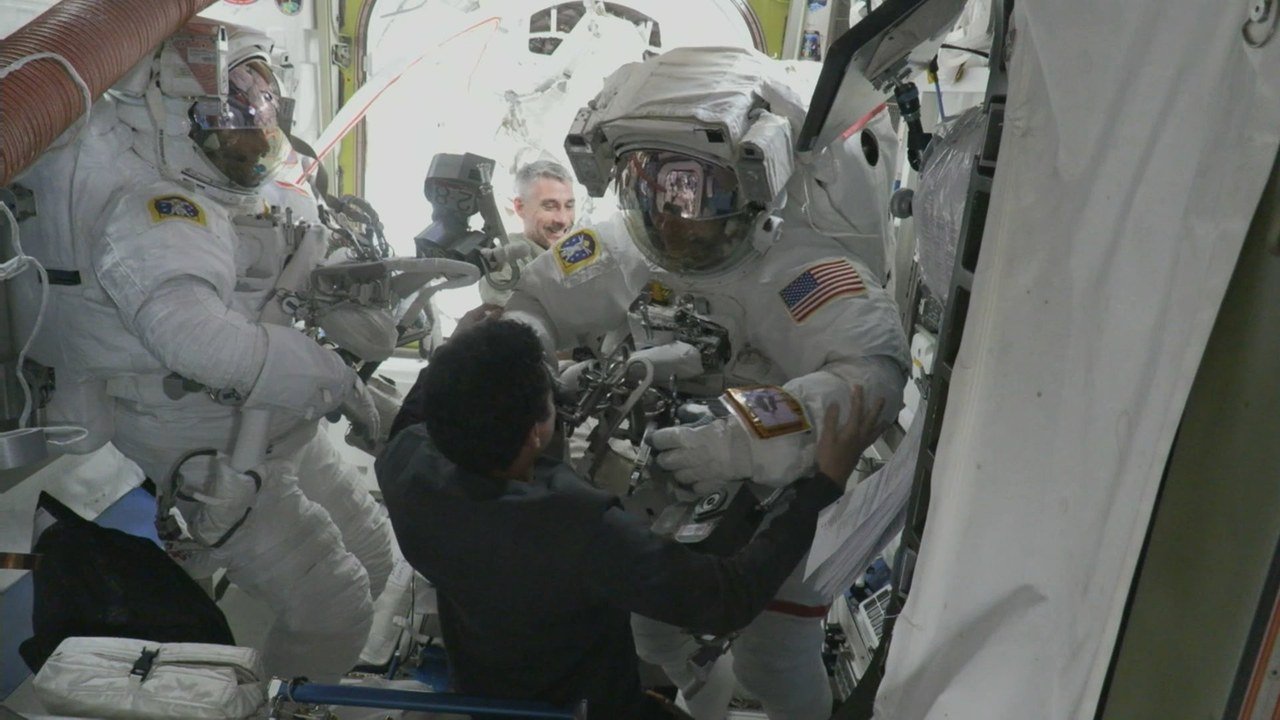
Two astronauts left the International Space Station on Thursday, Oct. 29, to bolt on a new solar wing, and one of them, Canadian Joshua Kutryk, made his first spacewalk. NASA says Menon and Kutryk “began a spacewalk at 7:57 a.m. EDT outside the International Space Station airlock to install and deploy an International Space Station Roll-Out Solar Array on the 2A electrical power channel” (NASA blog). That came to 4:57 a.m. PT. NASA had planned “about six hours and 45 minutes of external maintenance” (NASA, Oct. 28).
NASA counts the outing as “U.S. spacewalk 100” and as “the 285th spacewalk supporting space station assembly, maintenance, and upgrades” (NASA). According to the agency, the new array “will be the seventh IROSA and will provide additional power to support critical station operations, including its safe and controlled deorbit” (NASA). NASA lists this as Menon’s fourth spacewalk and Kutryk’s first. Menon wears the suit with red stripes; Kutryk wears the unmarked suit (NASA).
The work went in stages that NASA laid out the day before. “The spacewalking duo will first unbolt the roll-out solar array from a temporary stowage platform,” the agency wrote; then “Menon will carry the roll-out solar array to the truss worksite while riding the Canadarm2 robotic arm,” and Kutryk would follow along the truss on a tether (NASA, Oct. 28). NASA astronauts Jessica Watkins and Luke Delaney flew the arm from inside the station, Spaceflight Now reports (Spaceflight Now).
NASA tracked the progress on X. At 7:28 a.m. PT the agency posted: “At just over two hours into today’s spacewalk, the solar array is out of its carrier and being delivered to its installation site” (@NASA on X). At 9:35 a.m. PT it followed with: “Solar array, roll out! At about four-and-a-half hours into today’s spacewalk, the solar array began deployment. It is now fully deployed” (@NASA on X).
Watch: the new array unrolls, via NASA on X
Two short NASA clips from the station’s external cameras. If an embed does not load, it shows as a plain link to the original post.
View the @NASA post on X: “Solar array, roll out!”
View the @NASA post on X: the array leaves its carrier
Spaceflight Now’s preview, by William Harwood, explains the choreography. Once bolted to its bracket, the folded package swings open, “doubling its length from about 10 feet to 20 feet” (Spaceflight Now). Flight director Garrett Hehn called that step “one of our key points of the EVA,” or extravehicular activity. The crew then had to hook up the power cables while the station passed through Earth’s shadow. “We can’t have any sun on the arrays whenever we’re handling those hot cables,” Hehn explained. After that, the blanket unrolls on its own; Hehn likened the panels to a snap bracelet that, once released, “just continues rolling out steadily” (Spaceflight Now).
The upgrade dates to 2021. Space shuttles delivered the station’s eight original wings, “designed to last 15 years,” between 2000 and 2009, and rather than swapping them, NASA mounts the smaller IROSA arrays, “which generate about 8 kilowatts of electricity each, in front of the old wings, allowing the original panels’ unshaded portions to keep producing power,” Spaceflight Now reports (Spaceflight Now). It adds that “the eight IROSA arrays will raise the station’s available power from 160 kilowatts to about 215 kilowatts.” Gaurang Patel, operations integration manager for NASA’s Low Earth Orbit Program, put it this way at an Oct. 20 briefing: “Overall, these roll-out arrays increase our power generation capability up to 30 percent” (Spaceflight Now). The CSA gives the same “up to 30%” figure (CSA).
The first install did not go smoothly. “A spacesuit glitch and an array that wouldn’t unfold cleanly forced astronauts Shane Kimbrough and Thomas Pesquet to finish the job on a second spacewalk,” in June 2021, Spaceflight Now recalls (Spaceflight Now). The last two arrays arrived folded on a carrier in the trunk of a SpaceX Cargo Dragon launched on a Falcon 9 this month, and each assembly weighs about 750 pounds, according to Hehn (Spaceflight Now).
The suits carry their own history. “NASA’s spacesuits date to a design first flown in 1983,” Spaceflight Now notes, and “a NASA inspector general audit last year flagged aging hardware and thin supplies of spare-parts as potential safety weak spots” (Spaceflight Now). Hehn said on Oct. 20 that the suits remain “not entirely redundant” and acknowledged their age, adding, “which means we know they have some quirks” (Spaceflight Now).
For Canada, the day mixed a first spacewalk with its signature hardware. The CSA says Kutryk follows “Chris Hadfield, Steve MacLean, Dave Williams, and David Saint-Jacques,” and that Canadarm2 acts “as a base for one astronaut to stand on” (CSA). “There would be no way to accomplish this spacewalk without the help of Canadian robotics,” Mathieu Caron, director of the CSA’s astronaut office, said, according to CBC News; CSA astronaut Jenni Gibbons served as capcom from Houston, and the agency’s Robotics Mission Control Centre in Longueuil, Que., took part (CBC News).
Saint-Jacques, the last Canadian to spacewalk, gave a blunt view, CBC reports: “It’s ridiculously dangerous, but we’re well-prepared.” He also said: “A spacesuit is not a piece of clothing. It’s not like some, you know, winter suit,” calling it “a miniature spacecraft in the shape of a human body that you have to fly.” He sent a message to his colleague: “Josh, I know you’re gonna do a good job. You’ve got this” (CBC News). The CSA posted on X at 6:02 a.m. PT to mark Kutryk’s first spacewalk (@TheCanSpace on X).
The spacewalk ended at 3:08 p.m. EDT (12:08 p.m. PT) after 7 hours and 11 minutes, NASA says, with the seventh IROSA “installed and deployed” on the 2A power channel (NASA blog). According to NASA, the pair also “completed several get-ahead tasks” for the next outing. That ran longer than the “about six hours and 45 minutes” NASA had planned (NASA, Oct. 28).
One more array remains. Spaceflight Now reports that a Nov. 5 spacewalk will install the eighth and final IROSA, “capping an upgrade campaign that began in 2021,” and that the crew plans to move it with a hand-off maneuver the team “lovingly” calls “the leapfrog” (Spaceflight Now). NASA plans to retire the station in 2030 (Spaceflight Now). For more spaceflight news, this desk covered Elon Musk naming Ship 42 for Starship’s first tower catch (Seems News, Musk on Ship 42).