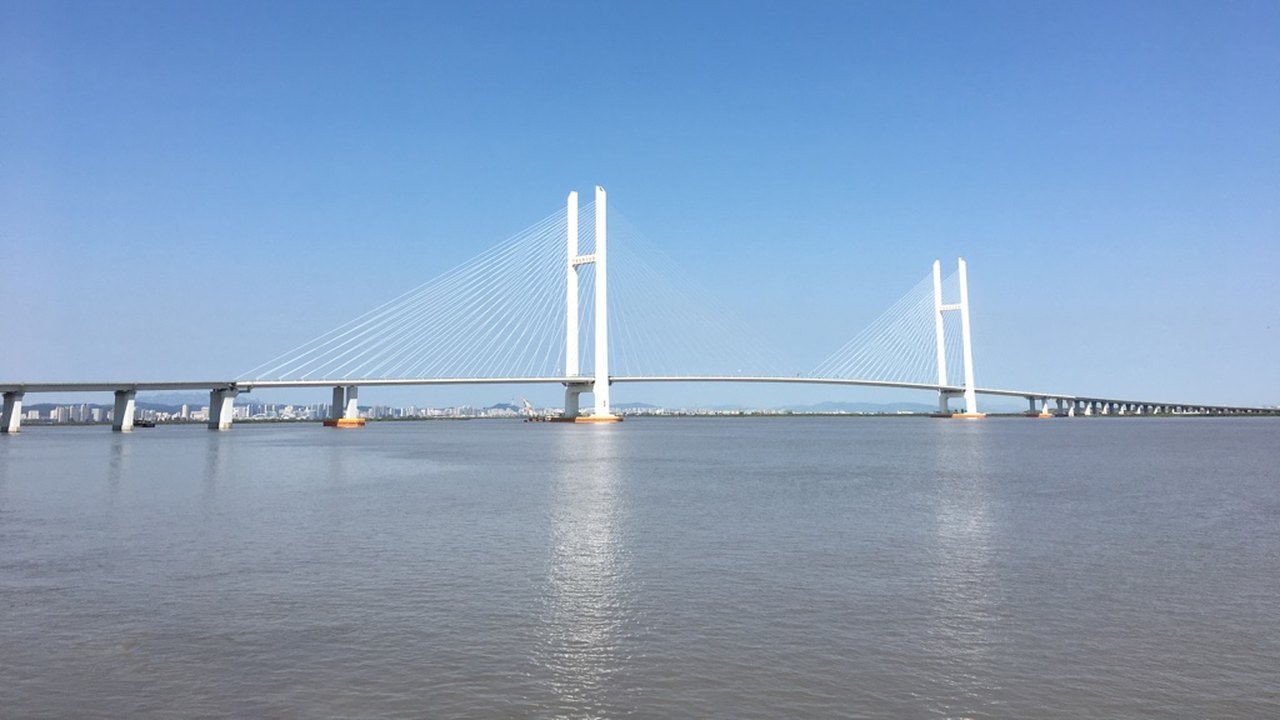
China and North Korea opened the New Yalu River Bridge, a four-lane road crossing between the Chinese border city of Dandong and the North Korean city of Sinuiju, on the morning of Thursday, October 15, according to China’s official Xinhua News Agency. Xinhua’s first flash, timed 10:00:59 a.m. Beijing time (7:00 PM PT Wednesday), said the opening ceremony took place that morning; a second Xinhua item at 10:34 a.m. said the bridge had officially opened and described it as an important facility for connectivity between the two countries that would further promote economic and trade exchanges and the movement of people, in this desk’s translation of the Chinese text. Reuters, reporting from Dandong, calls the bridge the two countries’ “most significant land border crossing” and says trucks festooned with the neighbors’ national flags drove across it, its towering pylons also decked in flags, while knots of spectators crowded a road on the Chinese side. AP, citing a China News Service video, describes flag-decked trucks waiting on the bridge, and CGTN and Yonhap also report the ceremony, Yonhap citing Xinhua.
Chinese Premier Li Qiang addressed the ceremony by video, according to Xinhua’s Chinese-language report. In Reuters’ translation, Li said “(Bilateral) relations are entering a new phase, embarking on a new chapter,” and that the crossing would “strongly promote” economic and trade cooperation. Xinhua’s Chinese text also has Li calling the bridge an important cross-border infrastructure project that Xi Jinping and Kim Jong-un jointly cared about and pushed forward, and voicing the hope that both sides use the opening to keep improving port clearance, connectivity and cooperation in border areas (this desk’s translation). Reuters, citing Xinhua, says North Korean Premier Pak Thae Song also delivered a video address, and that North Korea’s state media had yet to report on the event when Reuters filed. This desk could not check the KCNA website, which timed out on its request.
Beijing announced the date a day earlier. At the Foreign Ministry’s regular briefing on Wednesday, October 14, spokesperson Mao Ning said the bridge “will officially open to traffic on October 15” and that a joint ceremony would mark the inauguration, according to the ministry’s English transcript, which renders her description of the bridge as “an important infrastructure for bilateral connectivity.” The BBC and CNA quote her calling it an “important facility for connectivity,” a different English rendering of the same remark. A Reuters reporter at the briefing asked how much trade and tourism China expected and whether, as reports in North Korea said, the bridge would open only for cargo; the transcript shows Mao giving no figures and no answer on cargo, and promising timely updates on the ceremony.
The bridge stood finished but unused for years. Reuters and Yonhap say construction finished in 2014 and that the bridge stayed idle because North Korea left the roads and facilities on its side unfinished; Yonhap’s English service dates construction from October 2011 to October 2014, while China Daily, citing a 2014 Xinhua report, says construction began on December 31, 2010. China Daily adds, citing a Foreign Ministry statement, that the two governments signed an agreement in February 2010 on the bridge’s joint construction, management and maintenance, and that China fully funded its 2.22 billion yuan ($331.69 million) cost; Yonhap’s Korean-language service gives about 2.2 billion yuan. AP says the absence of substantial work in Sinuiju fueled speculation that Pyongyang felt wary of greater economic dependence on China or displeased with Beijing’s votes for UN resolutions toughening sanctions, and that some observers suggested the two sides differed over the bridge’s location; AP also cites an “unusually sharp report” in the Global Times, a newspaper affiliated with China’s ruling Communist Party, that quoted frustrated Dandong residents.
Sources differ on the bridge’s exact length. Yonhap’s Korean-language service, China Daily and CNA give 3,026 meters; Yonhap’s English service gave 3,024 meters in its October 14 preview; Reuters, AP and the BBC round it to 3 kilometers. The new span supplements the older Sino-Korean Friendship Bridge. Reuters says most goods have until now crossed about 10 km upstream on an 83-year-old bridge with a rail track and a single-lane road, which remains the busiest of about 15 crossing points along a roughly 1,350-km border. AP says the old bridge handles more than 70% of official trade between the two countries and lets vehicles move only one way at a time, and it cites the South Korean government as saying last year that at least 17 active road and rail links cross a border of more than 1,400 kilometers. The BBC says the Friendship Bridge went up between 1937 and 1943 during Imperial Japan’s occupation of the region; China Daily, citing Xinhua, calls it a one-way link built in 1937, and Yonhap says it opened in 1943.
Yonhap correspondents in Dandong describe tight control around the ceremony in a Korean-language report (this desk’s translation): Chinese police deployed in large numbers along the river; a hotel with a clear view of the bridge told all guests from the day before to keep their curtains closed, citing exterior-wall work; and from about 9 a.m. police restricted the movement of thousands of people who had gathered on the riverbank after hearing of the opening. Yonhap adds that North Korean container trucks decorated with flowers and Chinese trucks with red ribbons made trial runs until dusk the previous day. Reuters quotes two Dandong residents: a 50-year-old surnamed He said “coming here today and seeing it for myself makes me incredibly happy,” and a resident surnamed Xie said “this place will become much livelier, attracting more tourists.”
Seoul ties the opening to the June summit between Xi Jinping and Kim Jong-un in Pyongyang. An official at South Korea’s Unification Ministry called it “the first tangible implementation of the agreements reached during the June summit,” Yonhap reports, and said Seoul would monitor further developments; Reuters quotes a ministry official calling the opening “effectively the first visible case” of adopting the summit agreements. Analysts quoted by Reuters, the BBC and AP expect gradual change. Lim Eul-chul of Kyungnam University’s Institute for Far Eastern Studies told Reuters that “The bridge is unlikely to lead immediately to a full-scale return to pre-sanctions trade,” though he said it would help move heavy equipment, raw materials and energy products. Kang Jun-young of the Hankuk University of Foreign Studies told the BBC that a sharp and sudden rise in cross-border trade looks “unlikely” while UN sanctions remain, adding: “Pyongyang is also wary of a sudden flood of Chinese imports that would greatly expand China's influence over its domestic market.” Yonhap’s Korean report cites analysis that the bridge’s effect will center on some freight for now, noting that group tours and visas for Chinese tourists have not returned to normal.
Trade figures vary by measure. China Daily, citing China’s General Administration of Customs, puts 2025 two-way trade at $2.74 billion, up 25.5% on the year, and the BBC gives $2.7bn for last year, calling it a recovery to pre-pandemic levels; Reuters says China’s exports to North Korea alone reached a six-year high of $2.3 billion last year, up 25%, though still well below levels before UN sanctions tightened in 2017. AP says about 98% of North Korea’s external trade last year involved China. Other links have reopened this year: the BBC says Air China resumed direct Beijing–Pyongyang flights in March after a six-year pause and passenger trains restarted the same month, and that Xi made his first state visit of the year to Pyongyang in June. AP and CNA say the opening comes about a month after North Korea and Russia opened their own road bridge; the BBC says Russian state media put that bridge’s capacity at “up to 300 vehicles and more than 2,000 people every day.”
Seems News reading note: the opening itself rests on Chinese state media and on Reuters and Yonhap reporters in Dandong, who describe trucks crossing; North Korea’s own account does not appear in the reports this desk read. How much trade the bridge adds rests on forecasts from analysts and officials, so weigh those as expectations. Watch for KCNA’s report and Pak Thae Song’s remarks, any opening to passenger traffic or Chinese tour groups, and Chinese customs data on Dandong traffic in the coming months.
