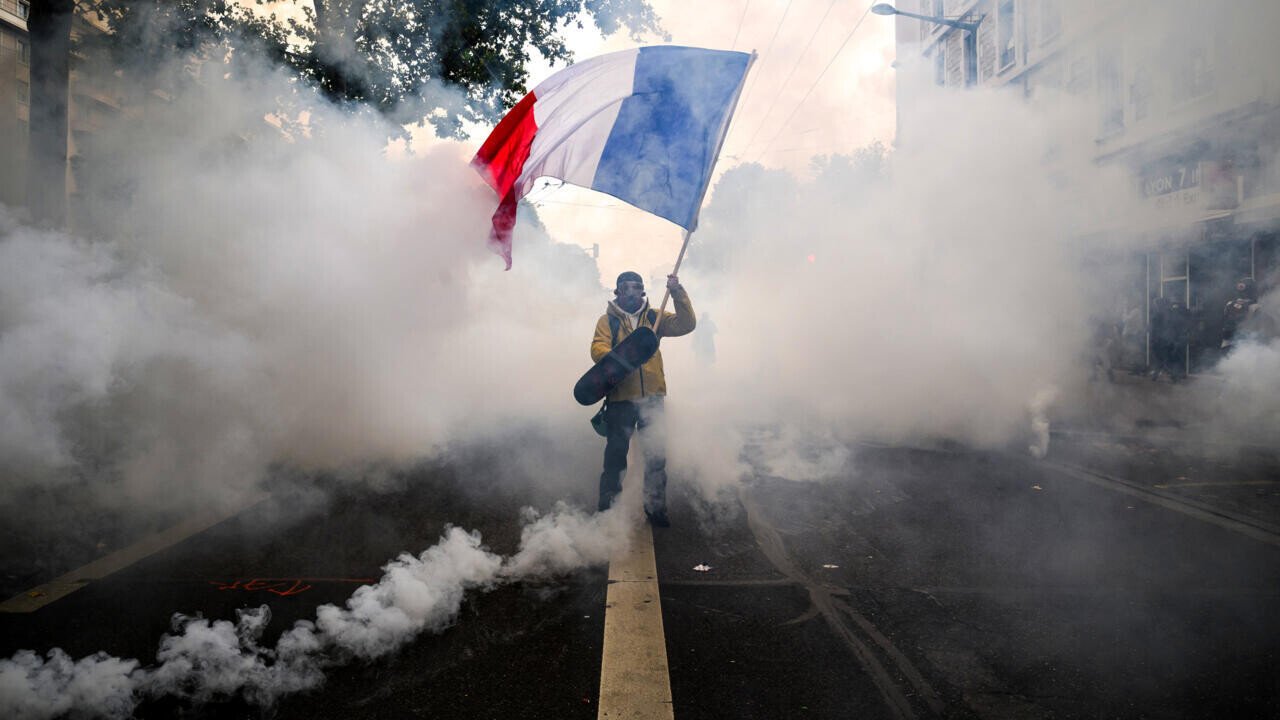
France held its third straight Saturday of mass protests over living costs and public services on Oct. 31, and the day ended much as the previous two had: largely peaceful marches by day, followed by clashes at dusk between police and small groups of masked rioters. About 320,000 people took part nationwide, including 70,000 in Paris, the Interior Ministry said, according to AFP, France 24 and Euronews. That figure fell from 410,000 on Oct. 24 and 550,000 on Oct. 17, by the government’s own counts, Euronews and France 24 report.
Organisers tell a different story about the size of the movement. Youth organisations said “nearly half a million people demonstrated, including 200,000 in the capital,” AFP reports, and dpa attributes a count of nearly 500,000 to an alliance of pupil and student organisations. For the two earlier Saturdays, organisers said they counted 800,000 demonstrators each day, according to Euronews. Euronews suggests that transport disruption may explain part of Saturday’s drop: its reporter in Lyon noted that “the trams and metro trains are only running at half,” and more than 40 Paris metro stations stayed closed, the outlet reports.
The movement started in September as a high school protest over neglected buildings, teacher shortages and a university admissions system that critics call unfair to disadvantaged students, Euronews reports. Labour unions and others angry at Macron have since joined, Euronews reports, and AFP and dpa both list Yellow Vest activists among the groups behind the marches. France 24 reports that the protests gathered momentum in late September as President Emmanuel Macron’s minority government opened talks on its 2027 budget. After a security clampdown and serious injuries to some protesters, the movement broadened its demands to include protection of civil liberties and the right to protest, AFP reports.
In Paris, authorities kept the main march out of the city centre. France’s top administrative court upheld a ban on a route between the Nation and Bastille squares, rejecting a challenge from unions, France 24 reports, so marchers set off from the Porte de Bagnolet near the ring road toward the Porte de Charenton on the south-eastern edge of the city, according to The Guardian. Many came in Halloween costumes ranging from Spider-Man to Frankenstein, AFP reports, carrying placards that read “No need for tear gas to make our future look bleak” and “Dressed up as an angry citizen for Halloween.” Far-left leader Jean-Luc Mélenchon marched at the head of the Paris demonstration, France 24 reports.
Watch: the Paris march, then the clashes at its end, via posts on X
Viewer note: the second clip shows street clashes, with tear gas, riot police and masked people moving bins. The stills this desk viewed show no injured people. If an embed does not load, it shows as a plain link to the original post.
View the @AnnaharEn post on X about the Paris march
View the @radioorient post on X about clashes at the Porte de Charenton
View the @franceinfo post on X with Laurent Nuñez’s statement
The trouble started where the march ended. At the Porte de Charenton, AFP journalists saw dozens of masked people dressed in black use hammers to pry up paving stones and throw them at police, according to AFP, and police responded with tear gas and repeated baton rushes. The Paris police prefecture said several hundred rioters attacked security forces with projectiles, AFP reports; The Guardian quotes the prefecture as describing “a hardcore of several hundred rioters.” Police fired tear gas in Lyon, France’s third-largest city, and in Toulouse, France 24 reports; in Toulouse police also used water cannon against an unauthorised protest that drew several thousand people, according to AFP and The Guardian. Tensions also flared at the end of unauthorised protests in Marseille, but calm returned as night fell, France 24 reports.
In Paris a Molotov cocktail struck a riot police officer, Interior Minister Laurent Nuñez said. Nuñez called the attack an “attempted murder” and said the officer escaped with minor injuries, AFP reports. dpa translates the same remark as “attempted manslaughter” and describes a gendarme engulfed in flames after a firebomb hit a barrier. In a post on X late on Saturday, Nuñez thanked the security forces and sent his thoughts to the gendarmerie personnel hurt by the Molotov cocktail. Far-right leader Marine Le Pen wrote on X that those responsible for the firebomb attack must face punishment “with the utmost severity,” calling the images “unbearable,” according to AFP.
Nuñez said the declared marches had passed off peacefully but described an “extraordinary” level of violence from some rioters as the rallies ended, The Guardian and AFP report; AFP adds that he blamed far-left extremist groups. “Security forces held their ground and protected city centres. Public order was maintained,” Nuñez told reporters, according to France 24, which cites Reuters. Outlets render his warning about the night ahead differently: AFP and The Guardian quote him as saying, “We are fully prepared for those looking for confrontation tonight,” while France 24 quotes, “The day is not over. We are ready for those looking for a fight tonight, and we will respond firmly.” His ministry urged marchers on X to separate themselves from violent groups and follow police instructions to disperse calmly.
The government sent about 70,000 police and gendarmes into the streets, according to dpa and The Guardian. Police carried out up to 40,000 checks across France, 15,000 of them in the Paris region, dpa reports, citing the minister. The ministry said that “radical elements” in cities including Bordeaux, Toulouse and Marseille tried to enter city centres “with the aim of carrying out vandalism and looting,” AFP reports; dpa adds Rennes, Lille, Nantes and Lyon to the list and says security forces stopped them. Police barred entry to the Place de la République and Les Halles from 11 p.m. to 6 a.m., and unaccompanied minors faced a 9 p.m. curfew around the Champs-Élysées, according to Euronews.
Detention figures differ slightly by outlet. The Interior Ministry counted 511 people detained nationwide by 8 p.m. Paris time, hundreds fewer than at the same hour a week earlier, dpa reports, and The Guardian gives the same 511. AFP quotes Nuñez putting the count at 520 as of 1900 GMT, which corresponds to 8 p.m. in Paris and noon PT. Earlier in the day the ministry had reported a “generally calm” situation, with 27 detentions by 2 p.m. against 217 at the same point on Oct. 24, Euronews reports. This desk could not reach the ministry’s own website and reports both figures.
Marchers described their reasons in their own words. “The French economy is doing badly no matter what happens, because today we’re being run by a group of incompetents who juggle billions while families are struggling with a few cents,” Jérôme Rodrigues said on the Paris march, according to The Guardian; France 24 carries the same remark and spells his name Jerome Rodriguez. “The fact that demonstrations are being pushed outside city centres, and that so many protests are being banned, is really an attack on freedom,” video game developer Alice Hien told AFP. In Lille, 47-year-old Aurelie Herrmann danced at the protest. “I dance because on television they only show damage and destruction, whereas you can perfectly well demonstrate in good spirits,” she told AFP.
The protests land on a fragile economy and a tense political calendar. On Friday, Fitch unexpectedly revised the outlook on French debt to negative, and data showed the economy shrinking in the third quarter, France 24 reports; the Chamber of Commerce estimates retail losses over three weeks of unrest at more than €1 billion ($1.1 billion). The presidential election falls less than six months away, with Le Pen leading opinion polls, according to AFP, and the government has little room to calm protesters with new spending, AFP reports.
Students say they will keep going. “Then we will join the 5 November demonstration called by workers and trade unions,” Sabrine Kharbach of the Union Étudiante told The Guardian, after student groups vowed new school and university blockades on Tuesday and Thursday. Youth-led protests also spread across Europe on Saturday: in Germany, police used water cannon in Cologne after a youth group called “Gen Z regelt!” held marches in dozens of cities, The Guardian reports, and at least two stores in Frankfurt suffered looting, according to a Reuters witness cited by the paper. Police in Barcelona and The Hague also went on alert after online calls to protest, Euronews reports.