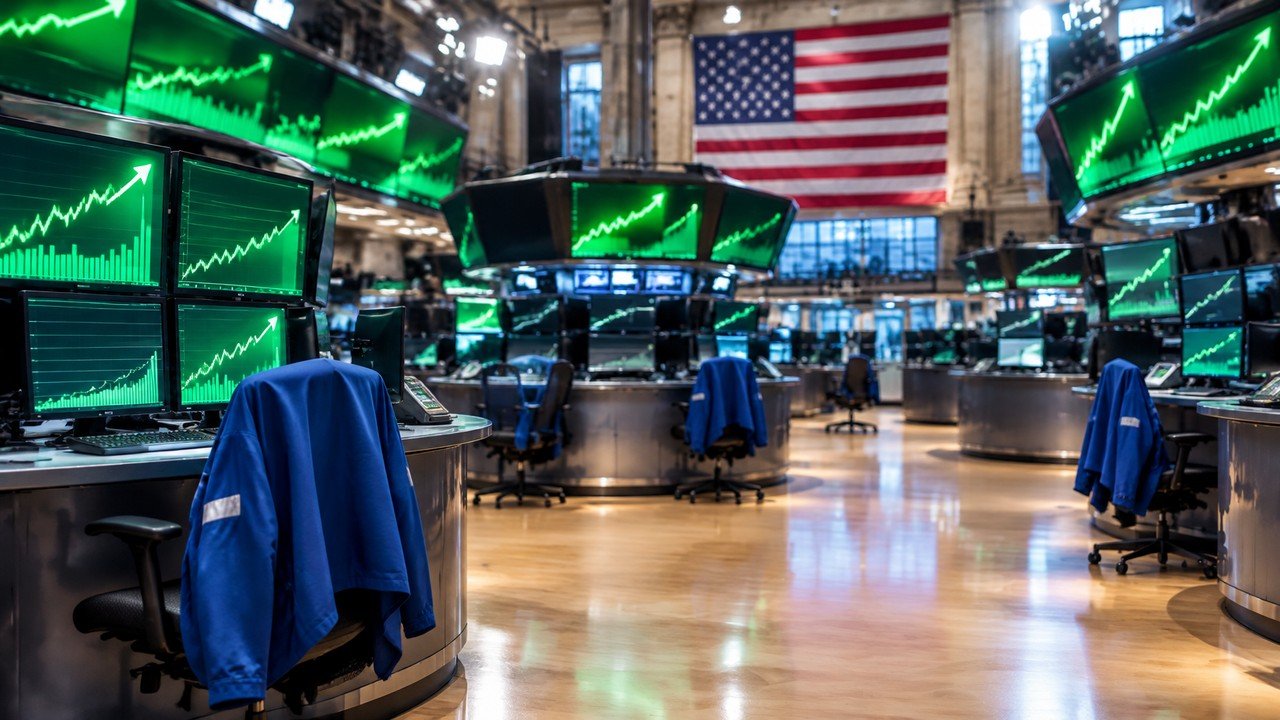
U.S. stocks closed sharply higher on Wednesday, Nov. 4, after Democrats took control of Congress in the midterm elections and oil prices tumbled. The Dow Jones Industrial Average jumped 1,569.40 points, or 3.03%, to finish at 53,356.12, CNBC reported in its live markets blog and Reuters confirmed in a closing wrap. CBS News described the move as the Dow’s biggest gain of the year and put the rise at nearly 1,600 points, or about 3%. The S&P 500 gained 119.7 points, or about 1.6%, to 7,688.62, and the Nasdaq Composite added 364.50 points, or about 1.4%, to 25,736.51, according to Reuters; CNBC listed the same closes as gains of 1.58% and 1.44%. CBS rounded the S&P close to 7,689.
Reporters tied the rally to election clarity and to President Donald Trump’s overnight comments accepting the Democratic sweep. Trump told The New York Times and The Wall Street Journal that he accepted the results and would work with Democrats, CNBC reported, and those headlines coincided with a rebound in stock-market futures. “Stocks are sharply higher today as election clarity reduces uncertainty,” Terry Sandven, chief equity strategist at U.S. Bank Wealth Management in Minneapolis, told Reuters. “The election introduces a degree of gridlock to the economic backdrop and that oftentimes is favorable for equity prices, and we are seeing some of that today.” Adam Crisafulli of Vital Knowledge told investors, according to CBS News: “Investors are happy to have the midterms out of the way… putting it in the rear-view mirror removes a key obstacle heading into a very favorable time of year seasonally.”
Thomas Hempell, a Generali Investments senior economist, told CNBC that Trump’s acknowledgement of the Democratic victory and his openness to collaborating with the opposition “have helped markets to rally on hopes that contestation of the results and more adverse polarization can be avoided.” George Saravelos, head of FX research at Deutsche Bank, said a Democratic Congress should “act as a break on extreme policy outcomes and bring down risk premia,” so long as the president’s decision holds, CNBC reported. Stephen Brown of Capital Economics wrote that the size of the Democratic gains “does not change too much for the near-term policy outlook, given the party still lacks a filibuster-proof majority in the Senate and President Trump has veto power to block legislation,” according to CBS News.
A plunge in crude prices added fuel. U.S. West Texas Intermediate lost 8.3% to settle at $88.12 a barrel, and Brent futures shed 8.7% to settle at $94.62, CNBC reported; DTN listed the same settles and called the WTI drop the sharpest one-day loss since April 17. The Guardian, in a mid-session live blog, still had Brent trading near $100 with declines of about 2.7%, so this desk relies on the CNBC and DTN settle prints for the close. Vice President JD Vance posted that “The reason we lost is the war” and that “The president himself said so last night,” CNBC reported. Andy Lipow of Lipow Oil Associates told CNBC that the elections lead the market to conclude “that Trump might now be inclined to make a deal” with Iran, and that Democrats may try to restrict war funding. Oil futures have fallen more than 14% this week as U.S. and Iranian officials signaled openness to diplomacy, CNBC wrote.
Watch: Reuters’ Wall Street closing wrap, posted on X
This desk viewed the clip’s preview frame before embedding. If an embed does not load, it shows as a plain link to the original post.
View the @Reuters post on X
AI-linked stocks split. Cash-rich technology heavyweights rose on expectations that a slower data-center buildout could ease their cash demands, while operators and some suppliers fell on fears that a slowdown would strain their growth plans, Reuters reported. Microsoft rose about 6.7%, Amazon.com about 6.1%, Alphabet about 3.2% and Meta Platforms about 1.4%, per Reuters; CNBC’s earlier session notes listed Apple, Amazon, Alphabet, Meta and Microsoft among the gainers with slightly rounded percentages. Data-center operators slumped: Hut 8 fell about 23%, IREN about 11%, Core Scientific about 10% and Applied Digital about 6.7%, Reuters reported. The Philadelphia SE Semiconductor Index hit a six-month low, dropping about 3.1%, though AMD rose about 1% after a stronger 2027 growth outlook, per Reuters. Scott Chronert, head of U.S. equity strategy at Citi Research, told Reuters: “It’s pretty clear that the AI trade will face some headwinds there… If you push out the pace or change the pace of the data center buildout, you begin to change the fundamental trajectory for many of those suppliers.”
State and ballot results fed that split. Democrats made gains in key data-center states including Texas and Georgia, where public opposition to rapid expansion has grown, Reuters wrote. Texas represents about 27% of U.S. data-center gigawatts, Wells Fargo estimated, according to an earlier CNBC note; Gina Hinojosa’s projected win over Gov. Greg Abbott and her pledge of an immediate moratorium on data centers had already focused investors on that risk before the close. Ballot measures on data-center development also failed in various states, CNBC reported. Consumer discretionary led S&P 500 sectors with a gain of about 4.3%, while energy fell about 4.8%, Reuters said; all but two sector indexes rose.
Other political losers on the tape included Trump Media & Technology, which fell nearly 25% on Wednesday, CBS News reported, and Elon Musk’s SpaceX and Tesla, which sank about 3.9% and 3.3% respectively per Reuters; CBS put SpaceX at a 3.8% decline and Tesla at 3.3%. Musk spent nearly half a billion dollars backing Republican candidates, including efforts in Texas, the home state of both companies, Reuters wrote. Defense names Northrop Grumman, RTX and Lockheed Martin also fell as Trump’s $1.5 trillion defense budget request faces a tougher path in a Democratic Congress, according to Reuters. Solar and clean-energy stocks rose: the Invesco Solar ETF climbed nearly 6%, Reuters reported, and CNBC earlier listed First Solar, Bloom Energy, Plug Power, Sunrun and others higher in the session.
Beyond equities, the dollar weakened against most major currencies and yields on long-dated Treasuries moved lower, Reuters and the Guardian reported. CBS News noted that political gridlock has historically limited Congress’s ability to pass sweeping tax and spending legislation, which investors often read as reducing policy-volatility risk, and that the S&P 500 has risen an average of about 15.5% in the six months after the last 14 midterm races dating to 1970, citing historical counts. This desk treats that history as context, not a forecast. CNBC also flagged that some strategists still worry a shift in Trump’s rhetoric could revive volatility.
This desk checked the closes against CNBC’s live blog, Reuters’ closing wrap (via Central Oregon Daily), CBS MoneyWatch, CNBC’s oil story, DTN’s oil update and the Guardian’s live blog; X posts on X; and Eastern and UTC times converted to PT (UTC−8). Star-Advertiser’s reprint of the Reuters wrap returned a Cloudflare block to this desk’s reader, so that page went unused. No primary exchange bulletin beyond the wire closes appears in this file; the numbers above come from the named newsrooms’ reported settles.