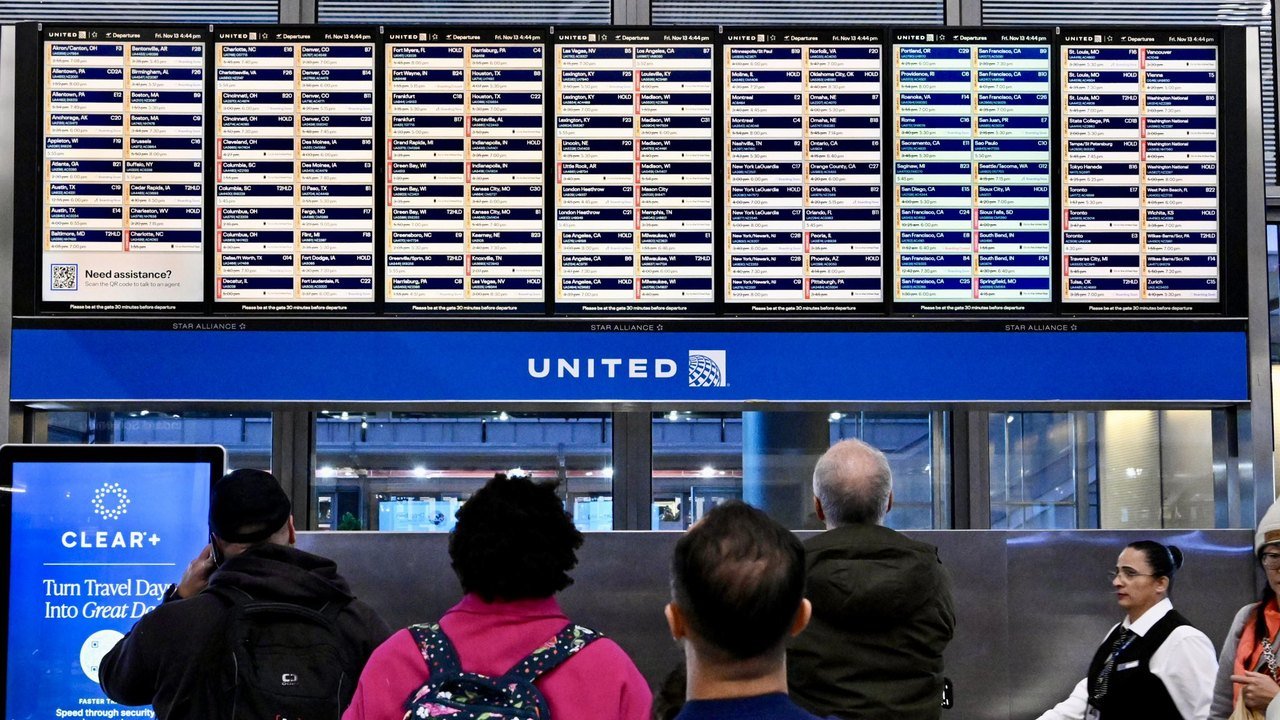
The Federal Aviation Administration let planes take off again on Friday night, Nov. 13, after holding departures at every U.S. airport for more than four hours, in what Reuters and the BBC describe as the longest nationwide shutdown since the Sept. 11, 2001, attacks. “At 8:15 tonight, Eastern time, we've opened up the airspace,” Transportation Secretary Sean Duffy told a news briefing, as quoted by CBS News. Reuters reports that Duffy spoke to reporters at the White House and warned that departures would resume only gradually. The reopening came at 5:15 p.m. Pacific time.
The trouble began in the middle of the afternoon on the East Coast. Duffy wrote in a post on X that at 3:36 p.m. Eastern, FAA facilities and TRACONs across the country “experienced telecommunications issues.” The FAA statement says the agency “issued a nationwide ground stop for all U.S. airports following communication issues impacting multiple Air Route Traffic Control Centers,” and that its technicians had started investigating. The BBC reports the first announcement went out at 15:54 EST (20:54 GMT), and CBS News reports the order cited “extraordinary circumstances and for reasons of safety.” Later, shortly after 6 p.m. Eastern, the FAA said “flights will be allowed to depart through coordination with the air traffic control system command center” as en route facilities recovered, according to ABC News on X.
Thousands of planes already in the air had to come down. Duffy’s X post puts the number airborne at more than 3,500 when the stop began and says pilots and controllers brought it down to under 400 by 8 p.m. Eastern. He wrote that the FAA “did not lose all radar or telecom” and that it made exceptions for medevac, life-saving cargo and law enforcement flights. Flight trackers counted differently: Flightradar24 on X says 4,042 flights bound for U.S. airports had already taken off at 20:54 UTC, while CBS News, also citing Flightradar24, puts the figure at about 3,100 airborne aircraft bound for U.S. airports. The BBC reports some flights diverted to other airports and others flew on.
Clips below come from Flightradar24, CBS News and ABC News: a time-lapse of U.S. airspace emptying, travelers at O’Hare, and the White House briefing.
View the @flightradar24 post on X
View the @CBSNews post on X
View the @ABC post on X
Officials described the cause in slightly different ways. Duffy, quoted by Reuters, said: “Our switches, our routers actually got overloaded with data and they started to give us inconsistencies in the data from those routers and because of that we shut the system down.” Reuters adds that he said controllers never completely lost radar or communications. The BBC quotes him calling it “analogue telecom.” Mullin, the Homeland Security secretary, said new technology added to an old system had overwhelmed it, according to the BBC; CBS News reports he said new security patches introduced into the older system appeared to “overwhelm” its routers.
Reporting points to a specific network. Multiple sources told CBS News that an update to the private communications network linking U.S. air traffic control caused the system to reboot, leading to a crash and a communications outage; CBS names L3Harris as the operator. Reuters reports, citing two airline officials, that the outage appeared to hit a telecommunications network overseen by L3Harris Technologies that carries the radio frequencies controllers use to talk to pilots. L3Harris did not respond to requests for comment from either outlet. CBS adds that the FAA hired Harris Corp., the predecessor of L3Harris, to run the network in July 2002, and that a November 2023 FAA-commissioned safety review called the network obsolete. The desk could not confirm the trigger independently.
Officials played down any attack. Mullin said officials had found “zero evidence” so far that the outage came from a cyberattack or a rogue AI system, Reuters reports, though investigators had not ruled out either possibility. “It appears this was mechanically driven, however, we're still looking,” he said, per Reuters, which adds that the National Security Agency joined Homeland Security on the investigation. CBS News quotes Mullin separating the event from the global Microsoft 365 outage that began on Thursday: “I want to make sure everybody understands that there is no connection between this and Microsoft.”
The disruption spread to travelers at home and abroad. Duffy said tens of thousands of passengers ended up stranded at airports, according to Reuters and the BBC. “It's going to take us some time to unwind what's happened this afternoon,” he said, per the BBC. Reuters cites aviation analysts who expect schedules to suffer for days. The BBC reports that Eurocontrol suspended all U.S.-bound traffic from its member states “on request of the FAA due to technical issues,” that Sydney’s airport grounded U.S.-bound flights and that Air Canada canceled flights between the two countries. Delta and United said they had started resuming operations, and JetBlue said it would restart on Saturday morning, the BBC reports; American Airlines said it would put flights to smaller cities and international destinations first to reposition planes and crews, per Reuters.
Costs came next. Reuters reports that U.S. airlines will not have to compensate stranded passengers because the carriers did not cause the FAA failure, and that shares of American, United and Delta fell between 1% and 2% in after-hours trading while JetBlue dropped about 3%. Earlier on Friday, before the outage, the White House and the Transportation Department had urged Congress to approve $30.1 billion for airports and air traffic control, Reuters reports. After the outage, Duffy asked for $50 billion to modernize the system, per Reuters and the BBC. “You will have more of them unless the American people and the Congress tell us to build,” he said, according to CBS News. The reports the desk read carry no response from congressional leaders.
The comparison to past shutdowns depends on the source. Reuters says the only other nationwide ground stop since 9/11 came in January 2023, when the FAA halted domestic departures for about 90 minutes. The BBC quotes Guy Gratton, an associate professor of aviation at Cranfield University, describing that 2023 stop, tied to a failure in the Notice to Air Missions system: “That lasted 1 hour and 52 minutes, delayed about 9,500 flights and cancelled about 1,300.” Robert Sumwalt, a former National Transportation Safety Board chair who serves as a CBS News transportation safety expert, told CBS News: “This is absolutely unprecedented.”
What comes next: a slow restart and an investigation. The FAA wrote on X: “Before clearing flights to resume, we thoroughly tested our systems to confirm they were stable and that operations remain reliable.” Duffy said he expects flights to get “back up and operational as we come into the heat of travel” around Thanksgiving, per CBS News. AP and The Washington Post also covered the stop; the desk could not open their pages (AP returned HTTP 403, the Post timed out) and did not rely on their text.