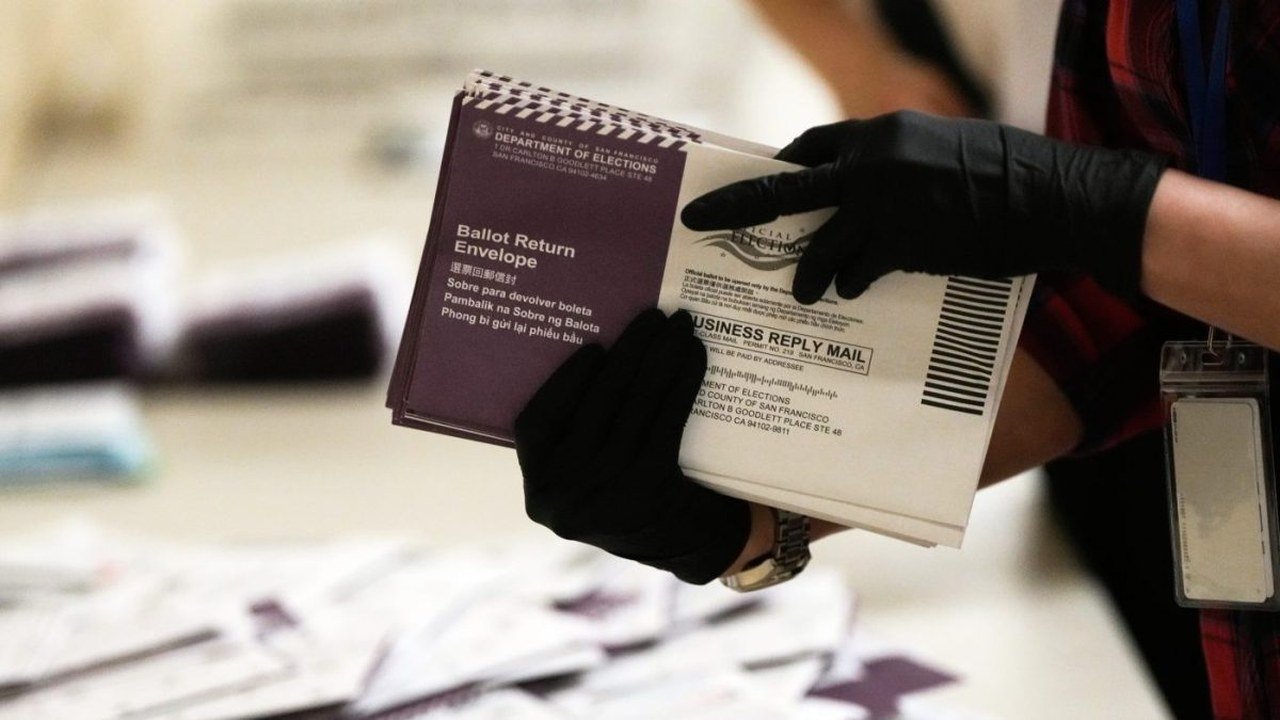
Four days before the Nov. 3 midterm elections, a federal judge in San Francisco ordered the Justice Department and the Department of Homeland Security to stop threatening the people who count the votes. U.S. District Judge Trina Thompson granted a temporary restraining order on Friday evening, Oct. 30, according to CNN, in a report published at 6:16 p.m. PT. Under the order, the two departments cannot demand that election officials in any state segregate ballots, purge voters from the rolls or halt ballot processing, and cannot threaten those officials with criminal prosecution, CNN reports. Thompson, whom President Joe Biden appointed, also barred other actions that “threaten, intimidate or coerce” election officials into changing how they process ballots on claims that voters lack eligibility, according to CNN.
NBC News reports that the eight-page order prohibits any action that may “threaten, intimidate or coerce state or local elections officials or workers to demand that they halt processing the ballots of any registered voter solely on the basis that the ballot belongs to an individual alleged by [the administration] to be ineligible to vote.” In her opinion, Thompson wrote, as quoted by NBC: “In the lead-up to the election, high-ranking DOJ and DHS officials have engaged in a campaign to intimidate, threaten, and coerce state and local officials and employees who are engaged in administering the ongoing midterm 2026 election.”
The judge also addressed the central legal threat. “When state and local government employees perform the work of distributing, processing, or counting ballots or otherwise administering the 2026 midterm election” in line with the law, “they do not violate federal criminal law even if a particular ballot belongs to a registered voter alleged by Defendants to be ineligible to vote,” she wrote, according to CNN. She found that federal officials likely violated the Voting Rights Act of 1965, which prohibits “attempting to intimidate, threaten or coerce” people who help others vote, and that the government had acted outside its legal or constitutional authority, CBS News reports.
Two passages from the opinion appear in several outlets. “Although Defendants claim that their actions are designed to halt unlawful voting by noncitizens, their actions are likely to have the effect of interfering with election administration and disenfranchising lawful voters,” Thompson wrote, as quoted by CNN, NBC News and CBS News. She opened the order itself, which CBS also quotes, with these lines: “One of the hallmarks of a fair election is the freedom to exercise the right to vote free from threat, fear, or intimidation. Free exercise of the right to vote is a core tenet of our democracy. It requires safeguarding to ensure full participation and public trust in our elections.”
Watch: an explainer on the ruling, via @CenterAisleNews on X
A short text-and-graphics clip posted soon after the ruling. If the embed does not load, it shows as a plain link to the original post.
View the @CenterAisleNews post on X about the election-worker ruling
Context: a related filing in a separate case, via @DemocracyDocket on X
View the @DemocracyDocket post on X about letters to five states
The order carries two further requirements. The Justice Department must tell the court about any pending search warrant applications or subpoenas, according to CBS News; CNN describes the requirement as covering “search warrant applications, grand jury subpoenas, or other demands to access election materials or ballots” tied to the administration’s lists of allegedly ineligible voters. The administration must also notify the state and local governments that received its letters about the order, the San Francisco Chronicle reports. The restraining order expires at 5 p.m. on Nov. 16, according to the order, which gives the Justice Department until noon on Monday, Nov. 2, to respond to the plaintiffs’ request for a preliminary injunction and sets a hearing on that request for 11 a.m. on Nov. 13.
A coalition of unions and advocacy groups brought the case on Thursday, Oct. 29: the Service Employees International Union, the American Federation of State, County and Municipal Employees, the League of United Latin American Citizens and the NAACP, according to a release from the NAACP Legal Defense Fund, which represents them along with Altshuler Berzon LLP, Democracy Defenders Fund and Protect Democracy. “No one should go to work fearing that doing their job could land them in jail,” SEIU International President April Verrett said in the release. CNN notes that the plaintiffs filed in the Northern District of California, a court the network describes as known to lean left.
The suit followed weeks of federal pressure on California counties. In an Oct. 13 letter, Acting Deputy Attorney General Trent McCotter demanded that the California Secretary of State and the Los Angeles County registrar sequester the ballots of about 20,000 registered voters, the plaintiffs’ lawyers say. Last week the department sent letters to election officials in 57 of California’s 58 counties, according to NBC News. One, dated Oct. 22 and sent to San Bernardino County, came from First Assistant U.S. Attorney Bilal Essayli and attached a list of “1133 likely aliens” registered to vote there, NBC reports. “Within 48 hours, we ask that you commit to working with DOJ and DHS to identify who on the accompanying list is a citizen and who is not,” Essayli wrote, according to NBC, and he asked officials to “segregate—not cancel” the ballots of anyone whose citizenship officials could not confirm. Santa Clara County leaders refused a similar demand last week that listed 902 voters, and Los Angeles, Orange and San Diego counties also received demands, the San Francisco Chronicle reports.
The administration defends its campaign as law enforcement. “Federal law prohibits noncitizens from voting. Enforcing that law is not an agenda item. It is the Department’s job,” a Justice Department statement said, according to the Guardian, which reports that a department spokesperson did not immediately respond to a request for comment on the appeals ruling. Essayli, the top federal prosecutor in Los Angeles, has warned: “Any election official who knowingly processes the ballot of a noncitizen is opening themselves to legal jeopardy,” the Guardian reports. Essayli wrote in his letters that DHS built its list through a “multilayered, multiagency investigative methodology,” according to NBC News. CNN and CBS each say they asked the Justice Department for comment on Thompson’s order.
State officials dispute the lists. California officials call the roughly 20,000-name list highly unreliable and say it most likely includes many U.S. citizens, the Guardian reports, and election officials say they cannot match ballots already processed back to the voters who cast them. CNN reports that the lists come from a DHS data-matching operation comparing state voter rolls with federal records, and that several judges have begun scrutinizing that approach in recent weeks.
Thompson’s order capped a run of court losses for the administration this week. On Wednesday, Oct. 28, another federal judge in California denied the department’s request to set aside the 20,000 ballots, finding that it “violates longstanding constitutional principles mandating that states have control over their elections,” according to NBC News and CBS News. On Friday, a Ninth Circuit panel turned down, 2-1, the department’s request to make California segregate the ballots. “As the district court found – and we discern no clear error – there is no feasible way to identify and segregate the ballots of specific individuals without potentially catastrophic effects on the entire system,” the majority wrote, according to the Guardian, which reports that Judge Mark J. Bennett, a Trump appointee, wrote the majority opinion with Judge Gabriel P. Sanchez, a Biden appointee.
Pressure on officials reaches beyond California. The department has issued grand jury subpoenas for officials in Los Angeles County, CBS News reports, and in July Harmeet Dhillon, who heads its Civil Rights Division, sent letters to all 50 states and Washington, D.C., threatening to criminally prosecute local election officials, according to the lawsuit as described by CBS. The department has also sent letters to 29 states and Washington, D.C., demanding that they preserve records and voter data from the 2024 election, according to CNN, which notes that federal law already requires 22 months of record retention. A similar ballot-segregation fight in Washington state remains pending, NBC News reports.
What comes next remains open. The order runs through Nov. 16, nearly two weeks after Election Day, and the Nov. 13 hearing gives the court a chance to decide whether to replace it with a longer-lasting injunction, according to CBS News and NBC News. None of the outlets reviewed by this desk reported, as of early Saturday, whether the Justice Department plans to appeal. Millions of Californians have already voted, and counties have processed hundreds of thousands of ballots, the Guardian reports.