The race to choose the next head of the United Nations moved one round further on Friday, and the same name came out on top. In the Security Council’s seventh informal straw poll, former Costa Rican vice president Rebeca Grynspan received 11 votes in favour and 4 against from the council’s 15 members, “marking her strongest showing in seven closed-door ballots conducted in recent months,” Reuters reported, citing two people close to the process (Reuters, via The Straits Times). The winner will replace António Guterres, who finishes his second five-year term this year.
The council never announces straw-poll numbers. According to the specialist monitor Security Council Report, the vote took place at 1:30 p.m. in New York (10:30 a.m. PT), and the council’s president for October, Greek Ambassador Aglaia Balta, planned to tell reporters only that the poll had happened. “At the same time, the results of the previous straw polls have been leaked shortly after the vote and published online,” the monitor noted on the eve of the ballot (Security Council Report). That pattern held again. Reuters published its account at 11:46 a.m. PT, and The National, La Nación and several UN watchers on X posted the same top-line numbers around the same time.
Watch: reports from UN headquarters on poll day, via @alextarquinio and @SABCNews on X
Two short video posts from New York. The first shows the Greek ambassador, as council president, speaking to reporters after the vote; the second shows a correspondent’s report as the poll got under way. If an embed does not load, it shows as a plain link to the original post.
View the @alextarquinio post on X: council president after the seventh straw poll
View the @SABCNews post on X: correspondent report from New York
According to the preliminary figures carried by The National, Grynspan’s 11–4–0 put her ahead of Argentina’s Rafael Grossi, the head of the UN nuclear watchdog, at 9–4–2 (nine “encourage,” four “discourage,” two “no opinion”); Guyana’s Carolyn Rodrigues-Birkett at 8–6–1; and the UAE’s Lana Nusseibeh at 7–6–2. La Nación’s US correspondent, Guillermo Idiart, also lists the three trailing candidates: Uganda’s Olara Otunnu at 4–11–0, and Ecuador’s María Fernanda Espinosa at 2–10–3 and Ivonne A-Baki at 1–14–0; a post on X embedded in his article labels the full table “unverified” (La Nación). Each candidate’s three numbers add up to 15, the size of the council.
The headline number carries a large caveat. To win the council’s recommendation, a candidate needs at least nine positive votes and no “discourage” vote from any of the five permanent members — Britain, China, France, Russia and the United States. Friday’s ballots made no distinction between those five and the ten elected members. According to Reuters, nothing on Friday’s ballot allowed anyone to work out how the permanent five voted. In plain terms: any of Grynspan’s four opposing votes could amount to a veto threat, or none of them could.
That uncertainty differs from the previous round. On Oct. 16, for the first time in this race, the council used colour-coded ballots that set the permanent members’ votes apart from those of the ten elected members. Grynspan then received nine “encourage,” five “discourage” and one “no opinion” vote, with two of the opposing votes from permanent members, according to Reuters’ account of that poll. The campaign group 1 for 8 Billion reported that “all three frontrunners” — Grynspan, Rodrigues-Birkett and Grossi — received two “discourage” votes from the permanent five that day. Compared with that round, Grynspan gained two supporters and lost one opponent, and Grossi gained one supporter while shedding two opponents.
The return to plain ballots ties back to the race’s newest entrant, according to the monitor. The UAE nominated Nusseibeh, a former UAE ambassador to the UN, on Oct. 21, after the sixth poll ended without a consensus candidate. According to Security Council Report, Bahrain, Russia and the United States argued at an informal meeting on Wednesday for keeping coloured ballots, but “it seems that a majority of members preferred going back to undifferentiated ballots.” Colombia and Panama, the monitor reported, observed that the council had not yet had the opportunity to test the new candidate’s strength (Security Council Report).
Nusseibeh’s first result disappointed some observers. Daniel Safran-Hon, a former UN official and non-resident senior adviser at the International Peace Institute, titled his analysis “Seventh UNSG Straw Poll: Great Expectations, Disappointing Debut for Nusseibeh as Grynspan Inches Ahead” (@DanielSafranHon on X). La Nación quotes a former UN official who follows the process: “Fue un muy mal día para ella” — in this desk’s translation, a very bad day for her (La Nación). The National, a UAE-based outlet, reported the same numbers without characterising her result (The National).
Her candidacy also drew pointed questions before the vote. Security Council Report described concerns among some council members about her independence, in connection with issues “such as the UAE’s support for Somaliland” and her past denials, as a UAE official, of any UAE role in supporting the Rapid Support Forces in Sudan’s war. Sudan and a civil-society representative asked her directly about it at her General Assembly dialogue on Oct. 27, the monitor reported, and human rights organisations, including Human Rights Watch, later raised it. In reply, according to the same report, “Nusseibeh cited Article 100 of the UN Charter and stressed the importance of the independence of the Secretary-General” (Security Council Report).
For Grossi, the round looked like a recovery. J. Alex Tarquinio, Foreign Policy’s UN correspondent, wrote on X that “Rafael Grossi moves into second place and looks viable again” (@alextarquinio on X). People around the Argentine diplomat told La Nación: “Fue su mejor votación y está muy cerca de Grynspan” — his best vote yet, and very close to Grynspan, in this desk’s translation (La Nación). La Nación also reports, without naming sources, that Grossi’s bid has the backing of the Trump administration but faces public criticism from Moscow over his role at the nuclear agency during the war in Ukraine, and that Grynspan’s candidacy would face US resistance because of support from China (La Nación). This desk could not confirm any permanent member’s position independently.
Region and gender hang over the contest. Latin American and Caribbean governments argue that, under the practice of rotating the job among regions, their region holds the next turn; the members of the Community of Latin American and Caribbean States delivered a joint statement to that effect at the council stakeout, according to Security Council Report. The top three finishers on Friday all come from that region. No woman has led the UN in its more than 80 years, Reuters notes (Reuters), and three of the top four on Friday — Grynspan, Rodrigues-Birkett and Nusseibeh — would end that record.
The field has also shrunk and grown. Senegal’s Macky Sall withdrew on Oct. 17 after the sixth poll, in which he drew five “encouraged” and ten “discouraged” votes, three of the latter from permanent members, according to Security Council Report. Sall said he hoped his exit would help a consensus emerge, noting that successive polls had pointed to a candidate from Latin America and the Caribbean, and possibly a woman, the monitor reported.
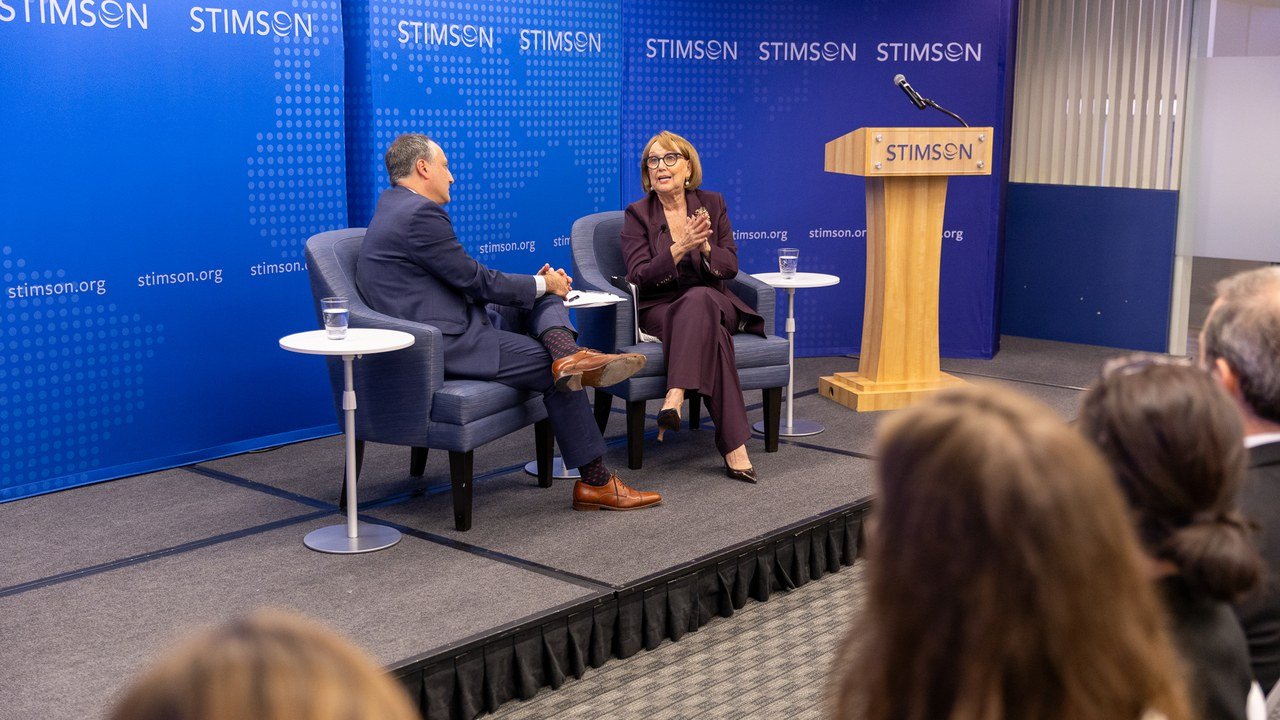
Grynspan, who heads the UN Conference on Trade and Development (La Nación), has framed the veto question as a negotiation rather than an endpoint. Before the sixth poll, she told Reuters she “wouldn’t be surprised” to receive a veto. “The game is not over -- we will have to continue working,” she said then (Reuters, Oct. 16). On Wednesday, two days before Friday’s ballot, she spoke at the Stimson Center, a think tank, about the future of international cooperation — the scene in the photo at the top of this page, according to Benjamin Gedan, who directs the center’s Latin America program (@benjamingedan on X).
What comes next depends partly on the calendar. Greece’s October presidency of the council ends with the month. Tarquinio wrote that Ambassador Balta “joked about being late on the news because straw poll results had already been leaked,” and that it now falls to Latvia to schedule the next poll (@alextarquinio on X). Envoy Magazine, a UN-focused outlet, wrote that without colour-coded ballots the results “raise more questions than answers” (@EnvoyUNEMAG on X). In 2016, the council needed six straw polls to settle on Guterres (Reuters); this race has now gone to seven with no clear consensus, and Guterres’s term ends on Dec. 31.
Once the council agrees, it adopts a formal resolution in a private meeting and sends its recommendation to the 193-member General Assembly, which makes the appointment under Article 97 of the UN Charter, according to Security Council Report. On the question of new contenders, Washington’s envoy to the UN, Mike Waltz, said after the sixth round: “Countries, if they want to put more candidates in, that’s certainly within their sovereign rights” (Reuters).