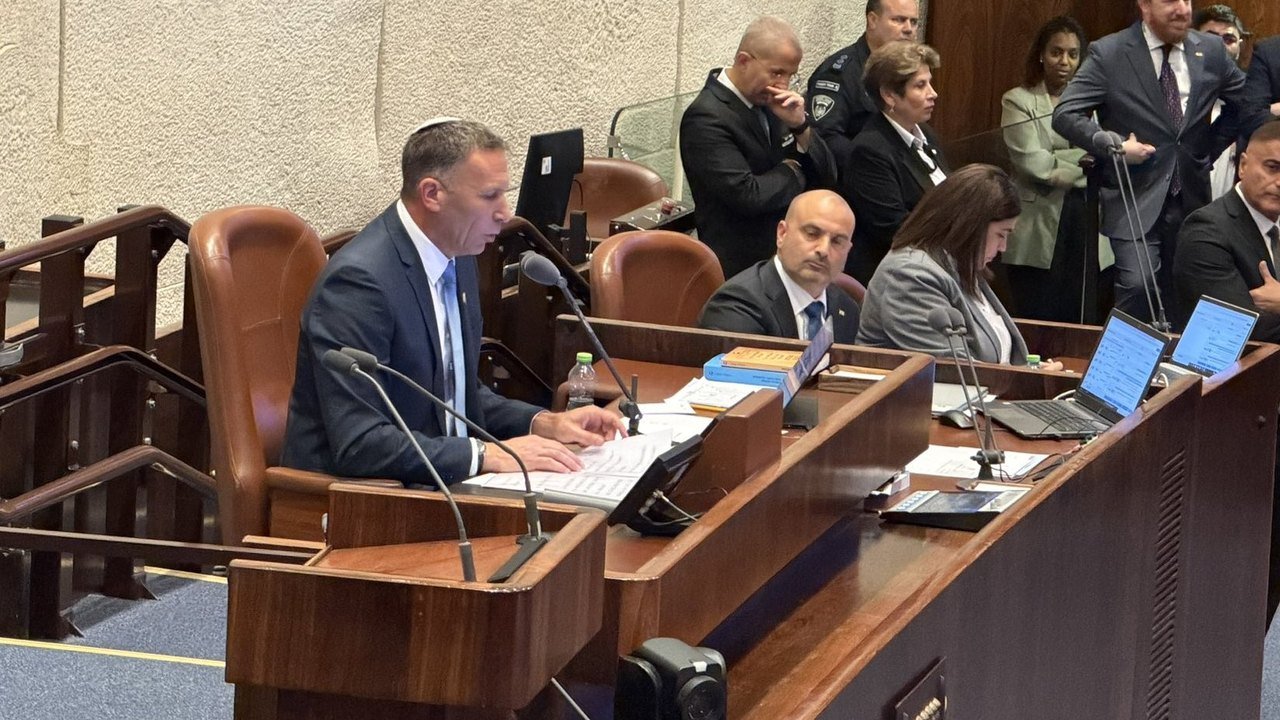
Israel’s parliament handed its top post to the camp trying to replace Prime Minister Benjamin Netanyahu on Tuesday evening, Nov. 17. Lawmakers elected Matan Kahana of Gadi Eisenkot’s Yashar party as speaker of the 26th Knesset with 66 votes, replacing Likud’s Amir Ohana, according to Ynet, France 24, which credits AFP and AP, and The Jerusalem Post. Likud’s candidate, Ofir Katz, received 52 votes, France 24 and The Jerusalem Post report. Ynet’s first flash said 66 lawmakers voted for Kahana and the rest did not take part or stayed away, with a separate vote on Katz to follow (Ynet live update).
The arithmetic came from the October election. Eisenkot’s bloc won 48 seats and Netanyahu’s 53 in the 120-member Knesset in the Oct. 27 vote, while two Arab-majority slates won 19, France 24 reports. According to The Jerusalem Post, the four parties in Eisenkot’s bloc and the Arab-led parties Raam and the Joint List backed Kahana, while Shas and United Torah Judaism supported Katz; JFeed adds Religious Zionism and Otzma Yehudit to Katz’s column. One Arab lawmaker missed the vote, France 24 says; JFeed names him as Yasser Hujirat. The election needed only a simple majority, The Times of Israel noted before the vote. Seems News covered the final count in its Nov. 11 report.
The speaker controls the pace of parliament. The office sets the timetable for parliamentary business and can speed up or delay debates and votes on bills, and the speaker serves as acting head of state when the president cannot carry out his duties, France 24 explains. With the speakership, Eisenkot’s bloc now controls the Knesset’s legislative agenda while talks on the next government remain unresolved, according to Ynet, which notes that Yashar’s Roy Folkman already chairs the Arrangements Committee and Yisrael Beytenu leader Avigdor Liberman chairs the temporary Foreign Affairs and Defense Committee. Eisenkot has until next month to form a government, France 24 says; Seems News covered his mandate in an earlier report.
A deal between the two camps cleared the way. Netanyahu’s outgoing coalition had planned a filibuster, Ynet reports, and in exchange for letting the election go ahead without delay, Eisenkot’s bloc agreed not to advance legislation repealing the outgoing government’s judicial overhaul until Monday, according to Ynet and JFeed. Accounts of the deal differ in detail: a summary by Israel.com cites Channel 12’s Dafna Liel as reporting that the repeal bill would still pass a preliminary reading on Wednesday and pause after that, while France 24 says Kahana could start undoing much of Netanyahu’s agenda as soon as Wednesday.
Likud had offered Kahana its own votes on one condition. The party said it would back him only if he committed not to appoint lawmakers from Arab parties as deputy speakers, according to JFeed, which quotes a Likud statement saying Kahana “refused our support on condition that he not appoint representatives of terror-supporting parties as his deputies.” Katz then entered the race. Before the vote, Katz urged the Arab parties not to support him and said he did not want the speakership “tainted by the votes of terror supporters,” Ynet reports. Raam lawmaker Walid Alhawashla answered that Likud had sought Arab lawmakers’ votes when it suited the party, Ynet adds. Joint List lawmaker Ahmad Tibi had announced on X that his faction would vote for Kahana, calling it a first and critical step toward repair and change (desk translation from Hebrew).
The debate turned sharp. Coalition members shouted “shame” each time an Arab lawmaker voted for Kahana, according to JFeed. Religious Zionism lawmaker Tzvika Mor tore his shirt at the podium in a traditional Jewish sign of mourning, protesting the political developments, Ynet reports. The Joint List asked Kahana to use his powers to stop lawmakers from calling Arab members “terror supporters,” “terror operatives” and “terrorists,” JFeed says. JFeed also describes Kahana as the first Knesset speaker elected with the support of the Arab parties, a claim this desk could not check against Knesset records.
Videos from X: a broadcast report, the speaker handover, and a protest at the podium before the vote.
View the @AJEnglish post on X
View the @JBreakingNews post on X
View the @ArutzSheva_En post on X
Kahana promised to serve the whole house. “I accept the role of speaker of the Knesset with a profound sense of reverence,” he said in his inaugural address, according to Ynet, and he said he would act as speaker for everyone regardless of race, religion or gender, per France 24; i24NEWS carries a similar line about the Knesset as the home of all citizens. On the clash over the courts, he said he hoped the next government would reform the checks and balances among the branches “with broad consensus,” and that while he held the post, “the Knesset will comply unconditionally with court rulings,” Ynet reports. He also told lawmakers that “the culture of debate here in this chamber has a direct and immediate impact on the way people speak to one another throughout the country,” and he turned to Eisenkot: “Gadi, I know you will leave no stone unturned to form a government that will unite and protect us.”
Netanyahu’s camp answered in strong terms. Likud said on X, in a statement Netanyahu also posted on his own account, that the speaker had won appointment “unilaterally with the votes of terror supporters” and called the night “a low point in the history of the Knesset,” in the translation published by The Jerusalem Post. The party said Eisenkot, former prime minister Naftali Bennett and Liberman had chosen “terror supporters over national unity” and added: “History will remember them for this.” National Security Minister Itamar Ben-Gvir wrote on X that Kahana owed his post to “Criminals, supporters of terrorism, and an adviser to Arafat,” per The Jerusalem Post’s translation. Netanyahu renewed his call for a national unity government that includes the ultra-Orthodox parties, Ynet reports.
Kahana’s allies welcomed the result. Eisenkot wrote on X that a new chapter had begun for the Knesset, one of “statesmanship, respectful and substantive dialogue,” and of the parliament acting as an “effective and strong oversight body,” according to The Jerusalem Post. Former prime minister Yair Lapid wrote on X that Kahana would “add honor to the Israeli parliament,” calling the vote “an important step on the path toward repairing and healing Israel.” Bennett, who served with Kahana in the Sayeret Matkal special forces unit, called him a “true friend and partner on the path” on X, and Democrats leader Yair Golan wrote: “We replaced the Speaker of the Knesset. Now we'll replace the government,” The Jerusalem Post reports.
Ohana left with a defense of his record. “We passed legislation with broad agreement, and some with deep opposition, but the heart of Israeli democracy never stopped beating,” he said in farewell remarks, according to Ynet, and he called the post a great privilege on X. Sources told Ynet that Netanyahu’s caretaker government may name Ohana strategic affairs minister. Kahana, 54, a former special forces soldier, served as religious services minister in the 2021–2022 government, where he clashed with ultra-Orthodox Jews by seeking to reduce the Chief Rabbinate’s power, France 24 reports. Seems News will watch for the deputy speaker votes, the timing of the judicial overhaul repeal, and whether Eisenkot can form a government before his deadline.