Jordan and Syria moved on Tuesday to contain a dispute over Jordan’s deadly airstrikes in southern Syria, a crisis that lasted about 24 hours, in Al Jazeera Arabic’s telling (Al Jazeera Arabic). In a phone call, Jordanian Foreign Minister Ayman Safadi and his Syrian counterpart, Asaad al-Shaibani, agreed to set up a joint security committee to examine “all details and facts” of Jordan’s airstrikes in southern Syria and to follow up on their fallout, according to the English text of the two foreign ministries’ joint statement published by Roya News (Roya News; Petra; Al Jazeera Arabic). Outlets date the call differently: Roya News says it took place on Tuesday, while Petra, Arab News and Shafaq News say Wednesday, local time (Roya News; Petra; Arab News; Shafaq News). Shafaq News published its report at 3:21 p.m. PT on Tuesday (Shafaq News).
Safadi told al-Shaibani that the strikes rested on field intelligence and aimed at “neutralising” confirmed threats and imminent attacks on Jordan, Arab News reports (Arab News). In Petra’s English summary of the statement, Safadi “expressed deep regret and sorrow over civilian casualties,” offered condolences to the Syrian people and said Jordan prioritizes the safety of Syrian civilians as it does its own (Petra). Besides reviewing the operation, the committee will refine “field and intelligence coordination mechanisms” against militant threats while safeguarding Syrian sovereignty, Petra says (Petra).
The strikes came on Monday evening. Syria’s Civil Defense service said at least four sites in rural Daraa and Suwayda provinces took hits and that its crews recovered seven bodies (Al Jazeera). Five of the dead — a man, a woman and three children — belonged to one family killed in a strike on a tent in the village of Al-Tai in Daraa province, the service said, according to Al Jazeera; three other family members, including a child, suffered injuries (Al Jazeera). A second strike killed an 80-year-old man in Al Shayyah, also in Daraa; a third hit a residential building in Muzayrib, in the Ain al-Basal area, without casualties; and a fourth killed a 60-year-old man in Shahba, in Suwayda province (Al Jazeera). Al-Monitor spells the family’s village Al-Taf and reports that hundreds attended a funeral there on Tuesday (Al-Monitor).
Jordan gives a different picture of the targets. Government spokesman Mohammad Momani said on Tuesday that the Jordanian Armed Forces hit Daesh strongholds after “the Kingdom’s patience wore thin” with militant movements, and that initial assessments put the toll at more than 20 Daesh operatives killed, alongside the destruction of a major weapons depot, Petra reports (Petra). Momani said Jordanian forces routinely avoid places where intelligence shows civilians, expressed regret over the civilian deaths and said Jordanian authorities have begun working with Syrian counterparts to look into them (Petra). Al Jazeera Arabic reports that the military named the operation Jordanian Deterrence – Hamoud (this desk’s translation of the Arabic name) and described it as revenge for the victims of the church attack (Al Jazeera Arabic). This desk has not independently checked either side’s casualty figures.
The two governments also disagree on whether Amman warned Damascus. Jordan’s military said it carried out the strikes “in coordination with the Syrian government,” but the Syrian government said they went ahead “without prior coordination or notification” and said it had opened an inquiry, according to Al Jazeera (Al Jazeera). Syria’s Foreign Ministry called the strikes an “unacceptable violation and breach of Syrian airspace without any prior coordination,” Al-Monitor reports, and a Syrian Foreign Ministry official told Al Jazeera the strikes amounted to a “treacherous attack” (Al-Monitor; Al Jazeera). Al-Monitor adds that Jordan’s public broadcaster Al Mamlaka, citing a source, reported that the dead included the mother and three nephews of one of the church-attack suspects, living in a tent near a targeted site; this desk could not verify that report (Al-Monitor).
The dispute reached the border. Syria’s General Authority for Borders and Customs closed the Nassib crossing on Tuesday, suspending traffic in both directions, according to Al Jazeera and Al Jazeera Arabic (Al Jazeera; Al Jazeera Arabic). Al Jazeera calls Nassib the only crossing for passengers and commercial goods between Jordan and Syria (Al Jazeera). After the joint statement, Syria’s state channel Al-Ikhbariya announced that passenger and commercial traffic through Nassib would return to normal from Wednesday morning, Al Jazeera Arabic reports (Al Jazeera Arabic).
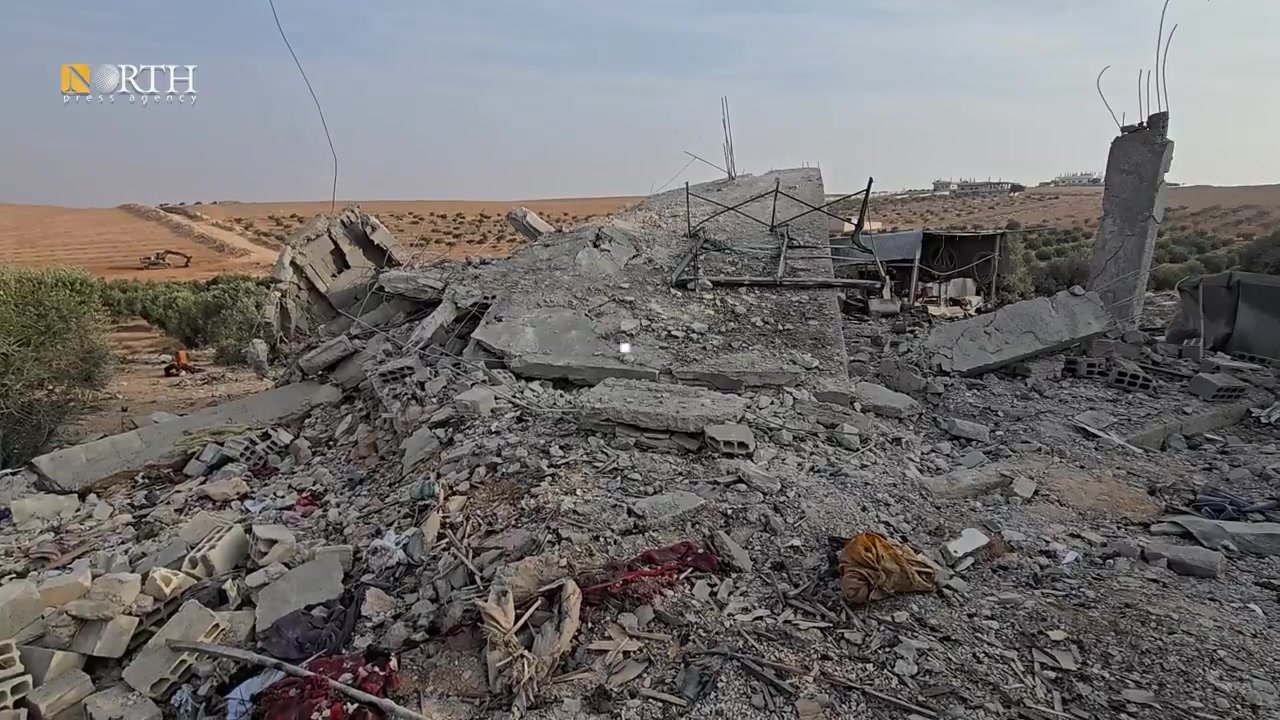
Watch: damage in Daraa on X
Two news agencies posted videos of damaged buildings in Daraa province after the strikes. This desk viewed eight stills from each clip; neither shows casualties. If an embed does not load, it shows as a plain link.
View the @NPA_English post on X
View the @SANAEnOfficial post on X
The chain of events began on Friday, Oct. 23, in Hamoud, a village in Jordan’s southern Karak governorate. Gunmen opened fire on mourners attending a funeral at St. George’s Greek Orthodox Church, killing nine people, according to Arab News, which puts the wounded at at least 40 (this desk’s Oct. 23 story reported eight dead; Al Jazeera now says at least nine); Al Jazeera Arabic reports that authorities counted 34 wounded (Arab News; Al Jazeera Arabic). On Monday, Jordanian security forces took three suspects — two brothers and their brother-in-law — into custody in the village of Al-Jadeeda after a shootout of about three hours, a Jordanian government source told Al Jazeera, which says the three suffered serious injuries (Al Jazeera). According to Arab News, no group has emerged as confirmed responsible for the attack, although Jordanian authorities have linked those behind it to militants operating across the border in Syria (Arab News).
Jordan’s account of a Syrian link shifted over the same day. Interior Minister Mazen al-Faraya said that, so far, no indications tied the attackers to outside groups, Al Jazeera Arabic reports; the military statement on the strikes then said the Karak attackers had ties to the militant groups it targeted in southern Syria (Al Jazeera Arabic). Al-Monitor describes the same sequence: officials first said they had found no evidence of ties to organized cells, and later the military said an inquiry had established links and identified the strike targets as ISIS militants (Al-Monitor). King Abdullah II had pledged the “harshest penalties” for those responsible, according to Al Jazeera (Al Jazeera).
The episode strains a security partnership. Jordan and Syria have cooperated on security since Ahmed al-Sharaa took power after the fall of Bashar al-Assad in late 2024, though tensions have persisted over cross-border drug smuggling, Al-Monitor reports; al-Shaibani met King Abdullah in Aqaba last week, and in May Jordan struck Suwayda in an operation aimed at Captagon drug smuggling (Al-Monitor). In their statement, the ministers stressed close cooperation against terrorism and arms and drug smuggling “through effective and sustainable institutional channels,” according to Roya News’ English text (Roya News). Momani, in Petra’s report, said Jordan remains committed to Syria’s sovereignty and territorial integrity (Petra). What the new committee finds, and whether it publishes its findings, remains open; none of the statements this desk read names its members or sets a timeline.