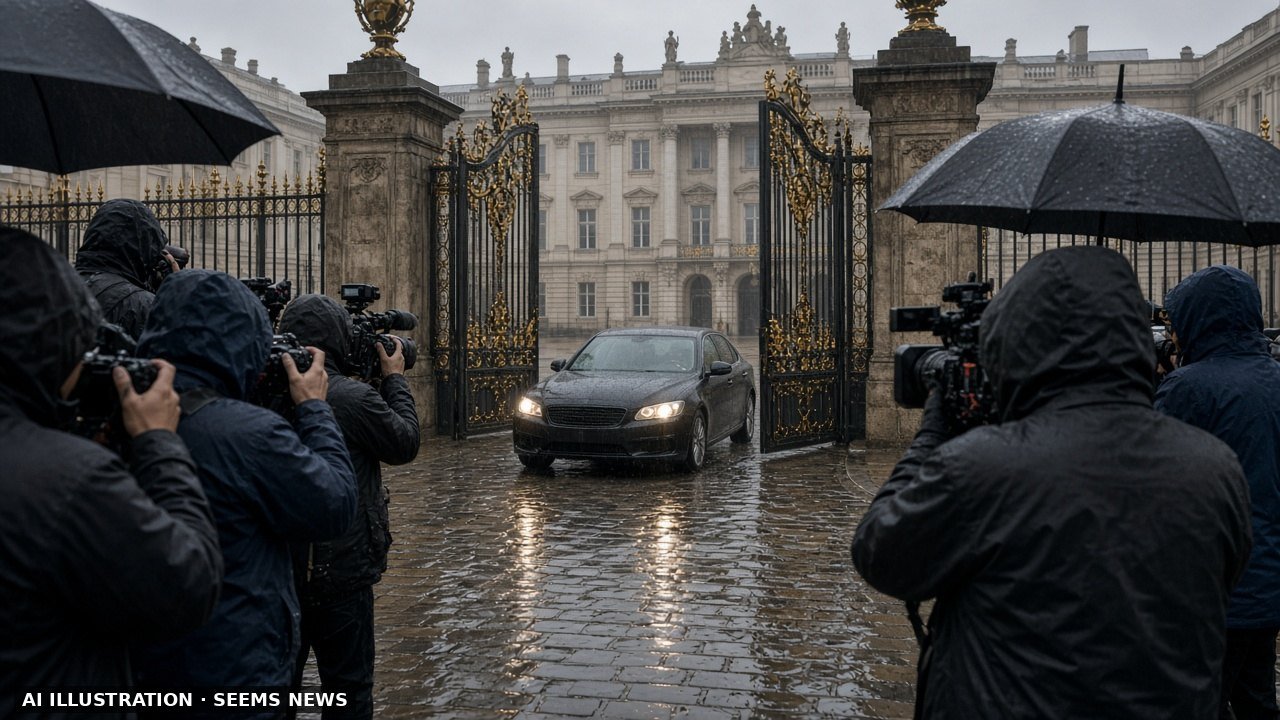
Belgium’s government survived the morning, at least for now. Prime Minister Bart De Wever went to the Royal Palace in Brussels on Monday to hand King Philippe the resignation of his five-party coalition after overnight budget talks collapsed, as this desk reported earlier on Monday. The king did not take it. “Belgian PM Bart De Wever has failed in his bid to resign,” VRT NWS wrote in its English-language report, adding that the king now has the request under consideration.
De Wever arrived at the palace around 9:30 a.m. local time (about 12:30 a.m. PT), according to 21News. He left after an audience of about an hour and a half without speaking to reporters, Euronews reported. Shortly afterward the palace confirmed that the king, for now, does not accept the resignation, according to 21News. The public broadcaster VRT NWS posted the news on X at 11:38 a.m. local time (2:38 a.m. PT), with a short clip from outside the palace, in a post by @vrtnws.
Watch: VRT NWS reports the king’s decision, via @vrtnws on X
If an embed does not load, it shows as a plain link to the original post.
View the @vrtnws post on X
The palace statement reached English-language readers in two slightly different translations. VRT NWS rendered the key line as: “The King is considering his decision and will begin consultations with the party leaders of the governing coalition from tomorrow.” Euronews gave it as saying the king “is taking his decision under consideration and will consult the chairs of the various coalition parties from tomorrow.” Both outlets reported that the king regrets that no budget agreement emerged and that he warned the country cannot afford a prolonged political crisis.
The original statement went out in Belgium’s national languages, and the Dutch-language outlet 21News quoted a fuller line from it: “ In een context van grote geopolitieke onzekerheid en aanzienlijke economische uitdagingen kan het land zich geen langdurige politieke crisis veroorloven.” In this desk’s translation, that means: in a context of great geopolitical uncertainty and considerable economic challenges, the country cannot afford a prolonged political crisis. The king also called on all parties involved “to prioritise the public interest and a willingness to compromise,” in VRT NWS’s wording, or “to put the general interest and a willingness to compromise first,” in Euronews’s.
The next steps now have dates. From Tuesday the king will receive the leaders of the five coalition parties, the Flemish nationalist N-VA, the francophone liberal MR, the francophone centrist Les Engagés, the Flemish socialist Vooruit and the Flemish Christian democrat CD&V, according to 21News. The Limburg regional broadcaster TVL reported that De Wever will come back to the palace on Friday, Nov. 6, and VRT NWS also reported a new audience on Friday.
The talks themselves broke down over who should carry the cost of about €10 billion in savings, the amount Belgium needs to stay within EU spending limits, according to Euronews. Euronews reported that the centrist and socialist parties want €1 billion to €1.5 billion to come from taxing higher incomes, while the conservatives want to clamp down on spending, and that Deputy Prime Minister David Clarinval of MR blamed Vooruit for the failed talks over its insistence on higher taxes.
Clarinval made the same case on X, according to 21News, which carried his French-language post: “Le volume de taxes sur la table reste beaucoup trop élevé et dépasse largement ce qui était prévu dans l’accord de gouvernement.” In this desk’s translation, the volume of taxes on the table remains far too high and goes well beyond what the government agreement planned. Foreign Minister Maxime Prévot of Les Engagés pointed to “too many sticking points,” Euronews reported. “If I were to list all the sticking points, it would take an eternity,” he told Belgian media, according to Euronews.
The opposition used the moment to attack the prime minister. Matti Vandemaele of the Flemish green party Groen said, according to Euronews: “Prime Minister De Wever is failing to get his government on the same page, unless everyone follows his N-VA programme.” He added: “De Wever likes to present himself as the man of the big deals, but in practice he is mainly the prime minister of standstill. The fact that we risk falling back on provisional twelfths for the second year in a row is a complete humiliation for a sitting prime minister.” Provisional twelfths let the state spend, month by month, one twelfth of the last approved budget.
The money pressure behind the standoff has not eased. Belgium’s budget deficit reached 5% last year against a European maximum of 3%, and its national debt stands above €735 billion, more than 110% of GDP, where the EU permits 60%, according to Euronews. Euronews also reported that interest rates on Belgian government bonds have risen because of the failure to agree, so the country pays more to service its debt.
Outlets disagree on what an acceptance would mean. Euronews wrote that new elections would follow if the king accepts the resignation. Earlier on Monday, VRT political journalist Ivan De Vadder said a new government could still form without a vote: “Il est toujours possible de former un nouveau gouvernement sur la base des rapports de force issus des dernières élections,” he said, according to VRT and Belga, meaning a new government can still form from the balance of power left by the last election. 21News described a prolonged crisis, possibly followed by new elections and a difficult government formation, as a central concern behind the king’s consultations.
The coalition has walked this road before. The so-called Arizona agreement itself took 234 days of negotiations, according to Euronews. In early November 2025 the same partners failed to find €10 billion, and De Wever, rather than resign, asked the king to extend the deadline and received 50 extra days, Euronews reported. According to VRT NWS, the partners then reached a deal on €9.2 billion in savings. This time De Wever went further and formally offered to step down, and the palace answered with a week of consultations rather than a yes or a no.
This desk will update the story when the palace or Belgian outlets report the outcome of Tuesday’s consultations or of Friday’s audience. As of about 4 a.m. PT on Monday, no checked source had reported any final decision on the resignation.