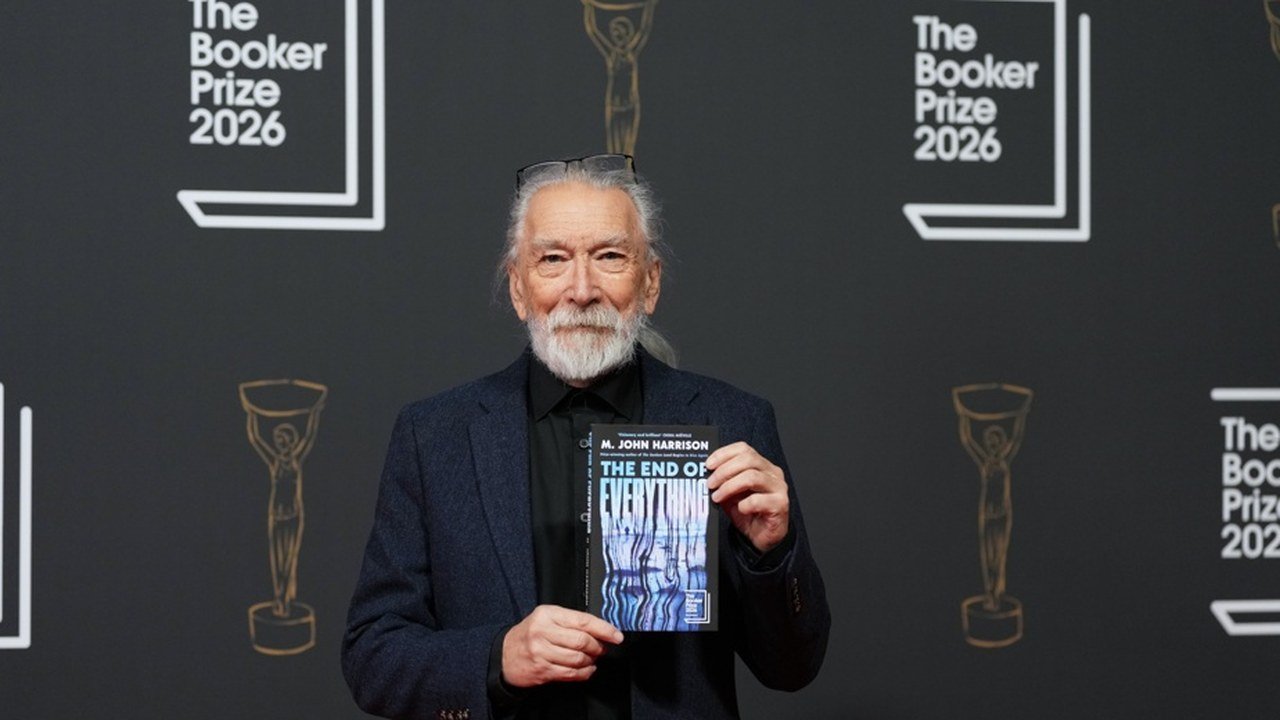
British writer M. John Harrison won the Booker Prize 2026 on Monday night, Nov. 9, for The End of Everything, a short satirical novel set on a near-future Kent coast after a catastrophe nobody can explain, according to the Booker Prize Foundation. He received £50,000 and a trophy from David Szalay, last year’s winner, at a ceremony at Old Billingsgate in London that BBC Radio 4’s Front Row broadcast live, the foundation says. AP gives the prize money as about $67,000.
At 81, Harrison now holds the record as the prize’s oldest winner, the foundation says. He overtakes Margaret Atwood, who shared the award in 2019 at 79 for The Testaments, the Guardian reports, and the BBC says he has now surpassed Atwood as the oldest ever Booker winner. Born in Rugby, Warwickshire, in 1945, Harrison sold his first story in 1965 and spent most of the 1970s running the books pages of the speculative fiction magazine New Worlds, according to the Guardian.
“I really didn’t expect to be up here this evening, I honestly didn’t — here at the end of everything. But here I am,” Harrison said as he accepted the award, according to File 770, a science-fiction fandom news site. “You talk glibly about your life being changed, but it’s weird when it happens. I feel like a proper writer at last: totally lacking in confidence.”
Watch: the Booker Prize 2026 win on X
If an embed does not load, it shows as a plain link to the original post. The clips add pictures and sound to the reports above; they do not replace them, and this desk did not watch every second of each clip.
View the @AFP post on X
View the @bookingclubpod post on X
View the @riverheadbooks post on X
The judges reached their choice unanimously after spending “a whole day debating the six remarkable novels on this year’s shortlist,” chair Mary Beard said in the foundation’s release. “It’s a book that turns you upside down, raises a wry smile – and surprisingly, given the subject matter, leaves you with a twinge of optimism,” she said. Beard told reporters on Monday, “There was a lot of discussion, disagreement and debate. But nobody stomped off,” the BBC reports, and she also called it “a challenging read, but some of the best fiction is challenging.” Beard sat on the panel with poet Raymond Antrobus, musician Jarvis Cocker, critic Rebecca Liu and novelist Patricia Lockwood, the foundation says.
The novel follows Phillip Tennent, a beachcomber, and his elderly aunt Marnie as they try to get by years after a mysterious catastrophe and an invasion of shape-shifting beings called the iGhetti, according to the foundation and the Guardian. Beard said the “i” in iGhetti hints “at something digital, but you can’t be sure,” and Wood described the book’s landscape as “Large Language Model-dotted,” per the foundation’s release. Harrison wrote in the Guardian that he meant it as “a disaster story in which the disaster is the failure to comprehend,” the Guardian and the BBC report.
How to label the book splits the sources. Wood says, “Many past Booker Prize authors have borrowed facets of science fiction in their work,” but calls Harrison “the first Booker winner to have emerged from the bona fide SF world,” per the foundation. AP goes further, calling the novel the first work of science fiction to take the award, and the Guardian’s headline calls Harrison the first science fiction author to win. Harrison himself resists the tag: AP reports that he said Booker recognition shows the era of “genres as fences and boxes, pigeonholes, is over,” and File 770 cites a Daily Telegraph interview in which he said he refuses to have the words “science fiction” on his books. On BBC Radio 4’s Front Row last month he asked, “Why shouldn’t a well written [work of] SF be considered to be literary fiction?”, according to the Guardian.
Critics have split on the book itself. The BBC says it has divided opinion among readers and quotes the Guardian’s review warning that “it won’t be for everyone,” and cites the Literary Review calling it “a work of uncanny beauty, tender and terrifying in equal parts.” The foundation’s release quotes Helen Macdonald’s line in the Observer: “I don’t think I’ll read a better book this year, perhaps decade.”
Harrison beat a shortlist that included two former winners, Marlon James, the bookmakers’ favourite, for The Disappearers and Douglas Stuart for John of John, along with Elizabeth Strout’s The Things We Never Say, Luke Kennard’s Black Bag and Rebecca Perry’s debut May We Feed the King, according to the Guardian, which says each shortlisted author receives £2,500. His earlier prizes include the Boardman Tasker Prize for Climbers in 1989, the Arthur C. Clarke Award for Nova Swing in 2007 and the Goldsmiths Prize for The Sunken Land Begins to Rise Again in 2020, the foundation says; he served as a Booker judge in 2022, according to the Booker Prizes’ profile of him and the Guardian.
What comes next: the foundation points to the sales jump that followed last year’s win, saying Szalay’s Flesh sold over 7,900 hardback copies in the U.K. in the week after it won, a 1,441% rise. Harrison’s first public event as winner, a conversation with author Sara Collins at Tyneside Cinema in Newcastle on Thursday, Nov. 12, has already sold out, according to the foundation.