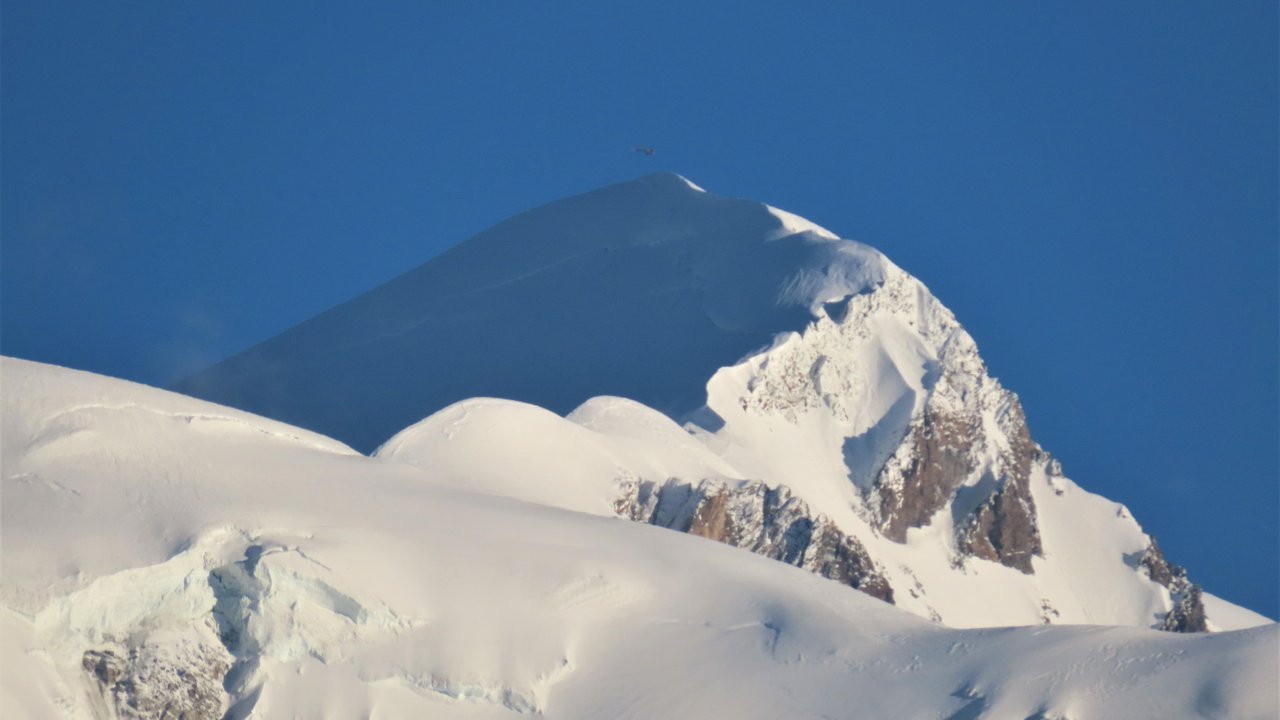
Mont Blanc’s snowy summit stood 4,807.47 metres above sea level in mid-September, nearly two metres higher than the last figure announced in 2023, chartered surveyors from the French department of Haute-Savoie said on Wednesday, October 14, according to AFP, France 3 and Euronews. France 3 says Jean des Garets, president of the Haute-Savoie chamber of chartered surveyors, presented the result at a press briefing in Saint-Gervais-les-Bains. Mont Blanc’s “summit is constantly shifting,” des Garets said, in AFP’s English translation; Euronews renders the same line as “the summit is in constant motion.” The earliest report this desk found came from franceinfo (Radio France) at 11:24 a.m. Paris time (2:24 AM PT), followed by France 3 at 11:32 a.m. and AFP’s English dispatch on RTL Today at 11:54 a.m. The franceinfo radio story gives the height as 4,807 metres and 45 centimetres, two centimetres short of the 4,807.47 metres that AFP, France 3, Euronews, AP, the Guardian, I Love Ski and the franceinfo television report from France 2 carry, and that the surveyors’ project site lists as its latest measurement.
The headline gain rests on a three-year comparison. AFP calls it a 1.88-metre increase on the last reported measurement in 2023, and Euronews says that measurement came to 4,805.59 metres, “the lowest figure in recent years.” I Love Ski calls 4,805.59 metres the lowest level recorded since modern surveys began in 2001 and lists 4,810.40 metres for that first survey and 4,810.90 metres for 2007, the highest in the series; France 3 also gives 2007 as the highest reading and puts 2021 at 4,807.81 metres, nearly identical to this year. The Guardian says the summit has shrunk back by 3.43 metres since the 2007 high. Several outlets tie the figure to the 19th century: AFP says the latest measurement comes close to those recorded at the end of that century, according to the surveyors, and Euronews and I Love Ski put it about 27 centimetres above the 1894 figure, which I Love Ski credits to the cousins Joseph and Henri Vallot. AFP’s French copy on France 24 adds that popular culture, including the pens of the brand that shares the mountain’s name, often rounds the height to 4,810 metres (this desk’s translation).
Measured against more recent readings, the summit dropped. I Love Ski says interim measurements in the surveyors’ scientific report give 4,808.51 metres for 2024 and 4,808.76 metres for 2025, and calls the 2026 figure higher than 2023’s “but lower than these two more recent observations.” The Guardian built its headline on that comparison, saying Western Europe’s highest mountain “shrank by more than a metre last year,” putting “the roof of Europe” 1.29 metres lower than in 2025. Franceinfo also says the new figure comes in below 2024 and 2025, and quotes des Garets saying that, across 25 years of measurements, the average sits around 4,808 metres and 80 centimetres, with readings above it for the first 13 years and below it ever since (this desk’s translation). AP’s headline, by contrast, says the snowy crown “grows nearly 2 meters higher in 3 years”; this desk read only a truncated search-engine excerpt of the AP story, which also mentions a higher measurement in the surveyors’ records. The outlets also describe the survey rhythm differently: AFP says researchers have measured the mountain every two to three years since 2001, the IGN says satellite field measurements began in 2001 at two-year intervals, and franceinfo says the surveyors climb every year.
The surveyors measure the cap of snow and ice that covers the rock, AFP’s French copy on France 24 says. AFP’s English dispatch on RTL Today says the rocky peak measures around 4,792 metres above sea level while its thick covering of ice and snow varies from year to year with wind and weather; France 3 compares that layer to a huge snowdrift that shifts with high-altitude winds and precipitation (this desk’s translation), and Euronews lists wind, precipitation, temperature, sunshine and seasonal weather. AFP’s French copy on France 24 quotes the surveyors’ press kit as describing 2026 as “particulièrement sèche” (particularly dry) and saying the zero-degree isotherm, the altitude at which air reaches freezing, rose above 5,000 metres during exceptional heat episodes, while stressing that neither observation alone explains the year-to-year swings. That copy also says a ground-penetrating radar, new this year, let the team model both the ice cap and the rocky summit beneath it, which it puts at 4,789.40 metres against 4,792 metres measured by other scientists in 2004. “On n’a pas encore pris le temps d’analyser et de comprendre pourquoi on a cet écart,” des Garets said, according to AFP; in this desk’s translation, the team has not yet taken the time to analyse and understand the gap.
The surveyors and a glaciologist warned against reading climate trends into one number. “Each individual measurement is not significant in itself,” des Garets said in the context of global warming, adding that it “provides data that will be analysed over time,” AFP reports; AFP also quotes glaciologist Luc Moreau telling the press conference that the summit has “not been significantly altered by climate change” for now. A UNGE spokesperson told the Guardian: “An increase in summit altitude does not necessarily mean that the mountain has gained ice mass, nor does it contradict the documented retreat of Alpine glaciers.” The Guardian quotes des Garets saying “for the moment, climate change doesn’t seem to have the same impact above 4,000 metres,” and, in comments it says he gave the French channel TF1, describing the Tête-Rousse glacier on the way up: “It has literally melted before our very eyes and now in some places we’re crossing a stream instead of a glacier.” The Guardian sets the measurement against western Europe’s hottest summer on record and a Swiss finding that one-fifth of that country’s ice disappeared in five years. Franceinfo says the longer downward trend may link to climate change but that confirming it will take many more years of data.
The climb itself took days. I Love Ski, citing the official statement, says 32 participants in 11 rope teams left Saint-Gervais-Mont-Blanc for a three-day expedition from September 15 to 17, with around ten hours of climbing, a 2,500-metre ascent and nearly 30 kilograms of scientific equipment, and that favourable weather allowed two hours of data collection at sunrise on Thursday, September 17, against about an hour in 2023. The franceinfo television report from France 2 also gives 32 people, ten hours, 2,500 metres and two hours at the top, while the franceinfo radio story says the team spent nearly three hours there. I Love Ski says satellite positioning (GNSS) fixes points to the centimetre, that drones captured more than 1,300 georeferenced images for a three-dimensional model of more than 15 million points, and that today’s accuracy runs between 2 and 5 centimetres, against around half a metre for the Vallot cousins. AFP’s French copy on France 24 says the team hauled 30 kilograms of equipment, against about ten in a usual year.
For the first time, the team also measured gravity at the summit, according to I Love Ski and AFP. The French national mapping institute’s magazine, IGN Mag, wrote before the climb that its engineers would carry a Scintrex CG-6 relative gravimeter weighing 5.5 kilograms, which had to stay powered for nearly 72 hours, and that earlier attempts in 2001, 2003 and 2004 never reached the top. AFP says three IGN members carried the instrument to measure the gravity field, which helps set the zero point used as the reference for altitude, and quotes IGN engineer Brice Virly calling it a first at the summit, useful for refining altitude calculations in years to come and for studying the ice layer (this desk’s translation). I Love Ski describes the gravity reading as a baseline for future comparisons rather than a result in itself.
Seems News reading note: the 4,807.47-metre height rests on the Haute-Savoie surveyors’ announcement as AFP, AP, France 3, Euronews, the Guardian, I Love Ski and France 2 report it and as the surveyors’ project site lists it; one early franceinfo radio story gives 4,807.45 metres. Whether the summit rose or fell depends on the comparison: up 1.88 metres from the last officially announced figure in 2023, down 1.29 metres from an interim 2025 reading. The 2024 and 2025 readings, the expedition logistics and the gravity details rest mostly on I Love Ski’s account of the surveyors’ report and on the IGN, and the 4,789.40-metre rock figure rests on AFP’s French copy alone. This desk did not read the surveyors’ press kit or scientific report. Watch for the full scientific report, an explanation of the rock-summit gap, and analysis of the first gravity data.
