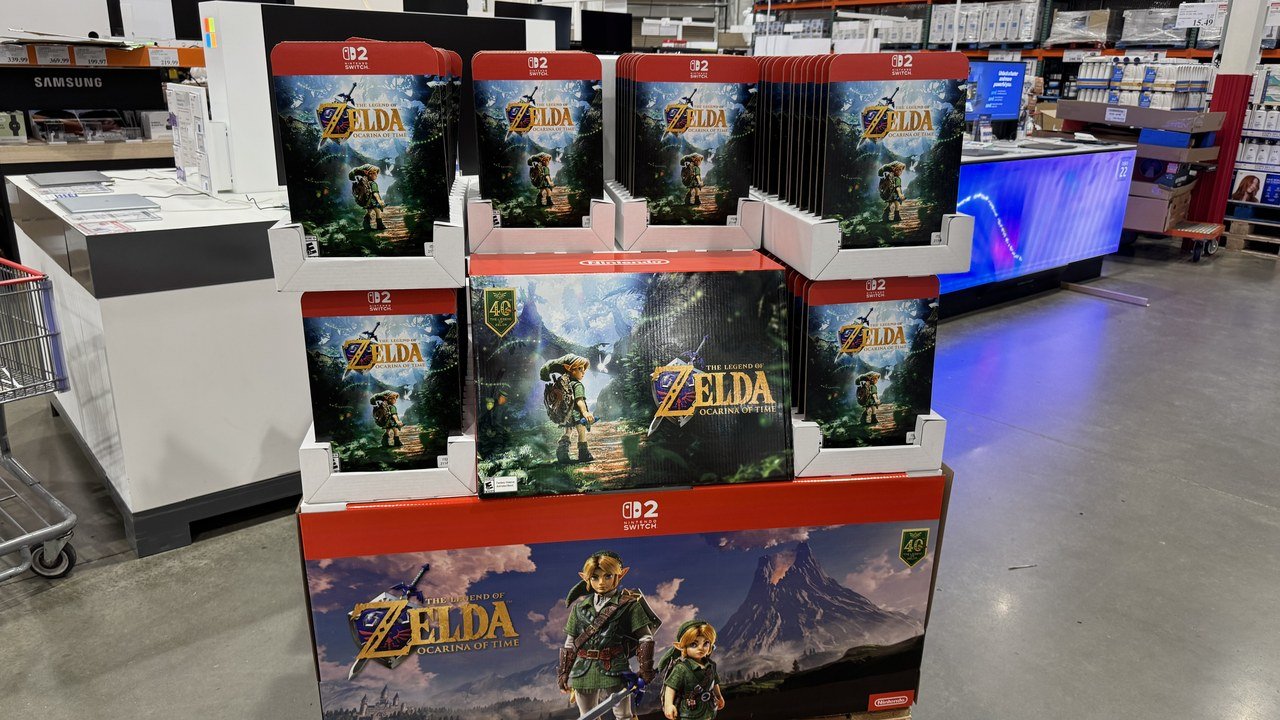
Nintendo released The Legend of Zelda: Ocarina of Time for Nintendo Switch 2 on Nov. 5, 2026, according to the Nintendo Store listing, which prices the game at $59.99 digital and $69.99 physical as a Switch 2 exclusive. A photo by Johnny Void, taken the same day at what he attributes to a Marysville Costco, shows a wooden COSTCO pallet stacked with the game, red-topped download slipcards, foil-style packaging, and a green 40th Anniversary shield. This desk has not confirmed the store address, shelf price, or remaining stock.
Expectations appear high, at least by Nintendo’s own description. In its Sept. 8, 2026 Direct write-up, Nintendo listed overhauled visuals, fully voiced cutscenes, expanded dialogue, symphonic orchestral music, and a reworked camera and movement (Nintendo Direct write-up). The company says a first print features “special packaging that features textured foil cover art, available while supplies last.” Critics appear to agree. Metacritic lists a score of 96 from roughly 80 critic reviews, all positive, and OpenCritic shows about 95, according to TheGamer and a Nintendo Life roundup; GGRecon and other roundups call it the highest-rated game of 2026 so far. IGN gave it 9/10, calling it an exceptional remake that stands on its own, though it said streamlined dungeons slightly reduce the puzzle magic. Nintendo Life also gave 9/10, praising visuals as stunning but noting that the absence of Master Quest keeps it short of definitive. GamesRadar and TheGamer each awarded 5/5, GameSpot 9/10, and RPG Site 8/10, the latter saying Nintendo built it with new players in mind first. This desk found no Nintendo sales guidance at filing time.
Within hours of launch, the remake reportedly booted on PC. VideoCardz reported that the game appears to have leaked as a dump before release and runs through an early Switch 2 emulator. DSOGaming and TheGamer described forks of an emulator called Lichii starting the game. According to those outlets and circulating clips, performance looks rough: washed-out bloom, stutter, frame rates often around 12 to 30 FPS, and black screens on some AMD hardware. Clips from X accounts including @Unreal_64, @lihks, @saudigamer, @Betaer, @mdaman010, @randomuser3524, and @m1nd_ya, along with YouTube channels such as Unreal Gaming PC, reznoire, and Finn Benchmarks, show the footage spreading (@Unreal_64 clip). GameBanana has opened a hub for Switch 2 remake mods. In the launch-day clips this desk reviewed, the footage appears to show plain emulation; this desk found no clear AI upscaling or AI frame generation.
AI plays a clearer role in a separate, older scene. Ship of Harkinian, a native PC port built by the Harbour Masters group from a decompilation of the N64 original, supports texture mods. Some of those packs use AI upscaling, such as R0CKH0PP3R’s UltraScale scripts, which, according to the project’s GitHub page, use Real-ESRGAN models to upscale backgrounds (UltraScale on GitHub). Not every project welcomes the tools: the Zelda64Recomp team, which ports Majora’s Mask natively to PC, bans generative AI contributions in its CONTRIBUTING guide (Zelda64Recomp). XDA Developers has contrasted what it calls “AI slop” in retro ports with careful projects such as Ship of Harkinian. Fan rebuilds in Unreal Engine 5, including work by the YouTube creator CryZENx, form a third category; those remain fan projects unaffiliated with Nintendo.
Will demand hold? Strong reviews argue for demand, while the same-day dumps raise a commercial question, but these three threads differ. AI upscaling of a 1998 game requires owning or decompiling old data, while dumping a brand-new remake touches a product Nintendo sells today. Nintendo has pursued emulator developers before; in 2024 the makers of the Switch emulator Yuzu agreed to pay $2.4 million and shut down after a Nintendo lawsuit, as The Verge reported. The current emulator footage suggests a game not yet reliably playable on PC. Public sources do not yet show Day-1 sales figures, so this desk cannot measure whether piracy affects sales. Nintendo had not commented on the dumps in materials this desk reviewed.
What this desk recommends
Readers who want this remake should buy the official Switch 2 release rather than download dumped copies. Nintendo’s developers, musicians, and artists spent years on the work behind the scores cited above; supporting them through legal purchase helps fund the next project. People who follow emulation and homebrew often say they should use only their own legally owned game dumps, not files from strangers online.
AI tools and fast emulation will keep changing how people access, upscale, and modify games. That shift already touches the older Ship of Harkinian scene and may reach this remake next. None of that requires taking a new release without paying for it. This desk recommends respecting the people who made the game while watching how the technology evolves.