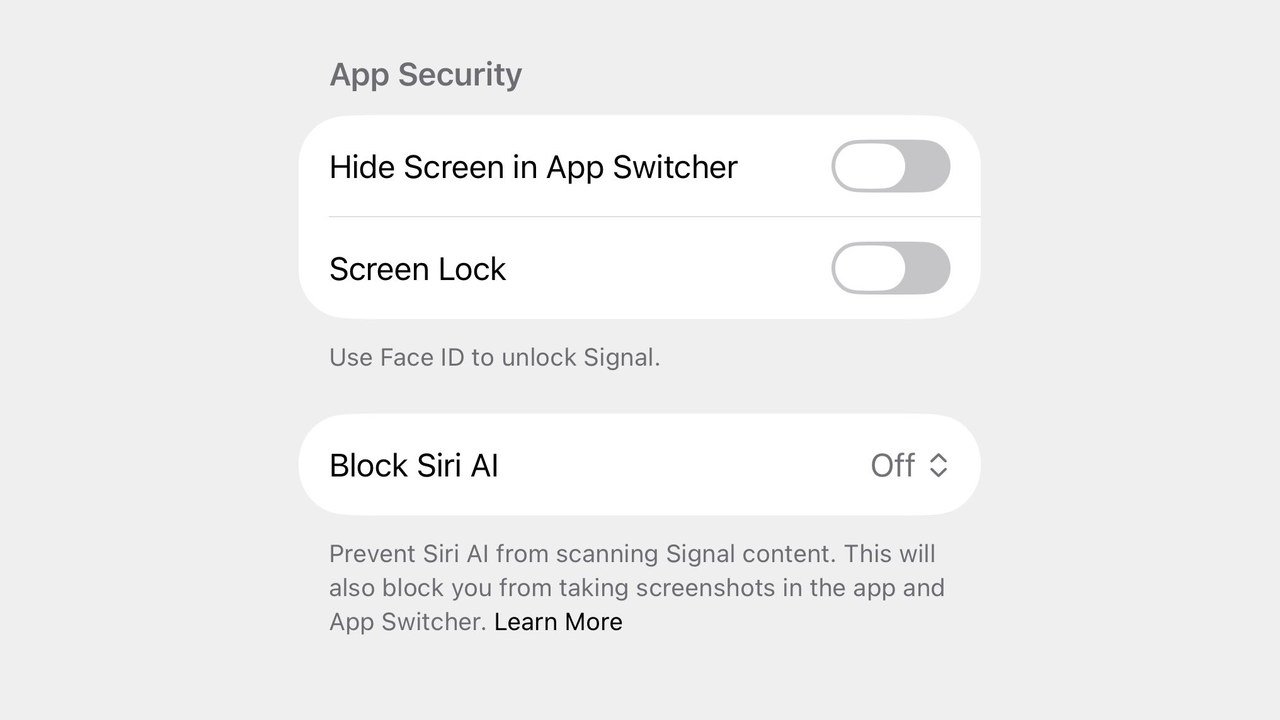
Signal, the encrypted messaging app, began restricting screenshots inside its phone app on Friday, Nov. 20, saying it wants to keep the AI assistants now built into mobile operating systems from capturing users’ chats. In a blog post, Signal President Meredith Whittaker writes that the app will block screenshots on iOS 27 and step in on Android versions where it can detect an AI assistant trying to read the Signal screen. Reuters, which first reported the change, says Apple, Alphabet’s Google and Microsoft did not immediately respond to requests for comment (Reuters via Investing.com). Signal announced the new default on X at 1:31 a.m. PT (@signalapp).
Whittaker casts the change as self-defense. “Right now, these agentic AI integrations are changing this environment in a way that’s making it increasingly hostile to privacy. This is an existential threat to Signal, and our ability to responsibly uphold our mission,” she writes in the post. She names two features, Gemini Intelligence with Google Gemini and Onscreen Awareness with Siri AI, as examples of agent tools that Google and Apple have built “deep into their operating systems.”
Her argument turns on where the data goes after it appears on screen. Signal’s open-source code and encryption protocol protect messages, the post says, but an operating-system agent that scans the screen can copy that content somewhere Signal never sees. “All of this is outside of Signal’s control once the data has been captured, and imperils the privacy of all the participants in a conversation,” Whittaker writes. Reuters sums up the post’s point: AI systems that scan screens can pull messages out of Signal’s secure environment and into whatever servers the agent uses (Reuters).
The new setting works differently on the two phone platforms, according to Signal’s support page. On iPhones with Signal 8.37 or later and iOS 27 or later, “Block Siri AI” comes switched on by default, with three choices: on, off, or off for 10 minutes for a quick screenshot. On Android, with Signal 8.35.1 or later, “Screen security” turns on automatically the first time an AI assistant tries to read Signal’s screen, and the app shows a message explaining what happened. While the setting stays on, it blocks screenshots and screen recordings inside Signal, keeps Signal content out of the recent-apps list and App Switcher, and stops on-device assistants from reading what Signal shows, the support page says. It does not change how Signal encrypts messages, the page adds.
Turning it off comes with a warning. Signal asks users to confirm, because AI assistants may then scan Signal content “and use it for features that may not be private,” the support page says. On Android, if a user dismisses the protection from the pop-up prompt rather than in settings, Signal switches it back on after 90 days. In her post, Whittaker says that disabling the block “will potentially expose your (and your contacts’) Signal content to these AI agents, and break our privacy guarantees.”
Signal admits the block leaves gaps. “Our remedy is also incomplete – while we are doing everything we can, restricting screenshots does not address other more sneaky ways AI agents could potentially access application data, such as retrieving content already present on a user’s device via the filesystem,” Whittaker writes. The post adds that Signal cannot cover every Android device, because many phone makers give it no reliable way to detect a screenshot attempt, and that it cannot reliably block screenshots on macOS at all. For Mac users on macOS 27, Signal’s only advice: add Signal to the Excluded Apps list under System Settings, then Siri.
Signal wants the platform owners to fix the problem at the source. The post calls on Apple, Google and Microsoft for two remedies: an easy, well-documented way for developers to opt their apps out of AI data access, covering screen reading, filesystem access, notifications, APIs and other operating-system frameworks, and better documentation of how the agents handle data. Whittaker says Signal spent “considerable developer time and energy doing forensic investigations” across Android and iOS to learn what the agents do, and that she feels “cautiously optimistic that some major OS providers, like Google and Apple, are engaging with us” (Signal).
The announcement lands two days after a Reuters investigation into Meta’s Muse agent, an app Reuters says has passed 10 million downloads since its September launch. According to internal Meta posts reviewed by Reuters, one employee said Muse surprised her with a reminder to answer a Signal message from her sister. “This seems like an extreme privacy violation. I definitely did not grant it access to other apps, or recall being asked about this,” she wrote. Working with Signal staff and the AI Now Institute, Reuters says it reproduced the access: on an Android phone, Muse used its permission to read push notifications, and on an Apple laptop it combined accessibility and screenshot tools. The same requests failed on an iPhone, Reuters reports.
Video from X: Reuters’ video report on its Muse investigation. Seems News did not verify or edit the footage.
View the @Reuters post on X
Meta disputes the framing. Spokesperson Daniel Roberts described the Reuters examples as “isolated incidents” and said Muse can reach other apps only through permissions people explicitly grant, according to Reuters. Google, like Meta, told Reuters that people “must deliberately grant permissions” for apps to read Android notifications. Apple said it built its accessibility tools for people with disabilities, and Reuters reports that an Apple operating-system update that week effectively closed the pathway it found while adding a new set of permissions aimed at agents. “We are committed to ensuring users understand exactly what they are allowing, so they can make informed choices about their data and privacy,” Apple said in a statement quoted by Reuters.
Whittaker had already criticized Meta in that report, saying it launched Muse “without showing any respect for basic privacy or cybersecurity” and calling the deployment of agents with wide access to people’s devices “technologically reckless,” Reuters reported. In Friday’s post she widens the target to any third-party agent that leans on accessibility settings, which she describes as tools “meant to empower actual people to get the most out of their apps and services, not to act as a skeleton key that provides access to AI agents” (Signal).
Signal has used this tactic before. Last year it turned on screenshot blocking by default to keep Microsoft’s Recall feature from storing images of Signal chats on Windows 11, according to the post, which describes Recall as capturing the screen every few seconds and building a searchable database from the text. The Verge and The Hacker News both tie the new mobile block to that earlier Windows setting.
Some users noticed the change before reading about it. “Silently enabled in the latest Signal iOS update (v8.38) released today — screenshots and screen captures are blocked, anywhere in the app, lol,” an X user posting as @ajrgd wrote on Friday morning, sharing a screenshot of the new setting, the image at the top of this story. The Hacker News reports that Apple released iOS 27.2 late last month with an Excluded Apps option that lets users choose which apps Siri, Search and suggestions can access, and that Gemini users can disconnect apps in a Connected Apps menu. Signal says it hopes to “have more to share on this topic soon.” Seems News covered an earlier clash over AI agents and private data in OpenAI’s apology to Australia over a Medicare breach.