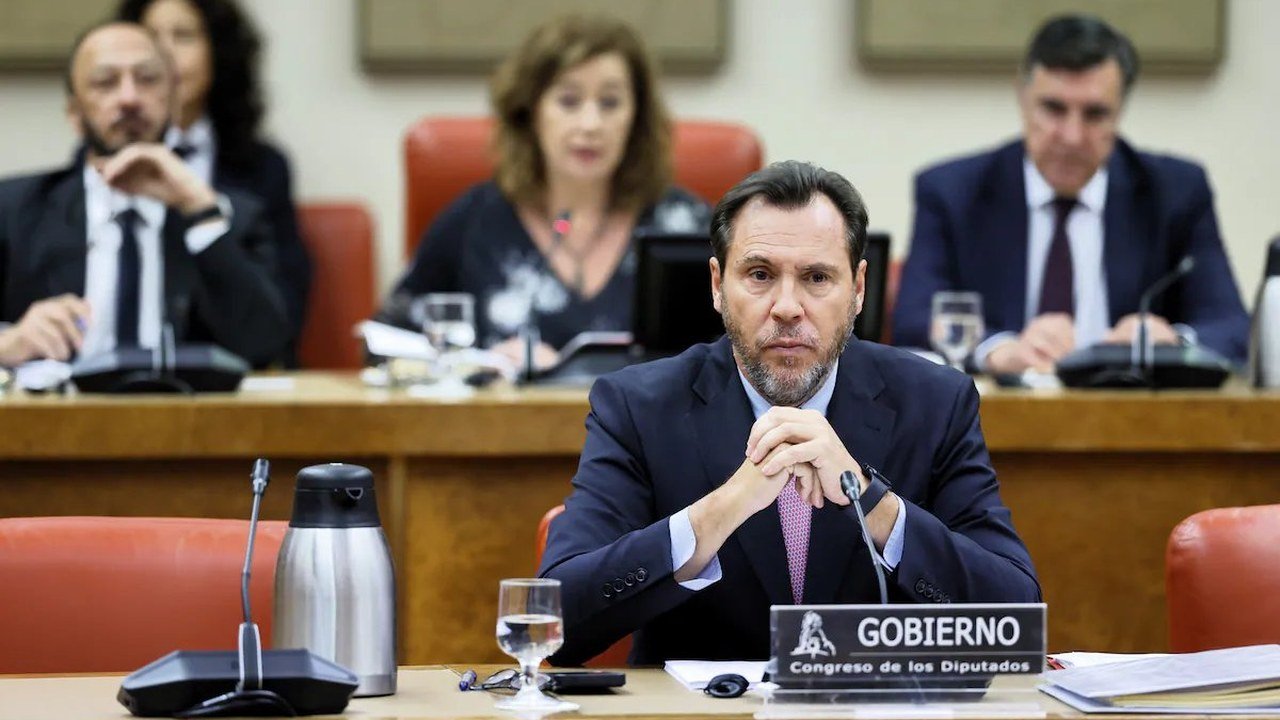
Spain’s Transport Minister Óscar Puente said on Tuesday, Nov. 3, that he would resign after two deadly train crashes in less than a year, without specifying when he will leave his post, Reuters reported in a story by Mireia Merino from Madrid. “A transport minister in a country like Spain cannot continue in office with two accidents of this severity in less than a year,” he told lawmakers, according to Reuters’ translation. The BBC, in a report by Guy Hedgecoe and Jaroslav Lukiv, translated the same line as “A transport minister in a country like Spain cannot remain in office after two accidents of this seriousness in less than a year,” and said Puente referred to a deadly crash in January in Andalusia as well as last week’s collision. The announcement came six days after the Oct. 28 high-speed collision near the town of Urda, south of Madrid, that killed 69 people, according to the BBC and Reuters.
Puente spoke at the Diputación Permanente, the standing committee that sits for Spain’s Congress of Deputies, where he had come to explain the circumstances of the crash, according to the BBC and Europa Press. The session ran for more than four hours, 20minutos reported, and Puente held the announcement until his final turn to speak, after 9 p.m. Madrid time (just after noon PT), according to Heraldo. Europa Press, a Spanish news agency, quoted his words in Spanish: “Un ministro de transportes de un país como España no puede continuar en su cargo con dos accidentes de esta gravedad en menos de un año. Por muy distintos que sean, y tenga o no responsabilidad directa en ellos, es una cuestión de dignidad política, de coherencia y de empatía con las víctimas.” In this desk’s translation, he said the decision rested on political dignity, consistency and empathy with the victims, however different the two accidents, and whether or not he bore direct responsibility for them.
Watch: Puente announces his resignation in Congress, posted on X
If an embed does not load, it shows as a plain link to the original post. Both clips carry Spanish audio.
View the @OndaCero_es post on X
View the @101tvandalucia post on X
Puente said he decided almost at once. He told the committee that he made the decision about his future in the first minutes after the tragedy, while on his way to the control center of Adif, Spain’s rail infrastructure manager, and that he told his family then, according to 20minutos. Reuters reported that he said he stayed on to deal with the consequences and to take measures to prevent such accidents in the future. El Español quoted him as adding: “La culpa no puede morir sola” — in this desk’s translation, the blame cannot die alone. He also stepped away from the Nov. 29 general election: “No solo renuncio a mi cargo como ministro de Transportes sino también a formar parte de las listas electorales el 29N. No seré cabeza de lista al Congreso de los Diputados por Valladolid,” he said, according to El Español, which noted that the official state gazette (BOE) had published the Socialist list for Valladolid, with Puente at its head, that same Tuesday.
The Prime Minister learned of the move late. Speaking to reporters in the corridors of Congress afterward, Puente said that “el presidente no sabía nada” until “unos minutos antes” of the announcement, according to El Español; Heraldo likewise reported that he informed Pedro Sánchez minutes before he spoke. In his farewell, Puente thanked Sánchez for his “confianza sin límite” (limitless trust), according to El Español and Heraldo, and said he knew the moment would feel sad for the Prime Minister, according to El Español and 20minutos. Sánchez had said earlier that authorities will “get to the bottom of every last detail of this tragedy,” according to the BBC.
Pressure had built for days. Puente had faced mounting calls to step down from opposition parties and some allies of the government, the BBC reported. At Tuesday’s session, both the opposition and the government’s usual parliamentary partners, with the exception of EH Bildu, asked him to resign, according to Europa Press. Heraldo reported that the conservative Popular Party (PP) and the far-right Vox had repeated that he should go, while the government’s partners softened their tone compared with earlier days. On Friday, Oct. 30, Puente had rejected calls to resign, saying his duty lay in solving the problem and explaining what happened, according to a Reuters report published in Portuguese by CNN Brasil. Gabriel Rufián, spokesman for the Catalan party ERC, said after the announcement that what matters now lies in knowing whether taking a high-speed train feels safe, according to Heraldo.
The crash itself remains under investigation. The Urda collision happened when a state-operated Renfe high-speed train smashed into the back of a stationary train operated by the company Iryo, according to the BBC. Three tapes of exchanges between Madrid’s control center and two train drivers “appear to show” that one train received clearance to move even though another had stalled on the track about 25 km (15 miles) ahead, the BBC reported; the Reuters report said the newspaper El País obtained the audio. According to the Reuters report carried by CNN Brasil, several trains had stopped automatically after a signaling-system failure and Madrid’s central control center took over; Puente said a controller authorized the Renfe train to proceed at normal speed, against a protocol that limits speed to 40 km/h in such conditions, and he said he had never used the term human error. An Adif union representative, Raquel Ayllon, told the state broadcaster TVE that critics had seized on human error too quickly while the safety-system failure deserved the focus, that report said.
The toll has settled at 69. Authorities said on Monday that they had identified all 69 victims and that 29 injured people remained in hospital, and Spain’s Integrated Data Center put the provisional toll at 69, 54 Spanish nationals and 15 foreigners, Xinhua reported. Reuters, in the Oct. 30 report, called it Spain’s deadliest rail accident since 2013 and said a January crash involving the same rail companies on the same line killed 46 people, according to CNN Brasil. El Español places that earlier crash at Adamuz, in Córdoba province, on Jan. 18. The same Reuters report said Puente expected the European rail traffic management system (ERTMS) to start operating on the Madrid–Seville line, the line where both crashes occurred, in early 2027.
The resignation lands weeks before a national vote. Sánchez called the Nov. 29 election, according to the Reuters report carried by CNN Brasil, and the crash added political pressure on him ahead of it, DW reported, citing AFP and Reuters. El Español wrote that the Socialists now need to rebuild their Valladolid list in a hurry. Neither Puente nor the government had named a successor or a departure date in the reports this desk read as of 12:58 p.m. PT. This story will update when the government names a new transport minister.