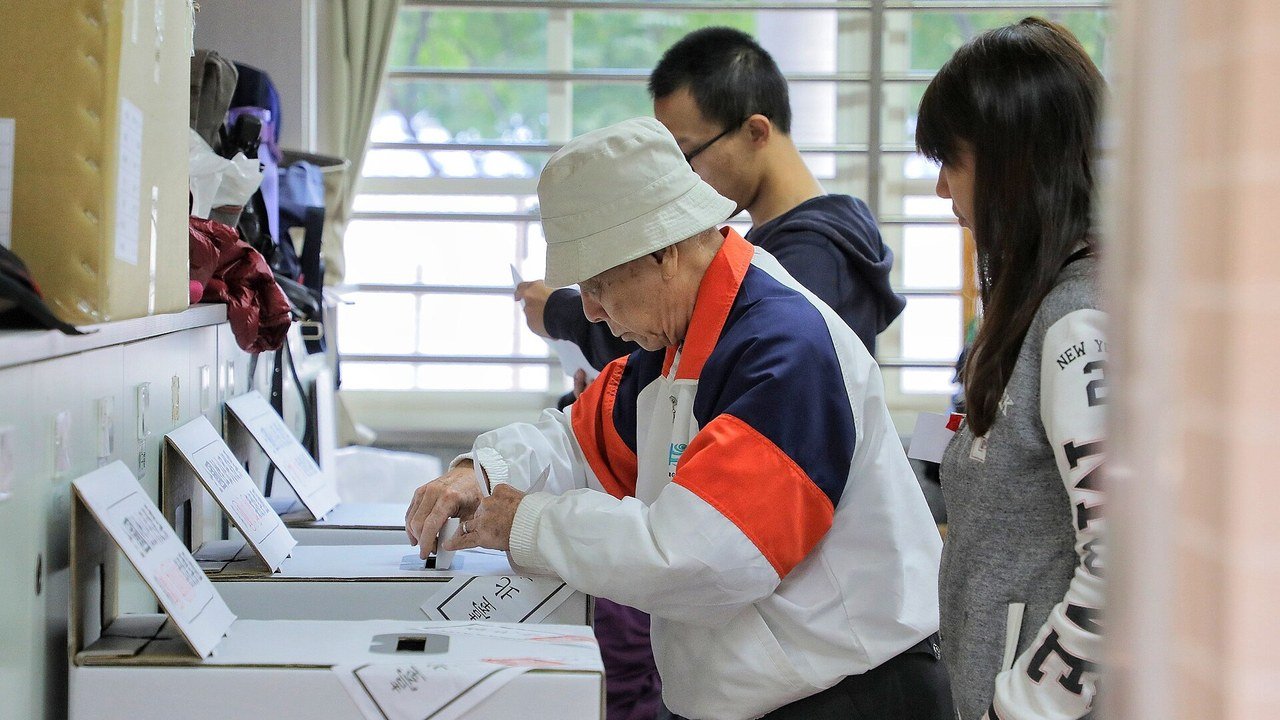

Taiwan’s governing Democratic Progressive Party doubled its count of cities and counties in Saturday’s local elections, while the opposition Kuomintang held the capital, Taipei, and neighboring New Taipei, according to unofficial results. Focus Taiwan’s end-of-night tally gives the DPP 10 of the 22 mayor and magistrate posts, the KMT 11 and an independent one, against 14 for the KMT, five for the DPP, one for the Taiwan People’s Party and two for independents in 2022 (Focus Taiwan). Radio Taiwan International’s results page shows the same 11–10–1 split and says the Central Election Commission announces the winners on Dec. 4 (RTI). Reuters, the Guardian and AFP, writing before the last races settled, put the DPP at “at least nine” or 10 and the KMT at 10 (Reuters; the Guardian; AFP via CNA).
The closest watched race went to the incumbent. KMT Mayor Chiang Wan-an took 781,312 votes, or 53.72%, to 664,586, or 45.69%, for the DPP’s Puma Shen, with all 1,790 Taipei polling stations counted, according to CEC figures relayed by RTI and the Taiwanese broadcaster TVBS; RTI puts Taipei turnout at 72.1% (RTI; TVBS). Shen conceded at about 7:51 p.m. Taiwan time, or 3:51 a.m. PT, Focus Taiwan reports (Focus Taiwan). “The result is already out - I lost,” he told supporters, according to AFP (AFP via CNA). In Reuters’ translation of the same speech, Shen said that “no matter who wins in the end, it will be a victory for Taipei and a victory for democracy” (Reuters).
Chiang thanked his rival. “Together, we have completed a celebration of democracy,” he said, in Reuters’ rendering; AFP translated the line as “Together, we have made this a celebration of democracy” (Reuters; AFP via CNA). The DPP has won the Taipei mayoralty only once, in 1994, Reuters notes (Reuters).
Shen ran under heavy pressure from Beijing. Reuters describes him as an academic-turned-lawmaker and expert on China’s information warfare whom Beijing has sanctioned and whom Chinese police want for what they call “separatism” (Reuters). On Friday, Chinese state media said the United States had backed him and “deeply interfered” in the vote, and Taiwan’s defense ministry said 33 Chinese warplanes and eight warships encircled the island, according to Reuters (Reuters). China’s Taiwan Affairs Office had not commented on the results when the Guardian published (the Guardian).
Elsewhere, the DPP’s biggest gain came in Taichung, where Ho Hsin-chun beat the KMT’s Johnny Chiang by 776,310 votes (50.68%) to 741,231 (48.39%), according to RTI’s CEC figures (RTI). Focus Taiwan counts DPP pickups from the KMT in Taichung, Hsinchu County, Yilan, Changhua, Chiayi City and Yunlin, and one KMT pickup, Penghu, from the DPP (Focus Taiwan). Taiwan’s English-language broadcaster TaiwanPlus, in an X post at 8:17 a.m. PT, put the DPP’s flips at five; this desk could not tell which race accounts for the gap (@taiwanplusnews). In New Taipei, the most populous of the six special municipalities according to Al Jazeera (Al Jazeera), the KMT’s Lee Shu-chuan, listed by RTI as Hammer Lee, won 1,120,555 votes (51.21%) to 1,055,630 (48.25%) for the DPP’s Su Chiao-hui, RTI reports (RTI). The KMT also kept Taoyuan, and the DPP held Kaohsiung and Tainan, where Chen Ting-fei becomes the city’s first female mayor, according to Focus Taiwan (Focus Taiwan).
Videos from X: Reuters on the results, two TaiwanPlus reports from Saturday, and Focus Taiwan on voters heading to the polls. Claims in each post belong to the poster. Seems News has not independently verified the posts and did not edit them.
View the @Reuters post on X
View the @taiwanplusnews post on X
View the @taiwanplusnews analysis post on X
View the @Focus_Taiwan post on X
Two counties stay unsettled. In Yunlin, the DPP’s Liu Chien-kuo finished with 178,357 votes (49.21%) to 178,184 (49.16%) for the KMT’s Chang Chia-chun, inside the 0.3% margin that allows a formal recount request, Focus Taiwan reports (Focus Taiwan). In Hualien, the KMT’s Yu Shu-chen led independent council speaker Chang Chun by fewer than 400 votes in Focus Taiwan’s last update on the race, and Chang said he would request a recount, according to the same live report (Focus Taiwan). Those two races appear to explain why tallies published during the evening differ by a seat.
Voters also approved National Referendum No. 22, which asked whether they support “the government using nuclear power to boost the economy and thereby abolishing the ‘nuclear-free homeland’ energy policy” (Taipei Times). CEC results showed 7,434,677 yes votes and 4,557,768 no votes, or 61.99% in favor, on a 62.79% turnout, clearing a threshold of 5,000,959 yes votes, one-quarter of the 20,003,835 eligible voters, the Taipei Times reports (Taipei Times). Focus Taiwan gave the threshold as 5,009,095; one-quarter of the Taipei Times’ electorate figure matches 5,000,959, and either figure leaves the yes total well clear (Focus Taiwan). The vote comes about 1.5 years after Taiwan shut its last reactor in May 2025, Focus Taiwan notes.
The government responded cautiously. Executive Yuan spokesperson Michelle Lee said the Cabinet respected the result and would keep accelerating renewable energy, and that its position on nuclear power remained unchanged, the Taipei Times reports (Taipei Times). The National Nuclear Abolition Action Platform, an anti-nuclear group, called the question’s wording a “push poll,” according to the same report. Supporters argued that nuclear power can supply stable electricity for the artificial intelligence and semiconductor industries, the paper says.
Analysts read the night as a modest DPP gain with limits. “China will be breathing a sigh of relief” at the KMT’s wins in Taipei and New Taipei, William Yang of the International Crisis Group told the Guardian (the Guardian). Chen Shihmin of National Taiwan University called the result a modest DPP victory and said, in AFP’s report, “This result will allow the DPP to be united in supporting (President) Lai Ching-te when he seeks another term in 2028.” Lev Nachman, also of National Taiwan University, said of Lu Shiow-yen, Taichung’s outgoing KMT mayor and a possible 2028 presidential candidate: “Losing her home base, she now needs the support of a lot of KMT heavyweights to back her presidential push” (AFP via CNA). Focus Taiwan suggests the split result may leave the parties no more willing to compromise on national disputes such as Constitutional Court appointments (Focus Taiwan).
President Lai Ching-te thanked “the people of Taiwan for their support and trust in the DPP’s nominated candidates” in a Facebook post that did not mention China, the Guardian reports (the Guardian). Campaigning for presidential and legislative elections due early in 2028 will now begin in earnest, according to Reuters (Reuters).
This desk read Focus Taiwan’s live results blog, RTI’s results page, TVBS’s Taipei results table, Reuters’ wrap (via StreetInsider), AFP’s report (via CNA), the Guardian, Al Jazeera, ABC News (Australia) and the Taipei Times referendum report. All race results remain unofficial until the CEC announcement. This desk did not open the CEC’s own results site, and the AP story did not load.