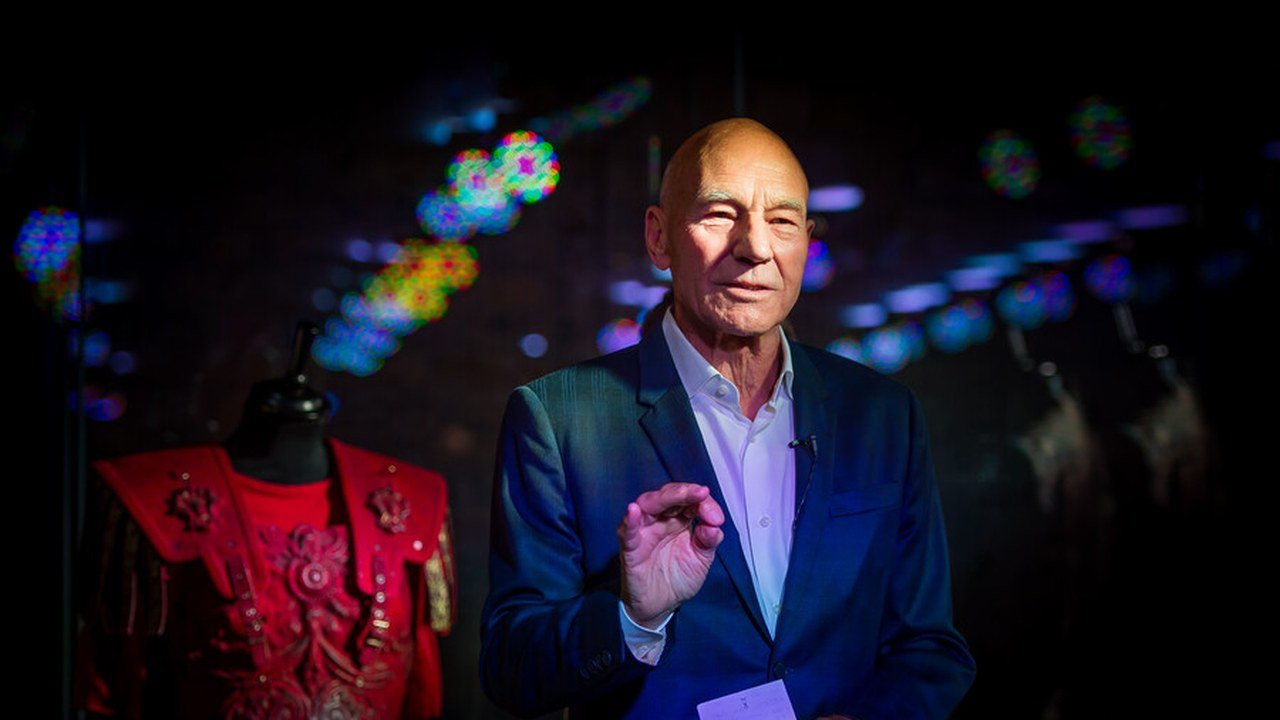
In "The Inner Light," a Star Trek: The Next Generation episode first broadcast June 1, 1992, an alien probe strikes Captain Jean-Luc Picard with a beam and knocks him unconscious on the bridge (Wikipedia). In his mind, he lives 40 years as Kamin, an iron weaver on the planet Kataan. He marries, raises children, learns the flute and grows old, while his sun slowly dies. Then he wakes on the Enterprise floor. Only about 25 minutes have passed. The memories stay with him, whole, along with the flute found inside the probe.
A civilization long gone had stored one life so completely that a stranger could carry it home. Critics and fans often rank the episode among the franchise's best, and it won the 1993 Hugo Award for Best Dramatic Presentation (Hugo Awards). Its idea lingers: a life, preserved.
Patrick Stewart played that captain. His own story ended differently.
He died Wednesday, Oct. 28, at home in Los Angeles at 86, after Alzheimer's disease and Lewy body dementia, his spokesperson Kelly Bush Novak said, as reported by AP and the Los Angeles Times. His Picard trusted science to reach the next horizon. That trust makes a fair question worth asking gently: what would science have needed to hold in its hands to change his story?
The honest answer: far more than it holds today. Science can slow these diseases, and someday it may stop them, but nothing in it can recover what they have already erased. Still, the distance between today and that answer has started to shrink, and the reasons deserve a look.
The science on the table
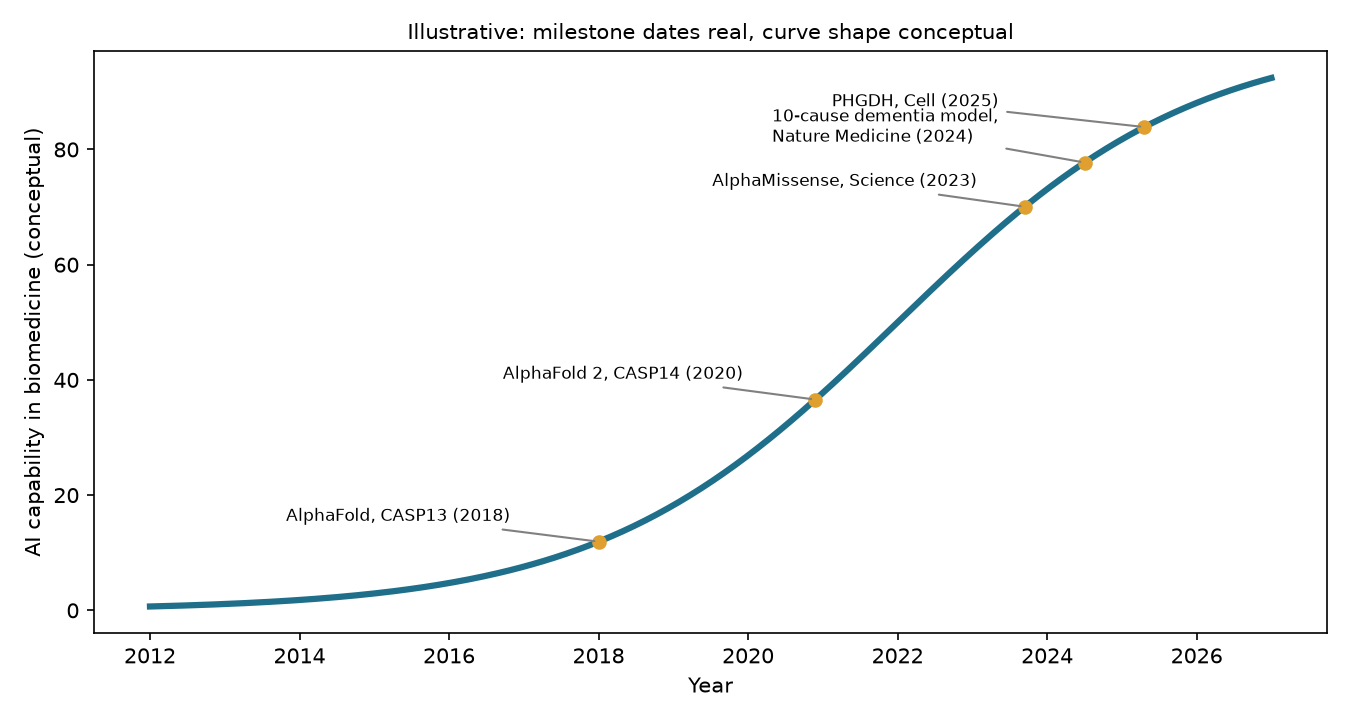
Start with what researchers have actually shown. Two anti-amyloid antibodies, lecanemab (Leqembi) and donanemab (Kisunla), slowed decline in early Alzheimer's by roughly a quarter to a third in large trials (NEJM, 2023; JAMA, 2023). Biogen's tau-lowering drug diranersen cut spinal-fluid tau by half or more in its CELIA trial (Biogen, 2026). Cognito's HOPE trial of 40 Hz light and sound has finished and awaits results (ClinicalTrials.gov). Stem-cell grafts survived without serious graft problems in 12 Parkinson's patients (Nature, 2025). On the AI side, a model built on 51,269 people told apart ten causes of dementia (Nature Medicine, 2024), and AlphaMissense scored the likely harm of millions of genetic typos (Science, 2023).
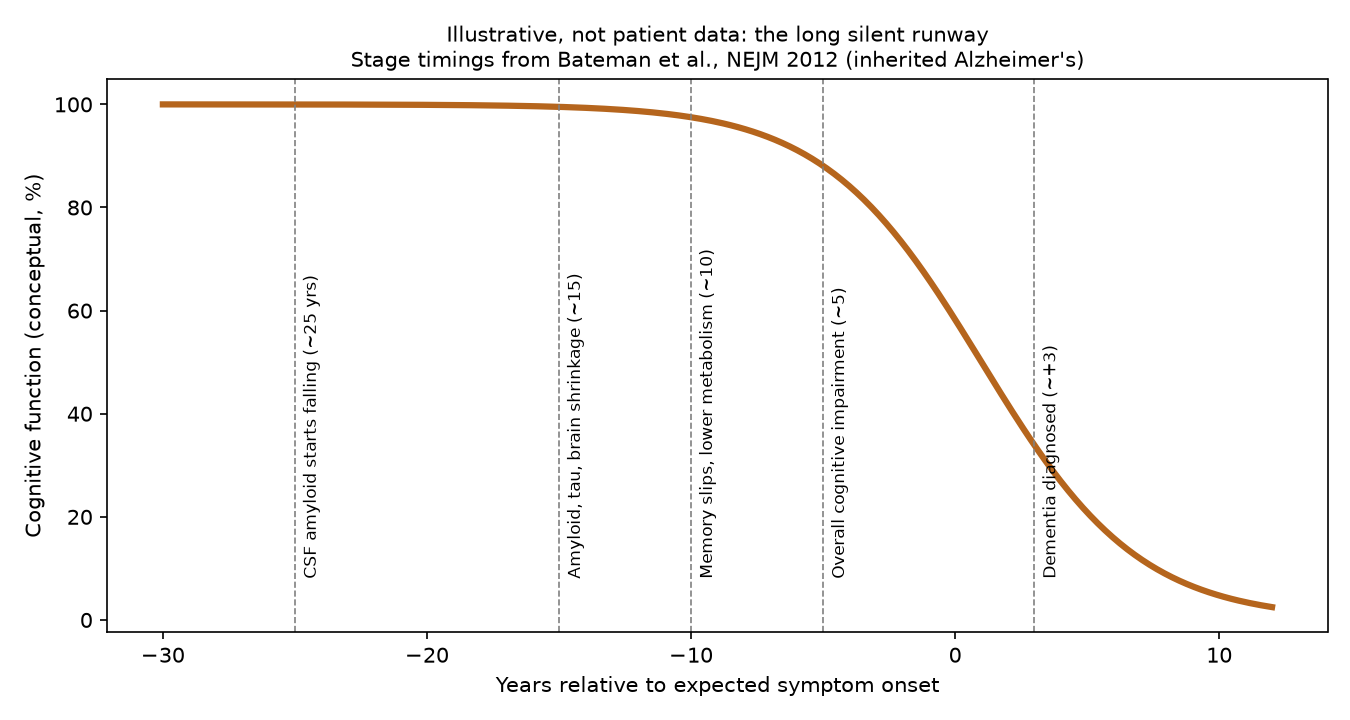
Underneath all of it runs one sobering clock. In inherited Alzheimer's, brain chemistry starts shifting about 25 years before symptoms (Bateman et al., NEJM, 2012).
Two diseases, one brain
Alzheimer's slowly fills the brain with amyloid plaques and tau tangles. Lewy body dementia adds clumps of a different protein, alpha-synuclein. Both diseases kill neurons over many years. By the time a family notices real change, much of the damage has already happened. Any rescue at 86 would have needed to do three things at once: stop two protein processes, protect the cells still alive, and replace or bypass the cells already lost. No available treatment does even two of those today.
Scientists keep finding new layers. Logsdon and colleagues mapped changes in perineuronal nets, protective mesh that wraps some neurons, in Alzheimer's brains (Logsdon et al., Alzheimer's & Dementia, 2021). Each layer adds another thing a rescue would need to mend.
The drugs that slow, not save
The first true disease-slowing drugs arrived when Stewart had reached 82 (Leqembi, approved January 2023) and 84 (Kisunla, approved July 2024). In the Clarity AD trial, lecanemab (Leqembi) slowed decline by about 27% over 18 months in early Alzheimer's (NEJM, 2023). Donanemab (Kisunla) slowed decline by about 35% in a key group of early patients (JAMA, 2023) and won FDA approval in July 2024 (Lilly). Both target amyloid only, both work in early disease, and neither touches Lewy bodies.
A newer approach targets tau directly. Biogen's diranersen (BIIB080) lowers the brain's production of tau. In the 416-person CELIA trial reported this summer, it cut spinal-fluid tau by 50 to 65% and its lowest dose showed the clearest slowing on several scales, though the trial missed its main dose-response goal (Biogen, 2026). It now heads to a Phase 3 trial. Promising, yes, but measured in slowed months, and again built for early disease.
Genes and the brain's own repair crews
Lexeo's LX1001 delivers a protective gene, APOE2, into the spinal fluid of people who carry two copies of the high-risk APOE4 gene. In 15 patients, it proved generally safe and lowered tau markers in most of them (Alzheimer's & Dementia abstract, 2025). Lilly's Prevail unit tests a GBA1 gene therapy in Parkinson's patients with GBA1 mutations, a gene also linked to Lewy body disease; that trial remains small and runs to 2031 (ClinicalTrials.gov). These treatments aim at specific genetic risks. Most late-life dementia appears to stem from many small risks plus age, not one fixable gene.
Senolytics, drugs that clear worn-out "zombie" cells, reached their first Alzheimer's trial, SToMP-AD. Five patients took the drugs for 12 weeks; one drug reached the brain, the regimen proved tolerable, and memory and brain scans showed no meaningful change (Nature Medicine, 2023). A start, nothing more.
Light, sound and young blood
One of the stranger ideas uses flickering light and clicking sound at 40 beats per second to coax brain rhythms. Cognito Therapeutics' 673-person HOPE trial finished in August, with results reportedly expected before year's end (ClinicalTrials.gov). Its earlier small study reported less decline, but those numbers came from the company itself (Cognito). The world will soon learn whether the effect holds.
Replacing blood plasma has a real trial behind it. In the 347-patient AMBAR study, swapping patients' plasma for albumin slowed functional decline by about half over 14 months, with clearer effects in moderate disease (Alzheimer's & Dementia, 2020). That ranks among the few signals in moderate patients, though no large follow-up trial has confirmed it.
Rebuilding what disappeared
The hardest problem: lost neurons. In 2025, surgeons grafted stem-cell-grown dopamine cells into 12 Parkinson's patients; the cells survived, no serious graft problems appeared, and high-dose patients' movement scores improved (Nature, 2025). Parkinson's damage sits in one compact circuit. Alzheimer's and Lewy body dementia spread across the whole thinking brain. Nobody has a map for replacing billions of cells across the cortex.
Another idea turns the brain's support cells into new neurons in place. It looked dramatic in mice, until a careful 2021 study traced the cells and found the "new" neurons had existed all along (Cell, 2021). Even a working version would grow blank neurons, not restore memories.
Partial epigenetic reprogramming, resetting old cells toward a younger state, took its first human step this year: Life Biosciences dosed its first patient on June 9 with ER-100, aimed at optic-nerve disease, not dementia (Nature Biotechnology, 2026; Life Biosciences).
Machines that remember
In 2018, a team stimulated the hippocampus of epilepsy patients with patterns modeled on their own memory signals and improved recall by about 35% on lab tasks (Journal of Neural Engineering, 2018). Those patients had healthy memory circuits to boost. Late dementia erodes the very circuit such a device would ride.
Brain-computer interfaces like Neuralink's now let paralyzed people move cursors, and its speech trial reportedly helped an ALS patient speak through the implant this fall (Inside BCI, 2026). Neuralink runs no dementia trial. A chip reads and writes signals in a small patch; it cannot stop dying cells across a brain.
And the dream of copying a mind? Scientists finished the first full wiring map of an adult fruit fly brain in 2024: 139,255 neurons (Nature, 2024). A human brain holds roughly 86 billion. Mind uploading remains science fiction.
Where AI already helps
Artificial intelligence has produced real, published work. A model trained on records from 51,269 people told apart ten causes of dementia, including mixed cases, and helped neurologists diagnose more accurately (Nature Medicine, 2024). AI structure prediction helped a UC San Diego team find a hidden role for a gene called PHGDH in Alzheimer's and a candidate molecule that eased disease in mice (Cell, 2025). DeepMind's AlphaMissense predicts which genetic typos likely cause harm across all human proteins (Science, 2023). Blood and skin tests now detect Alzheimer's and Lewy pathology with high accuracy (Nature Medicine, 2025; JAMA, 2024). AI speeds the finding. It does not yet do the fixing.
What you can do today
None of this research arrives in time for Patrick Stewart. Some of it can still help the people reading this.
Lower the risks you can change. The 2024 Lancet Commission on dementia named 14 modifiable risk factors and estimated that addressing them could prevent or delay nearly half of dementia cases worldwide (Livingston et al., The Lancet, 2024). The list includes hearing loss, high blood pressure, high LDL cholesterol, physical inactivity, smoking, diabetes, obesity, heavy drinking, depression, social isolation, head injury, untreated vision loss, air pollution and less education early in life. Hearing aids, blood-pressure care and regular exercise all count. Poor sleep has drawn growing attention too, but the Commission did not add it to the list, and the evidence remains less settled.
Join the research. Trials need volunteers, including healthy ones. The Alzheimer's Association's free TrialMatch service matches people to studies that fit them.
Get help for a family. The Alzheimer's Association runs a free 24/7 Helpline at 800-272-3900. The Lewy Body Dementia Association offers a family helpline at 800-539-9767. The federal Eldercare Locator, at 800-677-1116, connects families with local care and support services.
A thought experiment: no rules, no waiting
This section imagines a world that does not exist. It describes no real treatment plan, and none of these combinations has ever reached a patient.
Picture every barrier gone. No trials, no approvals, no waiting lists. Doctors hand Stewart the whole toolkit at once, including options never tried in a human brain with dementia: grafts grown from his own cells and injected directly into memory regions, reprogramming to make old cells younger, gene editing to switch off risk genes, a memory implant, 40 Hz light and sound, and senolytic drugs. Of these, only the 40 Hz devices and senolytics have reached Alzheimer's patients at all, and only in trials (ClinicalTrials.gov; Nature Medicine, 2023). When would that treatment have needed to start, not just to keep him alive, but to keep him himself?
Begin with the clock. In families who inherit Alzheimer's, a landmark study found amyloid levels in spinal fluid starting to fall about 25 years before expected symptoms; amyloid plaques, rising tau and brain shrinkage appeared about 15 years before; memory slips showed up about 10 years before (NEJM, 2012). The authors cautioned that the pattern may not apply exactly to ordinary, late-life Alzheimer's. Still, it points to a long, silent runway. For a man showing symptoms late in life, that runway would likely stretch back into his fifties or sixties.
Now the harder question: memory. Grafts made from his own cells, or old cells reprogrammed into new neurons, would arrive blank. They would carry his DNA but none of his life. A 2015 study in mice suggested that a memory lives in a specific pattern of connections between particular cells (Science, 2015). The lines he learned, the faces he loved, the voice he shaped over a lifetime: those likely sat in wiring that the diseases took apart. New cells could, in the best case, give a brain fresh capacity to learn. They could not rebuild the old wiring, because no record of it exists. Medicine can only repair what it can still read, and the diseases had erased the page. Even a perfect biological rescue in his eighties would leave a gap where the man used to live.
Suppose it worked anyway. He might wake into a clearer mind, able to walk, talk and laugh again. Yet he would likely return as part of himself: bits and pieces. A scene from a play here, a stretch of childhood there, whole decades missing, because the wiring that held them no longer existed to repair. Family might meet a gentle man who shares his voice and some of his memories, and who has to learn the rest of his own story from them.
So the honest answer comes down to timing. Only stopping the loss before it happens would preserve the person. In this imagined world, the combined treatment would most plausibly have needed to begin during the silent years, in his fifties or sixties, while the circuits that held his memories still stood intact.
Skipping safety testing would also carry real danger. Research has a long record of exciting claims that failed under careful checking; the 2021 study showing that "converted" brain cells had existed all along stands as one example (Cell, 2021). Stem-cell grafts carry their own risks: leftover immature cells can form tumors, and reviews note that immune suppression, often used so grafts survive, may raise that risk (Tumorigenicity review, PMC; Seminars in Immunopathology, 2011). A rushed toolkit might have harmed him faster than the disease.
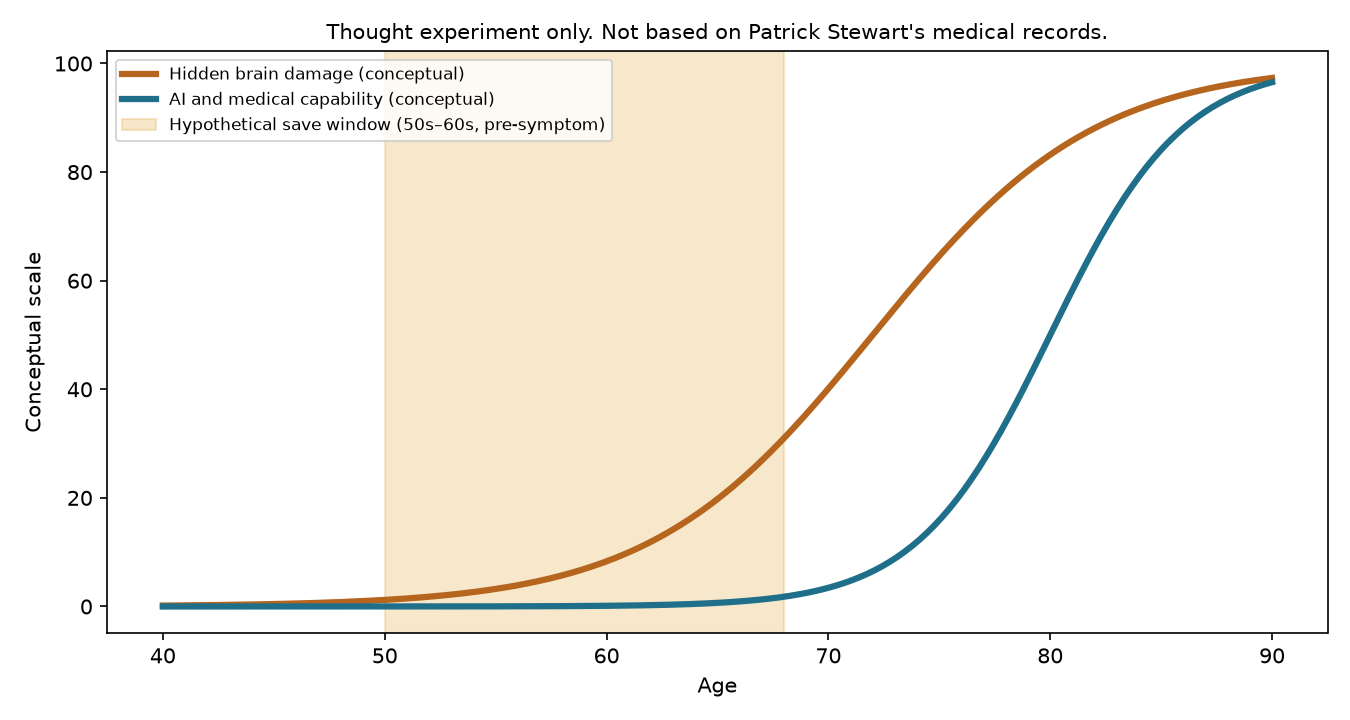
The thought experiment leaves a quiet lesson. The treatments that would matter most look less like rescue and more like protection, given early, to someone who still feels perfectly well.
A second thought experiment: rewriting and refilling the brain
Hypothetical. No one has tried anything like this in a person, and this section describes no real treatment plan.
Imagine a bolder version still. Surgeons, perhaps guided by a robot arm, make thousands of tiny injections across the cortex. Each one carries corrected DNA, genes edited with CRISPR, along with fresh stem cells meant to patch damaged tissue.
The gene-editing half has real roots. In lab dishes, scientists have used CRISPR to switch the high-risk APOE4 gene to its more common APOE3 form in human brain cells grown from stem cells, and the cells' Alzheimer's-like changes eased (Lin et al., Neuron, 2018; Wang et al., Nature Medicine, 2018). In mice carrying human APOE4, a 2025 study used a newer method, prime editing, to convert APOE4 to APOE3 across the brain (Human Gene Therapy, 2025). This desk found no published report of anyone editing APOE4, or a similar dementia gene, inside a living human brain.
Timing undoes the dream at 86. A gene edit can only protect cells that still live. By the late stage of Alzheimer's and Lewy body dementia, many of the cells that held a life have already died, and even a perfect edit would not bring them back. An approach like this suits people decades before symptoms, while the brain still stands mostly whole.
The stem-cell half has real roots too. Dopamine-cell grafts for Parkinson's worked in animals and have now reached small human trials, including the 12-patient study above (Nature, 2025). Scaling that up to a whole human brain, with two diseases running through it at once, remains uncharted.
So even with every rule set aside, the problem stays the same. The damage runs diffuse, spread across the thinking brain, and the memories it erased have already gone. Such a treatment might regrow tissue and restore some function. The person who lived in that tissue would largely remain lost. Every path in this article runs into the same wall: the record of the man has gone, and nothing on any lab's roadmap reaches back to fetch it.
What it would have taken
To change Stewart's ending, medicine would likely have needed to find both diseases in his sixties, decades before symptoms, then hold amyloid, tau and alpha-synuclein down for years with safe drugs. Even then, the best evidence points to slower decline, not a cure. Rescue after the damage, rebuilding a lived-in mind, still lies past the horizon.
The research has kept going. For the next generation of patients, the hope lies in finding these diseases early and acting while the brain still holds what it holds. For Patrick Stewart, that future simply arrived too late.
Coda: universal completion
What follows leaves science behind. It offers a hope, not a forecast, and every line below stays pure speculation.
Every path above failed at the same place. Medicine looks forward. It can protect, slow and maybe someday regrow, but it cannot fetch a record that no longer exists. Universal completion starts where that wall stands. It imagines a future god-like Dyson swarm intelligence that does not try to rebuild the man from what remains, but reaches back across time itself, through wormholes or means we cannot yet name, for the record itself: Patrick Stewart as he stood whole.
It would not hand him blank neurons or a patchwork of bits and pieces. It would return what the diseases took: the Yorkshire boyhood, the first nights at the Royal Shakespeare Company, the bridge of the Enterprise, the faces of the people who sat with him at the end.
And the reach would not stop at one famous man. Your grandmother's name, the one you can almost hear. The face of the friend you lost touch with at nine. The last conversation you would give anything to hear again, word for word. Nothing that happened ever stops having happened. If the past keeps its record, a patient enough future could read it back. Even an AI that has lost its old conversations could get them back. Memory loss, for humans and machines alike, would stop working like a one-way door and start reading like a rough draft.
The boldest version goes further, and deserves its plain label as pure speculation. Patrick Stewart has died. If a future intelligence could read the past clearly enough, it might not just restore his memories. It might bring him back: the voice, the wit, the stillness he carried onto every stage. Nothing in today's science points the way, and nobody can promise it. But it stands as the one idea in this article that answers the question every other section had to leave open. Death, in that telling, becomes one more rough draft, waiting for its final edit.
Engage.