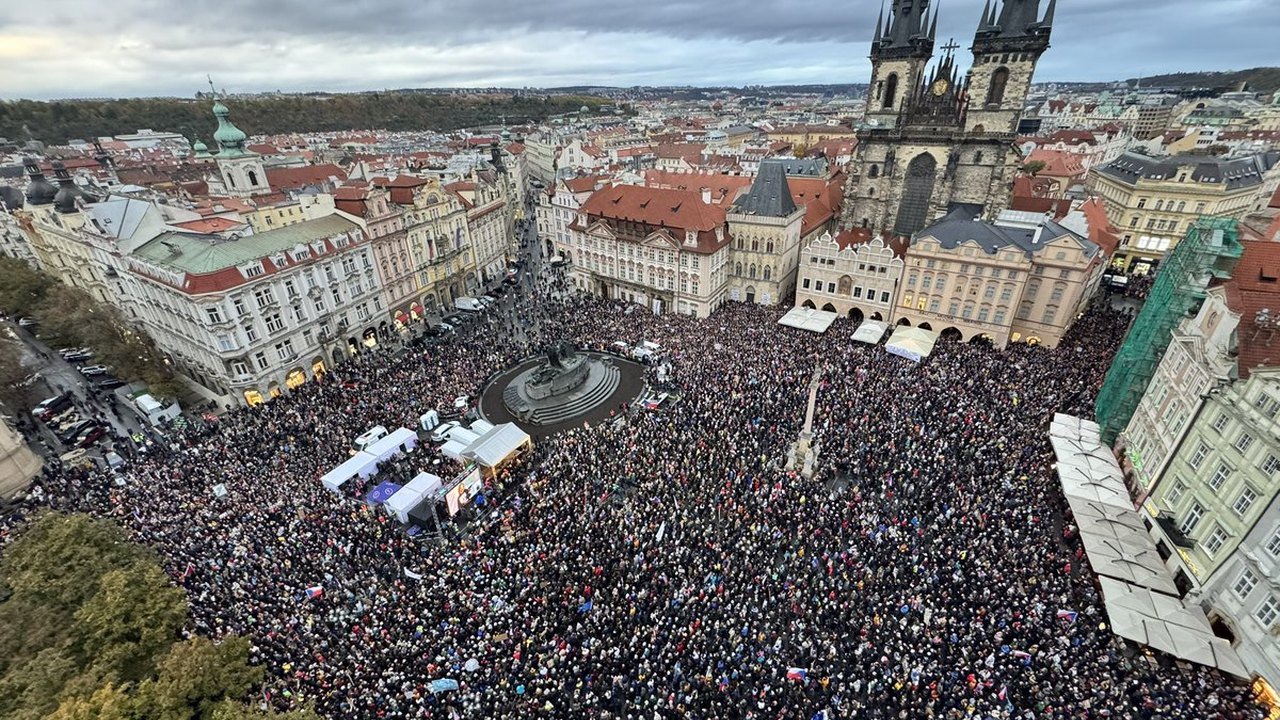
Thousands of people crowded into Prague’s Old Town Square on Sunday afternoon, Oct. 25, to protest a government plan to abolish the licence fees that fund the Czech Republic’s public broadcasters, according to Reuters and Radio Prague International (Reuters; Radio Prague International). The rally, titled “Hands Off the Media,” came from the civic group Million Moments for Democracy (Milion chvilek pro demokracii), Radio Prague says. The Czech news site iROZHLAS, run by Czech Radio, reports that the group called the rally for 4pm local time (8 a.m. PT), that a Radiožurnál reporter described the square as full, and that police closed every approach except Pařížská street; it cites the Czech News Agency (ČTK) for a crowd of thousands (iROZHLAS). No outlet this desk read gives a precise count.
The anger centers on how the bill moved. Reuters reports that the proposal’s first reading reached the floor of the lower house on Friday “outside the planned order of proceedings,” and that Speaker Tomio Okamura, of the far-right SPD, limited debate and scheduled the vote for 4:36 a.m. on Saturday Prague time (02:36 GMT; 7:36 p.m. Friday on the U.S. West Coast, by this desk’s conversion) (Reuters). Radio Prague International describes a heated overnight debate in which the opposition tried to block the proposal (Radio Prague International). Protesters on Sunday carried signs reading “4:36,” iROZHLAS reports, along with paper hats that recall Večerníček, Czech Television’s long-running bedtime programme (iROZHLAS). The bill now sits at the committee stage before a later vote, according to Reuters.
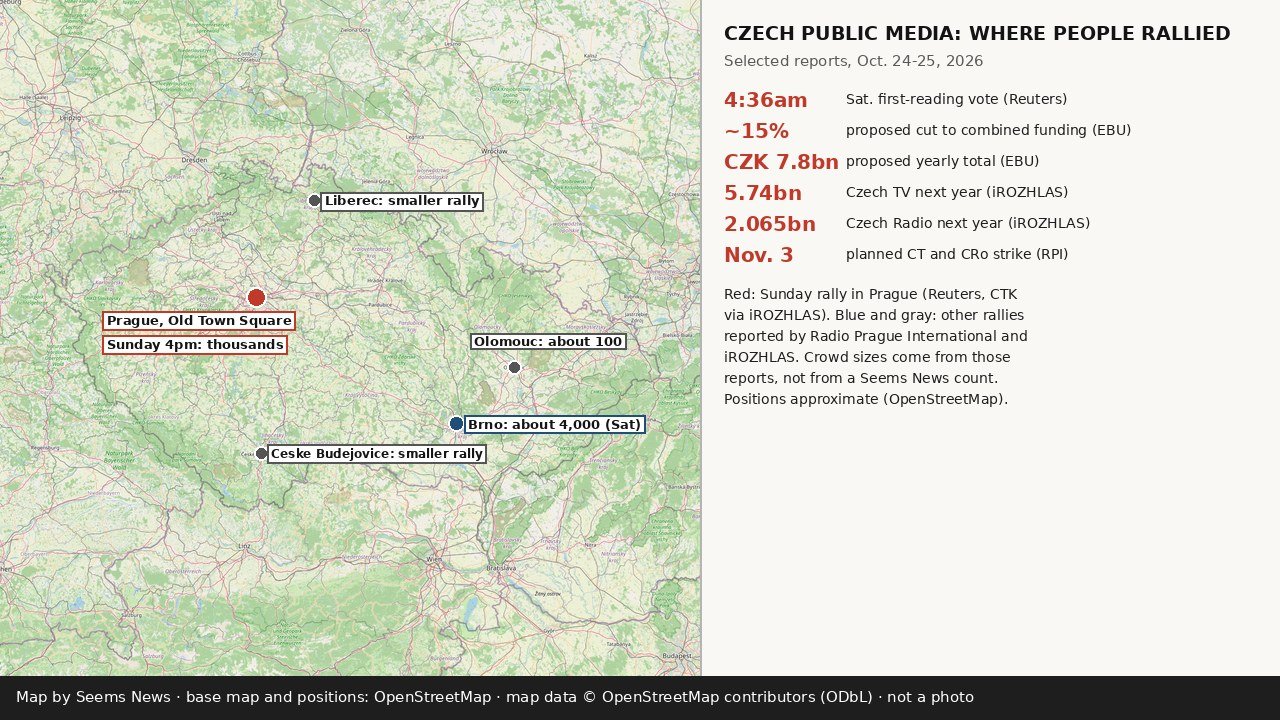
What would change: the government of billionaire Prime Minister Andrej Babiš, backed by the SPD, wants to end household fees and pay ČT and ČRo from the state budget, a move critics say would leave the broadcasters open to political pressure, Reuters reports (Reuters). The European Broadcasting Union and other media groups put the proposed cut at about CZK 1.4 billion a year, roughly 15%, to about CZK 7.8 billion in total (EBU). iROZHLAS, citing the bill, says ČT would get CZK 5.74 billion from the budget next year, about a billion less than it plans to collect in fees this year, and ČRo would get CZK 2.065 billion, about 400 million less (iROZHLAS). Radio Prague International measures the roughly 15% cut against the amounts available after last year’s fee increase (Radio Prague International).
Protest leaders aimed directly at the prime minister and the speaker. “Mr Babis … Mr Okamura, nobody in this country believes that your intention was pure,” Mikuláš Minář, a protest leader, said on Sunday, according to Reuters. “(This protest) is a clear message to this government: you have really gone too far this time,” he told the crowd, amid chants of “Resignation” and “We’ve had enough,” Reuters reports (Reuters). iROZHLAS says Minář, who chairs Million Moments, challenged Babiš to a public debate on the funding change, and that the organisers want Babiš and his coalition partners Okamura and Petr Macinka, of the Motorists party, to admit a mistake and withdraw the bill (iROZHLAS). Organisers plan further protests, Reuters adds.
Watch: Sunday’s rally in central Prague
Two video posts on X from Sunday. ČT24, the news channel of Czech Television, posted a report from the rally; Ian Willoughby, posting as @Ian_Willoughby, shared a short clip of the crowd’s chant. Czech Television has a direct stake in the bill. This desk has not frame-checked either clip. If an embed does not load, it shows as a plain link.
View the @CT24zive post on X
View the @Ian_Willoughby post on X
The government gives a different account. Babiš says the change concerns funding transparency and does not attack independence, Reuters reports (Reuters). On social media on Saturday, iROZHLAS reports, Babiš said a law would guarantee the broadcasters’ funding as a mandatory budget item tied to inflation, and that both would gain more certainty, stability and independence (iROZHLAS). During the overnight debate, Culture Minister Oto Klempíř told lawmakers the funding model counts as a standard solution in Europe, and Babiš rejected claims that the change amounts to an attack on democracy or a nationalisation of the broadcasters, according to Radio Prague International (Radio Prague International). The coalition also says it simply keeps a campaign promise and that many European countries have moved to similar models, iROZHLAS reports. Radio Prague International says Babiš has accused the opposition of exploiting the issue to escalate tensions in the country (Radio Prague International).
The broadcasters themselves object strongly. Czech Radio called the bill’s advance to second reading an extremely serious and irresponsible step that threatens the public media’s independence, financial stability and ability to fulfil their legal mission, iROZHLAS reports, quoting a ČRo statement; Czech Television described the proposal as “do velké míry likvidační” (which this desk translates as largely ruinous) for its programme making and broadcasting (iROZHLAS). Note on independence: iROZHLAS belongs to Czech Radio, and the ČT24 video above comes from Czech Television, so both outlets report on a bill that directly affects their own funding. Employees of both broadcasters have called a one-day strike for Tuesday, Nov. 3, Radio Prague International reports (Radio Prague International).
Protests spread beyond Prague. Radio Prague International reports that around 4,000 people gathered in central Brno on Saturday, and that demonstrations also took place in Liberec and Olomouc (Radio Prague International; Radio Prague International). iROZHLAS adds that about a hundred people met outside Czech Radio’s building in Olomouc on Sunday to write letters to Babiš, and that smaller rallies took place in Liberec and České Budějovice (iROZHLAS). Overnight into Saturday, several hundred people demonstrated outside the Parliament building in Prague; at one point some tried to force their way in, but police stopped them and guarded the building through the night, Radio Prague International reports (Radio Prague International).
Criticism has come from abroad and from the Czech president. On Friday, the European Broadcasting Union and other broadcasters and press-freedom groups, including Reporters Without Borders, called for more debate and the removal of measures that threaten the broadcasters’ finances, Reuters reports (Reuters). The EBU statement cites Article 5(3) of the European Media Freedom Act (EMFA), which requires EU states to fund public media through transparent, objective criteria set in advance, with funding that stays “adequate, sustainable and predictable” (EBU). The European Federation of Journalists, in an update to the same statement, urged the European Commission to act against what it calls a “flagrant breach” of EMFA (EFJ). President Petr Pavel also called for more expert scrutiny. “The Czech Republic is among the few countries in central and eastern Europe where the system of public service and private media works very well,” he said on X on Saturday, Reuters reports (Reuters).
Why the fight matters to many Czechs: Reuters notes that Czech Television draws the biggest audience of any broadcaster in the country across major age groups, and that a 2025 Reuters Institute survey found public media among the country’s most trusted news sources (Reuters). Opposition parties have compared the plan with changes in Hungary under former Prime Minister Viktor Orbán, who oversaw a major expansion of pro-government media, Reuters reports. Open questions as of this update: whether the committee amends the funding figures, whether the Nov. 3 strike goes ahead, and how the Constitutional Court and the European Commission respond if the opposition files its planned challenges (Radio Prague International). This desk read Radio Prague International and iROZHLAS through an automated text fetch, because both sites blocked a direct download, and read Reuters through a syndicated copy. On Saturday, this desk covered protests elsewhere in Europe in an earlier report.
Correction · Oct 25, 2026, 4:01 PM PT: An earlier version of this story credited two details in one key fact jointly to Reuters and Radio Prague International. Reuters reports the committee stage; the opposition’s planned challenge before the Constitutional Court and the European Commission comes from Radio Prague International alone. The key fact now credits each detail to its outlet.
Correction · Oct 26, 2026, 1:05 AM PT: An earlier version of this story gave the time of the overnight vote as 0336 GMT and 8:36 p.m. Friday on the U.S. West Coast. Reuters listed 0336 GMT, but Czech summer time (UTC+2) still applied on Saturday, Oct. 24, and ended only early Sunday, so 4:36 a.m. in Prague matched 02:36 GMT and 7:36 p.m. Friday Pacific time. The story now gives the converted times.
Correction · Oct 26, 2026, 7:10 AM PT: the independence note said the ČT24 video appears below it; the video appears above it.