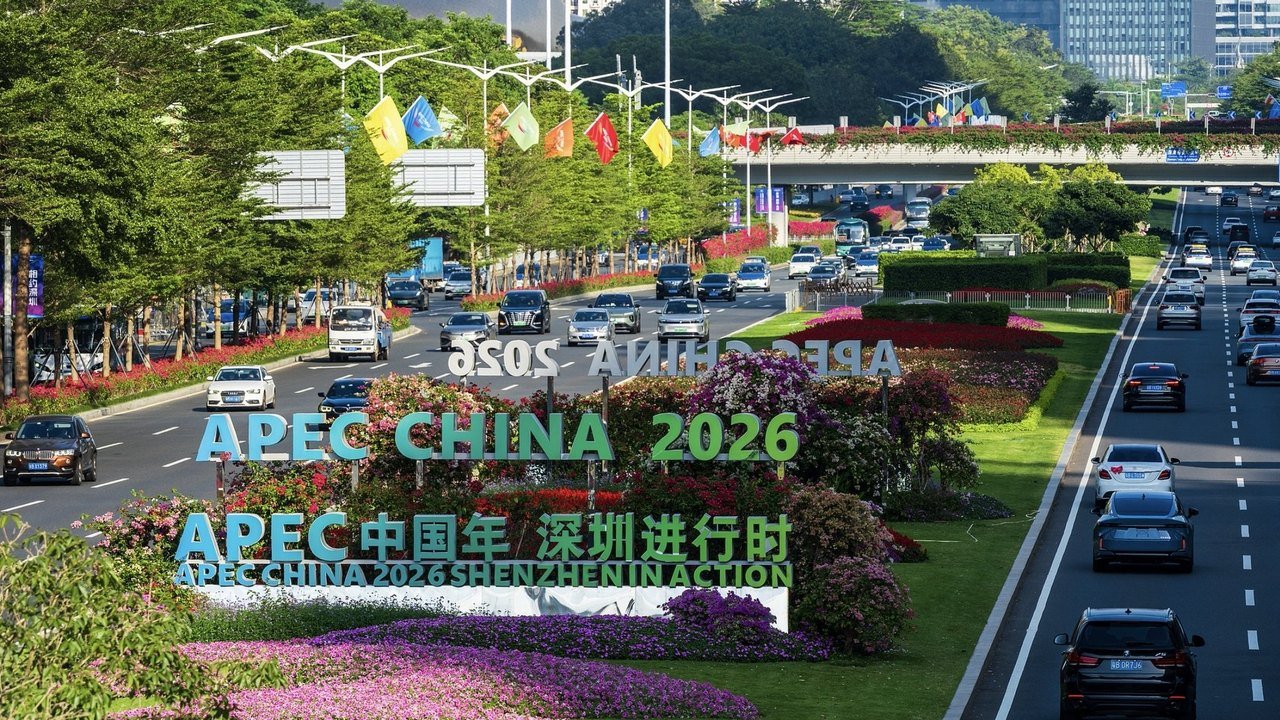
The leaders of the United States, China and Russia plan to sit down together in Shenzhen next week, the White House announced on Friday, Nov. 13. “President Trump will conclude his visit to China with a trilateral meeting between the president of the United States, the president of the People's Republic of China, and the president of the Russian Federation,” spokeswoman Olivia Wales told reporters, as quoted by the BBC. Reuters reports she said the meeting would take place on Thursday, which falls on Nov. 19, on the sidelines of the Asia-Pacific Economic Cooperation (APEC) summit. AFP, as published by CNA calls it the first-ever three-way meeting between the leaders of the three countries.
The White House singled out nuclear weapons. “The president has made it clear that, among other topics, he will discuss the reduction of nuclear weapons in the world, whose proliferation President Trump believes is very dangerous,” Wales said, in the wording carried by the BBC and NBC News. The AFP version on CNA renders the second half slightly differently: “This proliferation, President Trump believes, is very dangerous.” The NBC report says Wales spoke on a call with reporters on Friday night.
U.S. officials set expectations low. “We do not expect to get to any kind of agreement,” a senior Trump administration official said about the nuclear issue, according to Reuters reporters Trevor Hunnicutt and Jasper Ward. “This is a difficult topic for China to address, but we do think it's time for China to sort of step up, you know, to the adults' table, if you will, and have adult conversations about adult things.” The official added, per Reuters: “This is the beginning of hopefully a conversation that can be productive going forward.” NBC News reports the official described the session as an “entry point” and “the first conversation.”
China has long kept its arsenal out of such talks. Reuters reports that Trump’s repeated insistence on a nuclear focus has riled China, which hosts a summit focused on trade and commerce, and that Beijing has for years argued that Russia and the U.S. should talk directly because they hold the largest stockpiles. NBC News cites Pentagon estimates that put China’s arsenal at more than 600 warheads, against more than 5,000 each for the U.S. and Russia. The last U.S.–Russia arms pact, New START, expired in February, according to NBC and the BBC; NBC adds that Trump rejected a Russian call to extend it and asked instead for a deal that includes China. Reuters says it remained unclear whether Russia or China intended to discuss arms reductions with Trump at all.
The agenda splits two wars. “I think the president does intend to talk about Iran in the trilateral meeting with Xi Jinping and Vladimir Putin,” a senior U.S. official told reporters on a call, according to AFP via CNA. Ukraine stays off the table, officials said. “China is not really a part of that track, so it doesn't seem appropriate to have the Ukraine discussion there,” the official said, per AFP; Reuters carries a longer version of the same remark. The official said Washington runs a separate negotiating track with Kyiv and Moscow. Trump has no separate one-on-one meeting with Putin scheduled, AFP and Reuters report, though NBC News says the two leaders will appear together at events as well as at the three-way meeting.
Clips below come from Press Trust of India, India Today and ET Now, posted after the White House announcement.
View the @PTI_News post on X
View the @IndiaToday post on X
View the @ETNOWlive post on X
The trip runs four days. Trump leaves Washington on Monday and attends a summit of the Association of Southeast Asian Nations in the Philippines on Tuesday before flying to Shenzhen late on Wednesday, according to the BBC and AFP via CNA. He also plans a bilateral working lunch and meeting with Xi on Thursday, AFP reports; the BBC and AFP count it as their fourth meeting since Trump returned to office, while NBC News tallies eight face-to-face talks between the two men overall. Wales said the trip would “secure historic wins to the American people and advance America's interests in the Indo Pacific,” per the BBC.
Some topics stay out, officials said. Elon Musk will travel with Trump to China but will not attend the meeting with Xi and Putin, according to Reuters and AFP via CNA; NBC News reports that Musk joins as the only business leader in the official delegation. Two senior officials told NBC they do not expect Trump to raise with China the espionage investigation focused on Alice Huang, which NBC ties to former Nvidia chief executive Jensen Huang. “The situation with Nvidia should not really have any bearing on the trip,” one said, per NBC, adding: “In all of our discussions and negotiations with the Chinese, we do not negotiate American export controls.” Reuters reports Trump also does not plan to meet North Korean leader Kim Jong Un on the trip.
Beijing and Moscow stayed quieter. “Moscow and Beijing are yet to comment,” the BBC reported on the White House announcement, noting that Chinese state media on Friday reported only that Xi would take part in “bilateral” talks at APEC, citing a foreign ministry spokesman. Reuters reports that the Chinese and Russian embassies in Washington did not immediately respond to requests for comment. Earlier this month, Kremlin spokesman Dmitry Peskov cited “signals confirming readiness” for such talks, according to the BBC, citing Russia’s Tass news agency. NBC News quotes Peskov dismissing comparisons with the 1945 Yalta conference: “It’s clear that a meeting between the leaders of countries such as Russia, China and the United States is extremely significant.” Reuters notes the New York Post first reported the Thursday date.
Kyiv has voiced worry about a deal made over its head. Ukrainian President Volodymyr Zelenskyy said in late October, according to Politico Europe: “I really don’t want this to be a ‘Yalta – 2, 3, 4,’ when there is a redistribution of influence.” AFP via CNA reports he warned the Shenzhen meeting could become a Yalta-like “redistribution of spheres of influence.” Edgard Kagan, a former U.S. ambassador to Malaysia now at the Center for Strategic and International Studies, told NBC News that for Putin the meeting signals “a desire to talk to the president and talk to Chairman Xi in a way that suggests that they’re making decisions on Ukraine, which obviously the Ukrainians and the Europeans don’t like.”
What to watch: whether Beijing and Moscow confirm the format, and whether any joint statement on nuclear arms emerges on Nov. 19. AP and the South China Morning Post also covered the announcement; the desk could not open either page (both returned HTTP 403) and did not rely on their text.