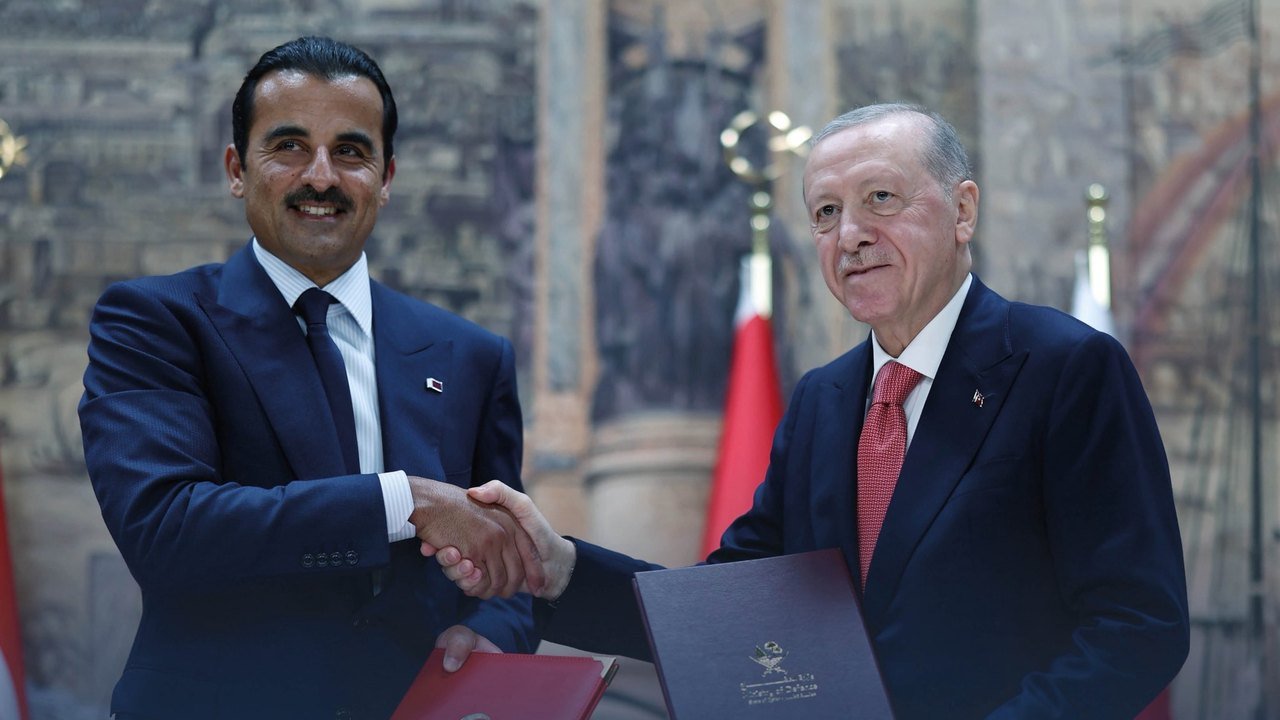
Turkey and Qatar have signed a mutual defense agreement that, according to The New Arab, builds on an established military partnership rather than creating one from scratch. Turkish President Recep Tayyip Erdoğan and Qatar’s Emir Sheikh Tamim bin Hamad Al Thani signed it on Friday, Nov. 13, at Dolmabahçe Palace in Istanbul, the Qatar News Agency reports, during the 12th meeting of the two countries’ Supreme Strategic Committee. Türkiye’s Directorate of Communications lists the “Mutual Defence Agreement between the Republic of Türkiye and the State of Qatar” as one of five documents signed that day, alongside memorandums on consumer protection and on peace, reconciliation and conflict resolution, an education agreement and the meeting’s joint communiqué.
The communiqué, published in English by Türkiye’s Ministry of Foreign Affairs and signed by Foreign Minister Hakan Fidan and Qatari Prime Minister and Foreign Minister Sheikh Mohammed bin Abdulrahman Al Thani, describes the pact’s aim as “strengthening collective defense and promoting regional security and stability, and a unified stance in confronting any external armed attack targeting either party or both of them.” It adds that the agreement reflects “not only the commitment of its signatories to safeguarding their sovereignty and territorial integrity, but also their shared vision of contributing to a more secure and stable regional order.” Under the same heading, the two sides “agreed to consult on, threats to their security as well as regional and global security issues and defense policies, and to enhance cooperation through joint military exercises, defense industry cooperation and personnel training exchanges.”
Outlets that have read the communiqué point to what it leaves out. “However, the full text of the agreement has not been publicly released, leaving questions about its precise military obligations,” The New Arab writes. It notes that the communiqué “does not explicitly state that an attack against one will be treated as an attack against both,” and that, unlike the Makkah Joint Defence Agreement that Turkey signed with Saudi Arabia and Pakistan in August, it sets out no automatic duty to deploy forces. Al Jazeera likewise reports that the communiqué, as reported, did not say what could trigger the agreement or what form a joint response would take. Turkey belongs to NATO and Qatar does not, so an attack on Qatar would not automatically bring in the alliance, The New Arab adds.
Erdoğan framed the deal around the Gulf. “We will continue working together with Qatar to prevent a resurgence of war in the Gulf region,” he said, in the translation Al Jazeera English posted on X, citing the Turkish president’s office. Euronews quotes Erdoğan’s office as saying the agreement will “add a new dimension to the brotherly ties between the two countries,” and reports that the two leaders also discussed Israel’s attacks on Gaza, efforts toward normalization in Syria and developments in Libya.
The clips below come from Al Jazeera English, Middle East Eye and Turkey’s Star newspaper, posted Nov. 13 and 14.
View the @AJEnglish post on X
View the @MiddleEastEye post on X
View the @stargazete post on X
The New Arab ties the timing to a deterioration in regional security after the U.S.-Israeli war against Iran. It reports that Qatar, which hosts the large U.S. installation at Al Udeid Air Base, came under Iranian missile and drone attacks during that conflict, and that Israel struck Hamas officials in Doha in September 2025. In the communiqué, Ankara and Doha say the U.S.-Iran conflict “must be resolved through dialogue and diplomacy” and call for “the swift and full resumption of safe, secure and unimpeded passage through the Strait of Hormuz,” per the Foreign Ministry text and Anadolu.
The military ties themselves go back more than a decade. A defense cooperation agreement dates to December 2014, and Turkish troops began deploying to Qatar in 2015 at the Tariq bin Ziyad base near Doha, according to The New Arab, which adds that Ankara kept its base open during the 2017 blockade of Qatar by Saudi Arabia, the United Arab Emirates, Bahrain and Egypt. Qatari writer Khalid bin Daham told Alhurra that a Qatari partner holds a 49.9% stake in BMC, maker of the Altay main battle tank, that Qatar bought a short-range Tolga air defense system this year, and that Doha has weighed a Turkish offer of the Steel Dome air defense system; this desk could not independently confirm those purchases.
Analysts read the pact’s purpose in different ways. Abdulla Banndar Al-Etaibi of Qatar University told Al Jazeera that the goal does not involve an alliance against any particular country but raising the cost of any potential aggression. Nayef Al-Nabet, a nonresident fellow at the Middle East Council on Global Affairs in Doha, noted to Alhurra that the joint statement does not explicitly mention Iran, and called the pact “a tool for strengthening security, deterrence and stability, not a declaration of a new alignment against Iran.” Retired Jordanian Maj. Gen. Mohammed Falah Al-Abadi offered a sharper view to Alhurra, saying it aims primarily “against Israel, and then Iran,” while Israeli writer Yoav Stern called it “a theoretical threat to Israel” whose practical weight Qatar’s limited military capabilities may reduce.
Al-Nabet also told Alhurra that Turkey would not replace Qatar’s existing security partners, including the United States, and that the agreement “expands Qatar’s defense options within its existing network of partnerships.” Euronews reports that Gulf states continue to call the U.S. security umbrella central to their defense even as they widen their options. This desk found no public response from Washington, Tehran or Jerusalem to the pact in the reports it reviewed by Saturday evening Pacific time.
Euronews places the pact within a fast-changing map of regional defense alliances. Turkey’s law ratifying the Mecca joint defense agreement with Pakistan and Saudi Arabia took effect on publication in the Official Gazette after parliament approved it 279-119 on Nov. 5, Anadolu reports, and Euronews says Turkey, Qatar, Pakistan and Indonesia signed the “Badr” memorandum on defense-industry cooperation in October. The Istanbul communiqué welcomes Badr as a step toward “the development of indigenous capabilities.” Beyond defense, the two governments repeated a goal of $5 billion in trade volume and noted that Turkish contractors have carried out 206 projects in Qatar worth $20.8 billion, according to the communiqué.
What to watch: whether either government publishes the treaty text or submits it for ratification, which would show any trigger clause and obligations; whether Washington, Tehran or Jerusalem responds; and whether Qatar moves ahead on the Turkish air defense systems that bin Daham described. The communiqué says the 13th session of the committee will meet in Qatar in 2027.