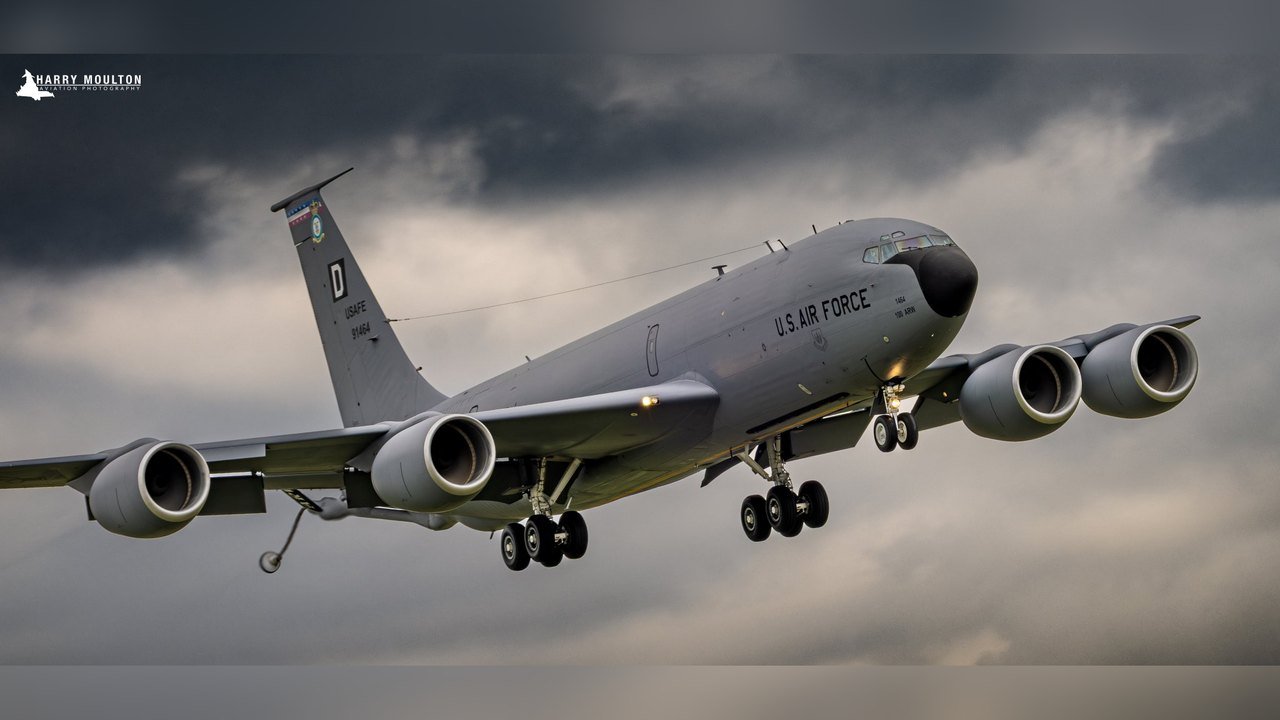
U.S. Air Force tankers began leaving RAF Mildenhall, a British base in Suffolk run by the U.S. Air Force, on Monday, Nov. 9, in what Reuters calls the second apparent evacuation of a U.S.-used British airbase in three months. Commercially available flight-tracking data showed at least 10 Boeing KC-135R Stratotanker refueling planes leaving the base on Monday, Reuters reports, along with at least three Osprey aircraft that landed at RAF Lakenheath, another base about 4 miles away. Using the public tracking site Flightradar24, BBC Verify says it watched 10 KC-135 tankers leave Mildenhall throughout Monday, and two more on Tuesday afternoon, one apparently headed toward Germany and one landing at Prestwick Airport near Glasgow.
The Wall Street Journal first reported the move and linked it to Iran, AP says, citing “people familiar with the matter.” According to the Journal’s account as relayed by AP via The Independent, two tankers stationed at Mildenhall got diverted to Germany on Monday, several more moved to other bases in Europe later that day, and U.S. officials decided to redeploy the aircraft after learning of the new threat on Monday. Reuters, citing the Journal, says the precise nature of the threat remained under discussion among U.S. officials. The BBC says it has not independently verified the Iran link.
Counts and destinations vary by tracker and outlet. AP cites the Military Air Tracking Alliance, which it describes as a team of about 30 open-source analysts, as spotting 13 U.S. aircraft from Mildenhall heading for bases in Scotland, Spain and Germany. The BBC traces Monday’s 10 tankers this way: two flew first toward U.S. bases in Germany and Italy and both ended up at Spangdahlem air base in south-west Germany; two more went to Spangdahlem, one to Ramstein in Germany and four to Morón air base in southern Spain; and one, belonging to the Nebraska Air National Guard, went to Prestwick, which the BBC says may have marked a planned stopover. Reuters lists one tanker to Germany, one to Scotland and two to Spain, with six destinations not reported. The National, citing flight-tracking data, counts nine tankers and three Ospreys leaving on Monday afternoon and evening; the @ArmchairAdml tracking account on X also logged nine KC-135s, including two transient tankers, and three CV-22Bs.
View the @SkyNews post on X
View the @GBNEWS post on X
View the @AlArabiya_Eng post on X
U.S. officials gave few details in public. A U.S. official told AP that the move came as a proactive rather than a reactive step, that some of the planes that left had arrived in transit while others belonged to the base, and that they may return; AP says the official did not elaborate on the nature or source of the threat. An official from U.S. Air Forces in Europe told AP the U.S. keeps “taking coordinated and appropriate actions” to ensure the safety of U.S. and U.K. personnel and their families. A U.S. Air Force spokesperson said aircraft “rotate between installations and operating locations for a variety of reasons, including training and real world requirements,” and added: “Due to operations security, we will not provide further information on movement of assets,” according to the Guardian. Rubio said the United States keeps “constantly repositioning forces around the world for a variety of reasons” and referred questions to the Pentagon, AP reports.
The Journal also reported, citing a U.S. official, that the U.S. raised the security posture at Mildenhall and Lakenheath to FPCON Charlie, the second-highest defensive threat level, according to Reuters. AP attributes the FPCON Charlie report to the Military Air Tracking Alliance and describes the level as one that applies when an incident occurs or intelligence indicates that some form of terrorist action against personnel or facilities looks likely. The BBC reports no apparent additional security at Mildenhall on Tuesday and says spots where the public could photograph aircraft stayed open.
Downing Street insisted British bases stay safe. “As you know, the US is one of our top security partners,” the prime minister’s official spokesperson said, according to the Evening Standard, which carries PA’s report. “Aircraft and other assets move regularly according to operational requirements.” The spokesperson added: “The protection of our bases, both in the UK and across the world, is a top priority.” Asked whether the government maintained that British bases remained safe, he said: “Yes.” Reuters says the spokesman for Prime Minister Andy Burnham also cited more than £2 billion ($2.7 billion) of investment in air defense and counter-drone capabilities. The Ministry of Defence said: “We do not routinely comment on the activity of other nations,” according to the BBC.
Education Secretary Lucy Powell told BBC Breakfast she could not comment on operational matters, the BBC reports, adding that “we take the security and safety of our bases incredibly seriously” and “we will always act on security intelligence when we need to.” Junior defence minister Luke Pollard told a military conference in Oslo “it was a decision for the US where they place their military assets” and that the UK kept “investing more” in counter-drone capabilities and base protection, according to the Guardian, which gives his words in reported form. The Guardian also reports that British sources emphasised no immediate or direct danger to the base or the area nearby, and that U.K. security officials believe Iran lacks the capability to launch an explosive attack on a base in Britain, although Tehran may threaten to do so.
Critics and analysts read the move differently. Liberal Democrat defence spokesperson James MacCleary wrote on X that it “seems like every other day now the security of our airfields is either compromised or under threat,” the BBC reports. Former U.K. national security adviser Lord Ricketts told BBC Radio 4’s Today programme: “Of course, they are large targets, an airbase has a long perimeter, so they are inevitably vulnerable.” He added: “Nobody knows at this stage what this information was. I suspect part of it is an abundance of caution.” Retired Air Marshal Greg Bagwell told BBC Verify “we need to keep an open mind,” the BBC says, and listed an exercise, weather or a hoax as part of “nuisance hybrid warfare” as possible explanations alongside a genuine threat.
The Guardian says the Pentagon has taken a risk-averse approach to threats against planes on the ground since the first phase of the Iran war in the spring, and reports that an Iranian missile hit five KC-135 Stratotankers on the ground in Saudi Arabia in March. Mildenhall hosts the 100th Air Refueling Wing, which AP calls the only permanent refueling wing in the European region; the BBC says about 3,000 military personnel serve there, about 80 miles (130 km) north of London, and that the base served as a staging area for aircraft and material bound for the Middle East during operations against Iran.
The departures follow the September episode at RAF Fairford in Gloucestershire. Five men got detained on Sept. 27 after three suspicious vans headed toward that base, AP reports, and the U.S. later withdrew its bombers, B-1s according to the Guardian and Reuters. Counts of later arrests and charges differ: AP says two men face charges under the National Security Act, and the Guardian names them as Mohmed Abdulkarim, 24, and Nouman Essghir, 24; the BBC says Counter Terrorism Policing confirmed on Tuesday seven arrests so far, plus an eighth man interviewed under caution and since charged under Section 3 of the National Security Act 2023. Iran’s Revolutionary Guards have called bases used to attack Iran legitimate targets, the Guardian and Reuters report, and the Guardian says Tehran’s ambassador to Britain has denied any role in a plot against Fairford. Reuters adds that MI5 chief Ken McCallum said last month that Iran-linked operations had led to more than 50 arrests over the past year. The desk found no Iranian comment on Mildenhall itself.