Aleksandar Vučić, who has dominated Serbian politics as prime minister or president since 2014, conceded defeat on Sunday, Oct. 25, to a student-led movement in a snap parliamentary election, Reuters reports (Reuters via CBC). “We still do not have final results,” Vučić told supporters at his party headquarters in Belgrade, according to the Guardian. “On the basis of a sample … it is clear that we have lost these elections, the Student’s List has won, they will have between 135 and 140 seats and we will have 105” (the Guardian). The BBC reports that he spoke late on Sunday at the headquarters of his Serbian Progressive Party (SNS) (BBC). Posts on X reporting the concession appear from about 20:47 GMT (1:47 p.m. PT).
The figures behind the concession come from a stratified sample, not a final count. Ipsos and CeSID, the Center for Free Elections and Democracy, put the list “Studentska lista – Studenti pobeđuju” (Student List – Students Win) at 52.4% of the vote and Vučić’s list “Aleksandar Vučić – Ujedinjena Srbija” at 39.2%, on 75% of their processed sample, the state news agency Tanjug reports in an item stamped 23:30 local time (3:30 p.m. PT) (Tanjug). An earlier release, on 56% of the sample, put the two lists at 52% and 39.3% and Ivica Dačić’s list at 2.3%, with every other list below 1%, RTK reports, citing CeSID’s official X account (RTK).
Seat projections from that 56% release give the Student List 139 seats and Vučić’s list 104, according to Tanjug and RTK. They give the Alliance of Vojvodina Hungarians (SVM) three seats, the Albanian Coalition two, and Rasim Ljajić’s list and the SDA of Sandžak one seat each, for a total of 250 (Tanjug; RTK). Reuters and the Guardian cite a representative CeSID–Ipsos sample that gives the students 138 seats and the SNS 104, with the remaining seats going to ethnic minority parties (Reuters via CBC; the Guardian). With 126 seats needed for a majority in the 250-seat assembly, every projection cited here puts the Student List above that line.
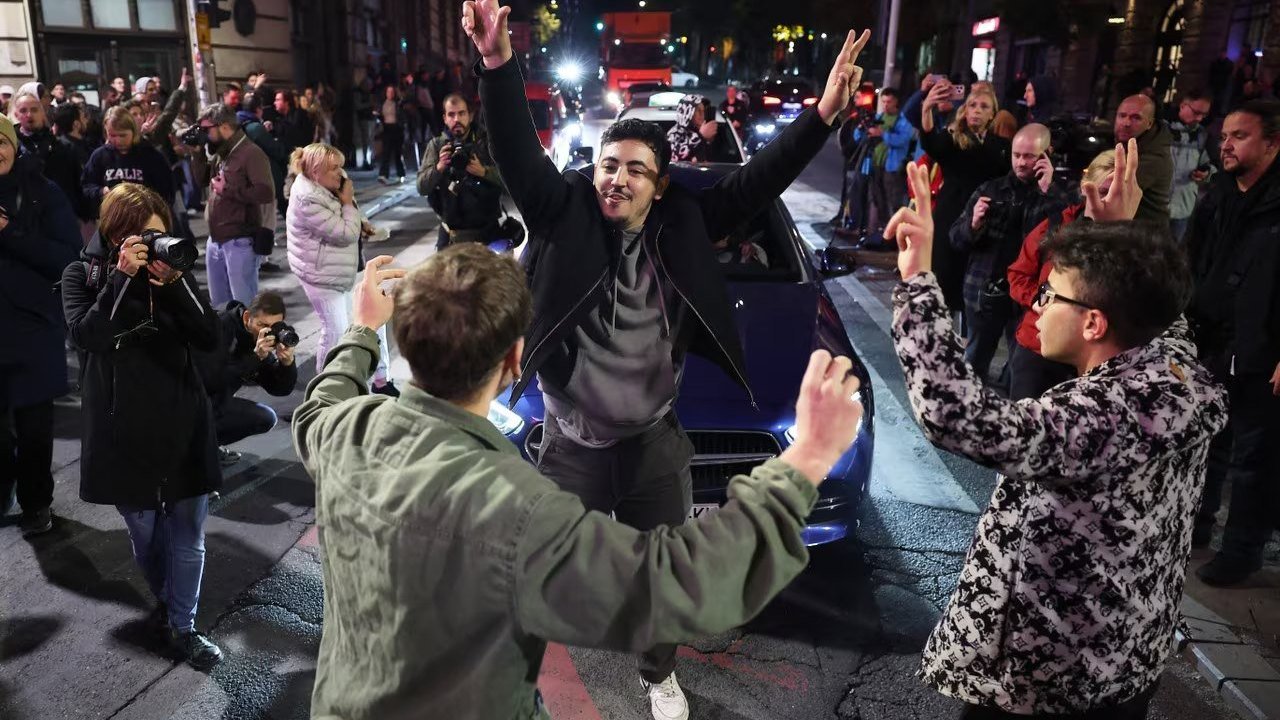
Celebrations followed within minutes. Reuters describes the streets of Belgrade erupting with cars honking and students shouting “victory” and “he’s done” (Reuters via CBC). “Serbia is free,” one student told the BBC. “It’s a miracle.” The BBC also reports dancing, fireworks and a crowded center in Novi Sad, the northern city where the protests began (BBC). At the Student List headquarters, Belgrade University professor Radomir Saičić, speaking for the students, said: “Dear Serbia, tonight the voice of the people is being heard. … Tonight we celebrate victory, tomorrow we build the future,” according to Reuters and the Guardian (Reuters via CBC; the Guardian).
Watch: Belgrade after the concession
A video post on X from Sunday evening shows crowds in central Belgrade after Vučić’s statement. This desk has not frame-checked the clip and cannot confirm who filmed it. If an embed does not load, it shows as a plain link.
View the @suedostX post on X
Turnout ran high all day. Reuters reports lines of unprecedented length outside polling stations and says even Vučić waited nearly two hours to vote in Belgrade; pollsters and the election commission put turnout close to 70% (Reuters via CBC). The Guardian reports a CeSID and Ipsos turnout estimate of 67.6% by 7 p.m. local time (the Guardian), and the BBC cites the election commission’s 64.9% by 6 p.m., two hours before polls closed (BBC). The BBC also reports queues of Serbian voters abroad, in Ljubljana, Munich, Paris, Los Angeles and Chicago, and police sealing off streets around the Republic Electoral Commission (RIK) in Belgrade.
The election grew out of a tragedy. In November 2024, a concrete canopy collapsed at the Novi Sad railway station and killed 16 people, the Guardian and the BBC report; the protests that followed turned into a broad anti-government movement (the Guardian; BBC). Reuters describes nearly two years of demonstrations against what protesters call corruption and creeping authoritarianism (Reuters via CBC). Vučić called the snap vote in September and resigned his second term as president to run for prime minister again, according to Reuters (Reuters via CBC).
The winning list has no obvious leaders, the BBC reports. It fielded 250 candidates, including doctors, academics, actors, farmers and sports figures, and cardiologist Ilija Srdanović heads it, though who would serve as prime minister remains unclear, Reuters reports (Reuters via CBC; BBC). “This will be a free state,” Srdanović told BBC Serbian (BBC). The BBC lists a manifesto that includes removing officials who cracked down on protesters, keeping party loyalists out of the leadership of public companies and freeing the public broadcaster from political control. Former basketball player Dejan Bodiroga, a candidate on the list, said while voting: “Serbia is voting today to decide which direction it will take – towards the future or the past,” the Guardian reports (the Guardian).
Vučić and his party offer a different account of the last decade. Supporters credit him with modernizing Serbia’s economy and building new highways, railways, schools and hospitals, Reuters reports, and in his campaign he pledged higher pensions and public-sector salaries (Reuters via CBC; BBC). Vučić and the SNS have repeatedly denied claims of corruption, repression and spying on opponents, according to Reuters and the BBC; Vučić has said foreign agents fund the students, which the students dismiss (Reuters via CBC; BBC). On Sunday he signaled that his party would regroup: “Some businessmen, some people will leave us, but our structure is firm, we are very united, very strong, we are used to being in the opposition,” Reuters quotes him as saying (Reuters via CBC).
Election monitors raised concerns before and during the vote. The Guardian reports that international and local observers cited detentions and reports of surveillance and cyber-attacks against activists ahead of polling day, and that independent monitors on Sunday recorded cases of ballot photographing, attempted vote-buying and carousel voting. Raša Nedeljkov of the monitoring group CRTA said that “a large number of irregularities continue to be recorded, while violent incidents outside polling stations are also becoming increasingly frequent” (the Guardian). This desk has not seen an official RIK ruling on any of those reports.
What comes next: the Republic Electoral Commission still has to publish official results, and Euronews notes it remains too early to say whether any smaller list crossed the 3% threshold, though that would not change the winner (Euronews). Abroad, any new government would have to balance relations with China, a major investor; Russia, Serbia’s traditional ally and main gas supplier; and the European Union, its largest trading partner, Reuters reports (Reuters via CBC). Reuters and the Guardian both compare the result with the defeat of Hungary’s Viktor Orbán in April, and Reuters says it may offer a blueprint for student movements that have protested across Europe in recent weeks (Reuters via CBC; the Guardian).
Correction · Oct 26, 2026, 7:10 AM PT: this desk removed one of two embedded X clips because it came from a partisan meme account rather than a news outlet or on-scene source; the remaining clip and the reporting stay unchanged.