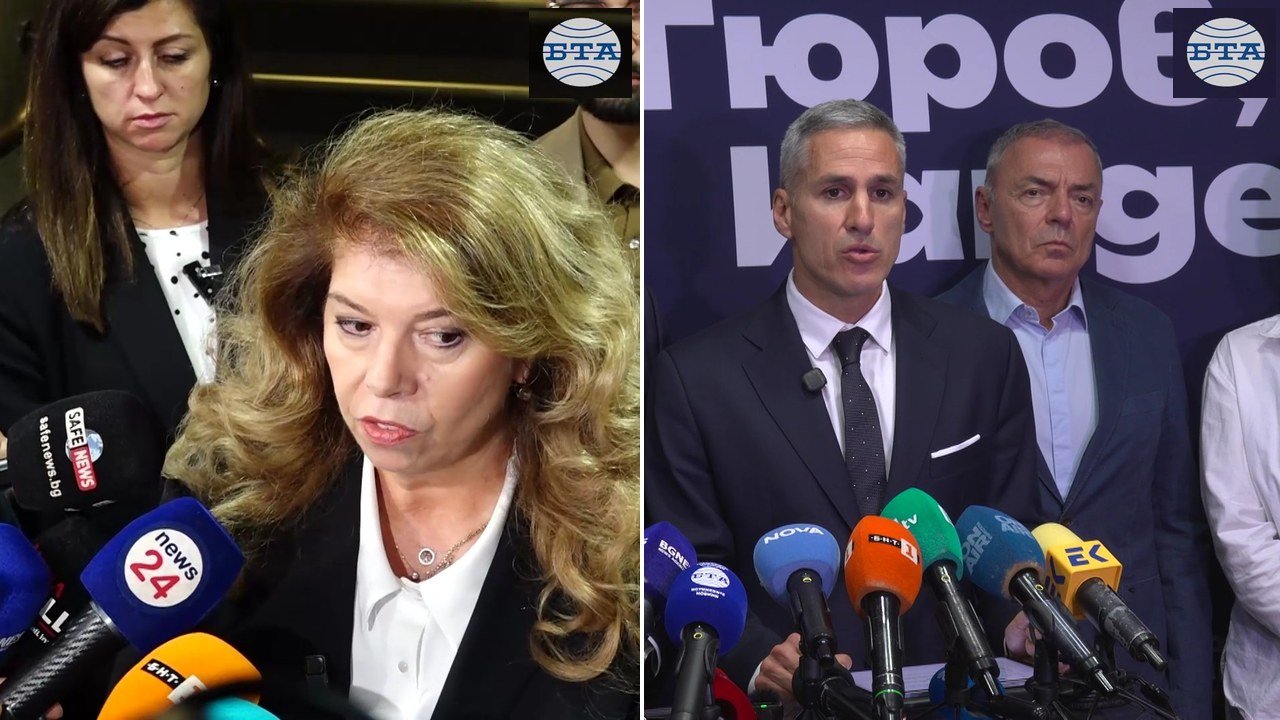
Bulgarians will vote again on Sunday, Nov. 1, to choose between President Iliana Yotova and former caretaker prime minister Andrey Gyurov, after a first round on Oct. 25 in which neither ticket came close to an outright win, according to the Central Election Commission’s count (CIK). With 99.94% of precinct protocols processed as of 9 a.m. Monday in Sofia (midnight PT), the commission shows Yotova and her running mate, Kiril Valchev, on 528,753 votes, or 34.763%, and Gyurov and his running mate, Georgi Kandev, on 485,927, or 31.947%. By this desk’s arithmetic, that leaves a gap of 42,826 votes, or about 2.8 percentage points.
The low turnout guaranteed the second round. Bulgaria’s rules require turnout above 50% of registered voters, plus more than half the votes, for a first-round victory, Al Jazeera reports (Al Jazeera). The Myara polling agency put turnout at 22.2% as of 8 p.m. local time (11 a.m. PT), according to Al Jazeera; Anadolu, citing Alpha Research figures released by Bulgarian National Television, reports 22.5% (Anadolu). The commission’s own activity page, the latest figure this desk could read, shows 1,058,669 of 6,637,238 registered voters, or 15.95%, had voted by 4 p.m. (CIK). AP’s headline describes the turnout as a record low (AP).
Behind the two leaders, the field thinned fast. Revival’s Kostadin Kostadinov, with running mate Petar Volgin, took 190,812 votes, or 12.545%, according to the CIK; Radostin Vasilev of MECh drew 4.608%, Ivelin Mihaylov of Velichie 3.788% and Ivan Hristanov 2.393%, while 67,323 voters, or 4.426%, chose the ballot line “I do not support anyone” (CIK). The Sofia Globe, which describes Revival as pro-Russian, reports that 21 of the remaining 24 candidates fell short of even 1% (The Sofia Globe). Euronews counts a record 27 candidates in the race (Euronews).
The result came in tighter than the campaign polls suggested. Euronews reports that in the weeks before the vote, surveys gave Yotova between 41% and 47% and Gyurov between 28% and 31% (Euronews). Exit polls on Sunday evening put Yotova at 35% to 36.5% and Gyurov at between 31% and 33.5%, according to Al Jazeera (Al Jazeera), and the official count put Yotova slightly below her exit-poll range and Gyurov inside his.
The two finalists offer different directions. Yotova, a former journalist and member of the European Parliament, won election as vice president alongside Rumen Radev in 2016 and 2021 and took over as president this year when Radev stepped down to run in parliamentary elections, Euronews reports; Radev now serves as prime minister (Euronews). She ran as an independent with the backing of Radev’s Progressive Bulgaria and the Socialist Party, according to Al Jazeera, and Euronews writes that she favours dialogue with Moscow and opposes military aid to Ukraine (Al Jazeera; Euronews). If she wins, she would become the first woman elected president in Bulgaria’s history, Euronews notes.
Gyurov, an economist and former deputy governor of the central bank, served as caretaker prime minister in the first months of 2026 and signed a security cooperation agreement with Kyiv during that time, Euronews reports (Euronews). The Sofia Globe reports that an initiative committee nominated him and that the pro-Western opposition groups We Continue the Change and Democratic Bulgaria endorsed him (The Sofia Globe). His strength abroad stood out: among votes cast outside Bulgaria, with 99.84% of protocols processed, he took 36,933 votes, or 45.707%, to Yotova’s 18,448, or 22.831%, the CIK shows (CIK).
Election night set the tone for the runoff week. “I invite Yotova to an open, honest and civilized debate to present our views on how we would exercise our powers and how we would act when Bulgaria faces difficult choices,” Gyurov said, according to Anadolu (Anadolu). Novinite quotes him as saying, “This is not the time for patting ourselves on the back,” and adding that “these elections will not be decided in party headquarters; we will seek support solely from the citizens” (Novinite). His running mate, Kandev, said he would not debate Valchev because the debate should involve the presidential candidates themselves, Novinite reports.
Yotova focused on the empty polling stations. “Thinking that we can change anything in the country without voting is an illusion,” she said, according to Anadolu, which reports that she stressed Bulgaria needed stable governance rather than alliances between parties (Anadolu). Novinite writes that she did not ask other parties or candidates for explicit endorsements, said voters should not have felt intimidated into staying home, and kept peace at the centre of her platform, rejecting a return to “haphazard coalitions” (Novinite). Valchev noted that a woman led the presidential race for the first time and challenged Kandev to a debate of his own, according to the same report.
Watch: what the two finalists said on election night
Two video posts on X carry the candidates’ election-night remarks: a roundup from Svobodna Tochka, a site run by the team of Radio Free Europe’s Bulgarian service, and BTA footage of Gyurov’s debate challenge shared by the @sofiagrad account. Both speak in Bulgarian. This desk has not frame-checked the clips. If an embed does not load, it shows as a plain link.
View the @SvobodnaTochka post on X
View the @sofiagrad post on X
The parties around the candidates began to position themselves. Bozhidar Bozhanov, a co-leader of Yes, Bulgaria within Democratic Bulgaria, told reporters that “this was the first half; there is another one ahead,” and that “he did not seek our support; we supported him because our voters wanted him to be the candidate,” BTA reports (BTA). Socialist leader Krum Zarkov signalled that Yotova could count on his party in the runoff, while Petar Vitanov of Progressive Bulgaria acknowledged that the party had failed to mobilize enough supporters, Novinite reports (Novinite).
The eliminated candidates hold the swing votes. Kostadinov said other parties would have to take Revival into account and that the party might use an internal poll to decide whether, and whom, to endorse, according to Novinite; Vasilev urged MECh voters to follow their conscience but told them not to vote for Yotova, and Hristanov said he would decide during the week (Novinite). Interior Minister Ivan Demerdzhiev said the vote “took place peacefully, without the usual practices of vote buying and vote manipulation,” Al Jazeera reports, citing Bulgarian National Television (Al Jazeera).
The office itself carries limited but real powers. The president leads the armed forces, can veto legislation and signs treaties, though the role remains largely ceremonial, Al Jazeera notes (Al Jazeera). The campaign turned on rising energy prices, inflation, Russia’s war in Ukraine and drone attacks on commercial ships off Bulgaria’s Black Sea coast, according to Euronews, which also frames the contest as the first major test of Radev’s Progressive Bulgaria since its April parliamentary win (Euronews). The commission has 48 hours from the close of voting to formally declare the two tickets for the runoff, The Sofia Globe reports (The Sofia Globe).