Arizona Gov. Katie Hobbs declared a statewide state of emergency on Monday, Nov. 2, after heavy rain that began Oct. 31 sent creeks over their banks, forced evacuations and rooftop rescues in Sedona, closed mountain highways and left two men dead in Flagstaff. The signed declaration, which Hobbs posted on X at 2:33 p.m. PT (3:33 p.m. Arizona time), cites “historic rainfall within 72 hours, catastrophic flooding, and high winds” and takes effect retroactively from Oct. 31. “The safety and security of every Arizonan is my top priority,” Hobbs said in a news release, according to Arizona’s Family (AZFamily) and KTAR News. “I am issuing this emergency declaration to ensure our local authorities have the resources they need to clear roads, repair infrastructure, and help displaced residents.”
The order itself spells out what the state will do. It directs $200,000 from the general fund to the director of the Arizona Division of Emergency Management, activates the State of Arizona Emergency Response and Recovery Plan, and orders the Arizona Department of Transportation (ADOT) to coordinate with the Federal Highway Administration and request aid under that agency’s Emergency Relief Program, according to the declaration. The document says the damage to roads, along with the response and traffic control, has “exceeded the capacity of the ADOT.” The State Emergency Operations Center “remains activated to monitor incoming requests, manage debris removal, and ensure life-safety operations continue seamlessly,” ABC15 reported.
The declaration covers parts of Apache, Coconino, Gila, Greenlee, Navajo, Pinal and Yavapai counties, as well as the Hopi Tribe, the Navajo Nation, the San Carlos Apache Tribe, the San Juan Southern Paiute Tribe and the White Mountain Apache Tribe, according to AZFamily. It lists damage to “sewer facilities, culvert failure, bridge impacts, water and gas lines, and multiple power outages,” and notes that Apache, Gila and Yavapai counties and the cities of Camp Verde, Prescott and Sedona had already declared their own emergencies, according to the text. ADOT crews have worked “around the clock” since Friday, Oct. 30, on what the agency called “record rainfall and flooding,” ADOT wrote on X.
In Flagstaff, two men died. The first call came shortly after 5:30 p.m. Arizona time on Sunday, when a man reportedly lost his footing near fast-moving water near Malpais Lane and Clay Avenue, fell in and never resurfaced, officials said, according to AZFamily. Police identified him as 73-year-old Williams Singavarapu of New York and found his body around 5:30 a.m. Monday, less than a mile from where he went missing; his death remains under investigation, the station reported. About three hours later, responders found an unresponsive man in a stormwater drainage area at North Highway 89 and Lynch Avenue. Investigators believe his death weather-related, and a medical examiner will determine the exact cause; police had not publicly identified him, according to AZFamily.
Coconino County’s emergency management director, Tim Carter, described the scale. “We haven’t seen impacts like this in years, if ever,” he told AZFamily. He warned people away from flooded roads: “Pushing up manhole covers, which weigh several hundred pounds. If the water can move that, that can definitely move a person.” The National Weather Service office in Flagstaff posted at 9:32 p.m. PT Monday that the area had already recorded “the wettest fall (Sep-Nov) on record dating back to 1898 with the rest of November still to go,” and that Nov. 1 ranked as “the 3rd wettest calendar day at the Flagstaff airport.”
Watch: Oak Creek overflows in Sedona, posted by FOX Weather on X
If an embed does not load, it shows as a plain link to the original post.
View the @foxweather post on X
In Sedona, Oak Creek drove the rescues. At least 40 people needed rescue from the creek, according to AZFamily. Hobbs’ office said state crews had made six rooftop evacuations in Sedona by Sunday afternoon as floodwaters trapped residents in their homes, KNAU reported. Ranger helicopter crews “conducted 27 rescue missions across the state over the weekend,” ABC15 posted on X. Sedona ordered evacuations in Zones 8, 9 and 10 on the city’s east side on Sunday morning, and most of those residents returned to “READY” status on Monday afternoon, according to the Sedona Fire District as cited by AZFamily. Coconino County said at 5:03 p.m. PT that Blackhawk Lane, Trails End Drive and Lane, and Bear Wallow Lane stayed closed, and that returning residents need proof of residency at police checkpoints.
Residents described the damage. “Overwhelmed, completely overwhelmed,” evacuee Cindy Wilmer told AZFamily. “It’s devastating.” Wilmer lacks insurance and faces paying for repairs out of pocket, the station reported. Floodwaters up to 8 feet high still rushed through parts of Sedona near Tlaquepaque on Monday morning, and Tlaquepaque canceled its Day of the Dead celebration, according to the same report. “We got on the street, and we looked down and were like, oh, the river is coming to us,” Sedona resident Susan Balensky told FOX 10, adding that she had seen the river run high before, “but not really come up over the banks to the point that it’s hitting the houses.” A shelter opened at the Camp Verde Community Gym, according to FOX 10.
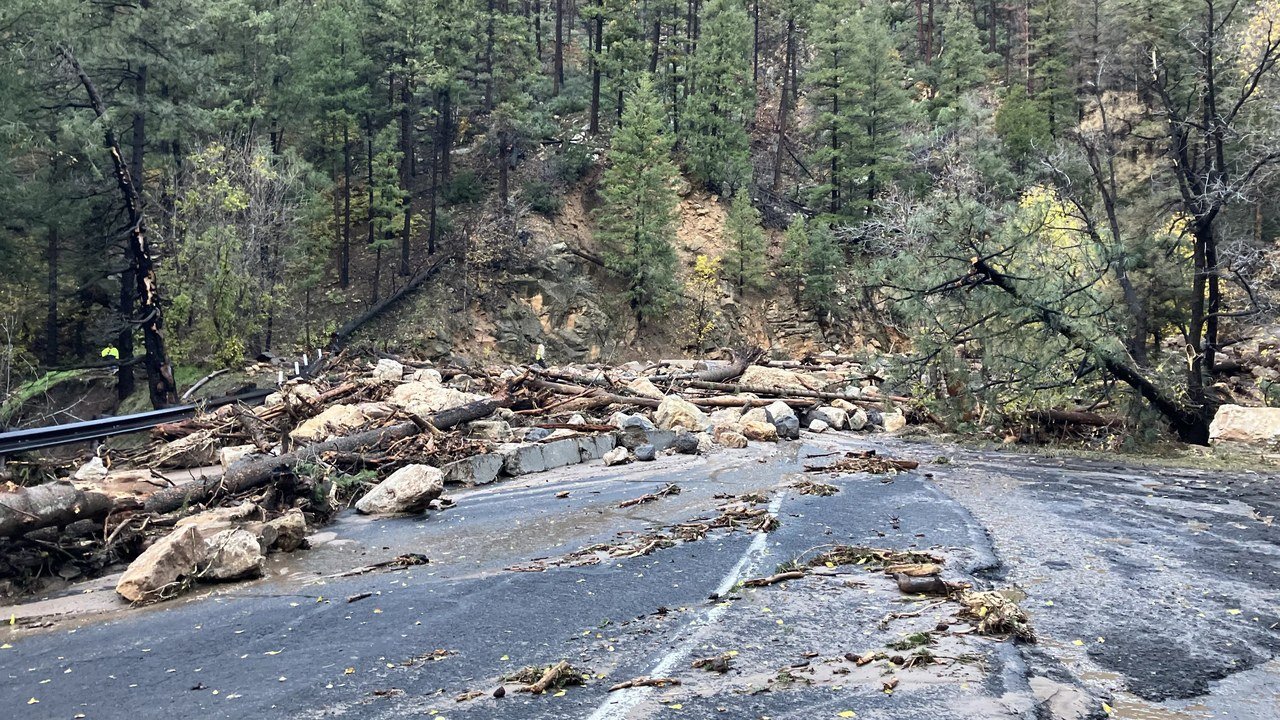
Several highways stayed shut on Monday night. State Route 89A through Oak Creek Canyon stayed closed between Sedona and Kachina Village. ADOT posted photos at 1:42 p.m. PT Monday showing where “flood waters deposited large piles of boulders and debris, damaged guardrails and undermined the road in several locations.” A list KTAR attributed to ADOT, timed at 8:58 p.m., also showed closures on State Route 87 north of Winslow and south of State Route 264, US 191 in Rock Point and State Route 288, according to KTAR. ADOT said at 7:54 p.m. PT Monday that State Route 377 had reopened, while other highways stayed closed with “no estimated reopening time.” Interstate 17 near Flagstaff closed for several hours Sunday and then reopened, KTAR reported.
The flooding reached other parts of the state too. Parts of the historic mining town of Clifton evacuated briefly overnight Sunday into Monday as the San Francisco River rose, and Gila County lifted “GO” evacuation orders for communities including Gisela and Tonto Basin as floodwaters receded, according to AZFamily. Apache County declared its own emergency on Monday, saying continuous rain had caused hazardous flooding on major roads, the station reported. In Maricopa County, home to Phoenix, Board of Supervisors Chair Kate Brophy McGee issued an emergency declaration for unincorporated areas, set to expire at 6 a.m. Friday, and asked the state to include the county in its declaration, according to KTAR. “There are communities and residents that are hurting, and I am hopeful this emergency declaration will help facilitate necessary resources for assistance,” Brophy McGee said. County officials put rain totals at 1 to 4 inches in lower areas and up to 8 inches at higher elevations, according to AZFamily.
Tuesday brings Election Day, and Coconino County said that all 38 of its polling locations would open at 6 a.m. and close at 7 p.m. Arizona time. The declaration offers no estimate of total damage, and this desk found no official figure for how far $200,000 will stretch or whether federal highway aid will arrive; ADOT has given no date for reopening SR 89A. For earlier flooding in the region, when the San Juan River set a flood of record at Farmington, N.M., in late October, see Seems News’ earlier report.