Southeast Asian leaders meeting in Manila on Sunday kept Myanmar’s military-backed leadership barred from the bloc’s top tables, while writing into their decision a possible route back: a phased return that hinges on progress toward peace. In a four-page “Review and Decision on the Implementation of the Five-Point Consensus,” dated Nov. 15 and marked as adopted, the leaders said they would “continue to uphold” earlier summit decisions on “Myanmar’s non-political representation at ASEAN Summits and ASEAN Foreign Ministers’ Meetings until there is meaningful progress in the implementation of the 5PC.”
The next point opens a door. ASEAN will “pursue a calibrated engagement with Myanmar through a phased and progress-based approach, taking into account developments on the ground,” the document says, adding: “Subject to sustained and concrete progress in the implementation of the 5PC by Myanmar, ASEAN may consider the gradual restoration of Myanmar’s full political representation.” Reuters, in a report carried by The Star, describes the outcome as a decision to maintain the exclusion “for now” while signaling a possible gradual return; DW, drawing on AFP and dpa, calls it an agreement to engage Myanmar’s government in stages.
Reuters also points to a line it calls a notable step: the leaders “encourage efforts by individual ASEAN Member States through constructive engagement with all relevant stakeholders, in consultation with the ASEAN Chair,” wording that, in Reuters’ reading, appears to endorse bilateral outreach to Myanmar by member countries (Reuters). Thailand and several other members have stepped up engagement with Myanmar in recent months, Reuters reports, adding pressure on the bloc to ease its ban. The Philippine newspaper BusinessMirror reports that Thailand floated a proposal last week to let at least Myanmar’s foreign minister rejoin ASEAN ministerial meetings, and that the leaders’ decision did not take it up.
Lazaro, who serves as the ASEAN chair’s special envoy on Myanmar, explained the approach to reporters. “The step-by-step approach is adherence to the Five-Point Consensus,” she said, according to BusinessMirror. “For example, the first one is a cessation of hostilities. We want to see how Myanmar responds to that because right now there’s still certain bombings and displacement of Myanmar people. So step-by-step we give it to them how they’re going to tackle this issue and we monitor that.”
Three clips posted on X on Sunday, Nov. 15, from the Manila summit.
View the @WIONews post on X
View the @gmanews post on X
View the @sidhant post on X
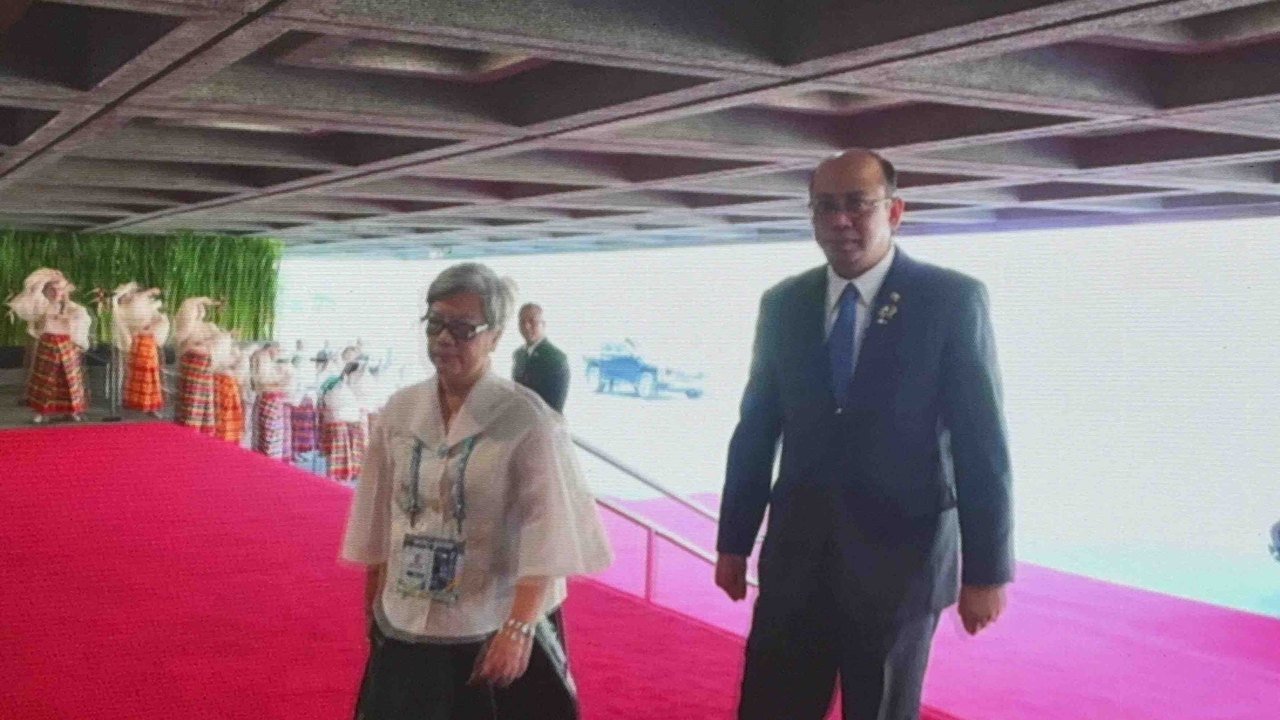
In practice, the ban leaves Myanmar’s seat at the summit to a career official. BusinessMirror reports that Myanmar President Min Aung Hlaing and Foreign Minister Tin Maung Swe remain barred, and that Han Wing Aung, director-general of the Myanmar Foreign Ministry’s ASEAN division, represented the country at the 49th summit. State broadcaster Radyo Pilipinas posted a photo on X on Sunday morning, Manila time, of representatives of Myanmar and Cambodia arriving at the Philippine International Convention Center for the opening ceremony; the post does not name the people pictured.
The leaders’ review offers a blunt verdict on the plan itself. They “reiterated our deep concern over the insufficient progress in the implementation of the 5PC, while noting limited progress in the provision of humanitarian assistance,” the decision says, and they “denounced the acts of violence in Myanmar against civilians and public facilities.” The document urges “the armed forces, security forces, and armed groups” to stop targeted attacks on civilians and calls for a sustained nationwide ceasefire. It also welcomes an aid mission that, from Oct. 28, began a month of deliveries to more than 11,000 households, including in four townships the bloc’s AHA Centre had not reached before.
The Five-Point Consensus dates from 2021, soon after Myanmar’s military seized power. It calls for an immediate end to violence and dialogue among all parties, and it offers ASEAN mediation and humanitarian help, according to Reuters. The coup ousted the elected government of Nobel Peace Prize laureate Aung San Suu Kyi and set off a civil war that the United Nations estimates has killed 100,000 people and displaced more than 3.5 million, Reuters reports. Coup leader Min Aung Hlaing took office as a civilian president this year after elections that monitors dismissed as a sham, DW reports; the ASEAN document itself notes “the conclusion of the three phases of Myanmar’s general elections” and the formation of a Myanmar ASEAN Affairs Committee on Sept. 29.
Min Aung Hlaing’s government wants to normalize ties with ASEAN and has drawn support from China, India and Russia, Reuters reports, adding that his administration has gained growing international recognition in recent months, including secret talks with U.S. officials. On the streets of Quezon City on Sunday, activists and student protesters held a demonstration against Min Aung Hlaing, according to an Associated Press photo caption published by BusinessMirror.
The decision carries several smaller changes. Senior officials will keep working on a proposal for a longer-term ASEAN special envoy on Myanmar. The leaders also agreed that after Singapore chairs ASEAN in 2027, the chair will keep rotating in alphabetical order “until a different decision is made” (ASEAN decision, points 23 and 27); DW reports that Thailand takes over in 2028. And the leaders pledged closer work with outside partners against transnational crime tied to the crisis, from human and drug trafficking to displacement and cyber threats, the document says.
Myanmar formed only one item on a crowded agenda. Philippine President Ferdinand Marcos Jr. asked fellow leaders at their retreat, “What more can we do for Myanmar?” according to DW, which reports talks on trade, regional security and sharing fuel supplies during disruptions linked to the war in Iran. Australia and the Philippines signed a defense agreement on Sunday, DW reports, and Canada and the Philippines said on Saturday that they had concluded free trade talks. Lazaro described negotiations with China on a South China Sea code of conduct as 80% complete, though diplomats told AFP a deal in Manila appeared unlikely, per DW; Chinese Premier Li Qiang represents Beijing at the summit.
DW reports that U.S. President Donald Trump should arrive on Tuesday, toward the end of the summit, and meet the leaders of India, Japan and Australia, ahead of his planned three-way talks with Xi Jinping and Vladimir Putin in Shenzhen on Thursday. Activists plan a march against his visit, according to DW.
What to watch: any formal response from Myanmar’s government or its ASEAN Affairs Committee; whether Thailand or other members step up bilateral outreach under the new wording; what yardsticks the foreign ministers use to judge “sustained and concrete progress” when they report to the next summit, as the decision directs; and whether the longer-term envoy proposal advances under Singapore’s chairmanship in 2027.