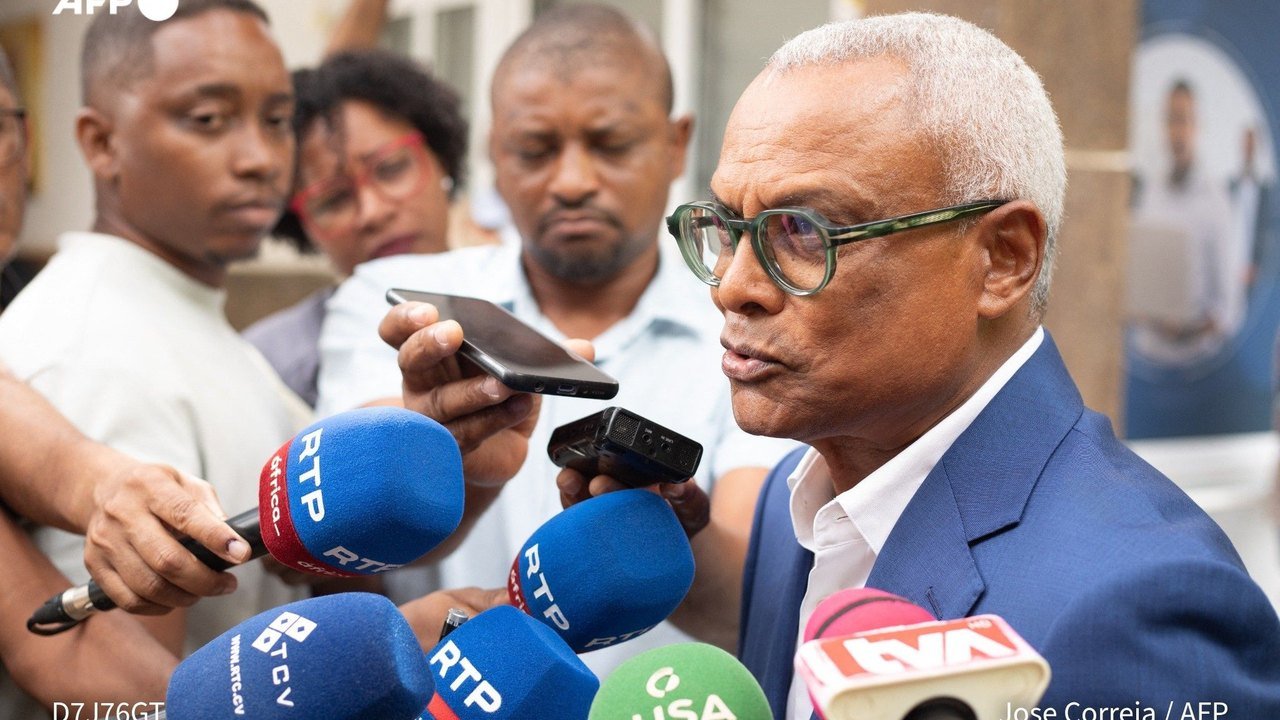
Voters in Cape Verde handed President José Maria Neves a second five-year term on Sunday, giving him a first-round majority large enough to avoid a runoff, according to provisional results. With 96.8% of polling tables counted at home and abroad, Neves had 63.8% of the vote, or 80,018 ballots, the state news agency Inforpress reported late Sunday, citing figures posted by the National Electoral Commission (CNE). DW, drawing on AFP, gave the same 63.8% figure and said Neves “won re-election Sunday.” By late Sunday, Pacific time, the CNE’s results site showed 1,270 of 1,296 tables counted, with Neves at 63.9% (80,875 votes) and a lead of 40,925 votes.
His main rival, Joana Rosa, a 61-year-old former justice minister, finished second with about 31.6%, or 39,660 votes, in Inforpress’s count; the CNE site later put her at 31.5% (39,950). Four other candidates each drew less than 1.5%: Gilson Alves (1.4%), Antero Tavares (1.3%), Casimiro de Pina (1.1%) and Loisito Tavares de Sousa (0.9%), according to Inforpress and the CNE figures. Neves won every constituency, at home and in the diaspora, except the island of Maio, where Rosa came out ahead, Inforpress reported.
Rosa conceded before the count finished. Speaking at her campaign headquarters in Praia’s Achada Santo António neighborhood at about 9 p.m. local time (2 p.m. PT), she said: “Já oportunamente apresentei ao Presidente reeleito as felicitações” — in this desk’s translation, that she had already offered her congratulations to the re-elected president — according to the Portuguese news agency Lusa, as published by Observador and RTP. She said she accepted the results as the expressed will of Cape Verdeans and noted that she had always said she had to prepare for any outcome, according to the same Lusa report and the Praia weekly A Nação.
Rosa, the first woman to stand for Cape Verde’s presidency, said her run had helped open paths for girls toward a more equal society, according to Lusa via Observador. She also pledged to stay in politics as an elected member of parliament: “Eu não vou morrer aqui, vou continuar viva na política,” she said (roughly, she will not die here and will stay alive in politics, in this desk’s translation). In remarks reported by Inforpress, she said she would keep defending strong institutions, independent courts and a balance of powers, and that she still held the concerns about a concentration of power that she had raised in the campaign.
Three clips posted on X around the vote, from the campaign’s final days and from a Praia polling station.
View the @wadrenglish post on X
View the @KlickNewsLive post on X
View the @biznakenya post on X
Neves called the result a big win. At his own campaign headquarters in Praia, where dozens of supporters greeted him, he said he had won “com perto de 64%” — with close to 64% — and called it an excellent victory, according to Lusa via Observador. The Cape Verdean outlet Balai reports that he promised to serve as president of all Cape Verdeans, saying: “O Presidente da República não tem maioria, o Presidente da República é de todos” — in this desk’s translation, the president has no majority; the president belongs to everyone. Balai adds that Neves pledged to promote freedoms, democracy and the rule of law, and to keep “lealdade institucional” (institutional loyalty) toward the government. China’s Xinhua news agency said on X that Neves declared victory at a press conference broadcast live by the national broadcaster TCV.
Low turnout shadowed the night. Provisional figures put abstention at about 68%, up from 52% in the 2021 presidential election, according to Lusa via Observador; the CNE site showed 130,463 voters out of 409,146 registered at the tables counted, or 31.9%. Rosa called the absence of voters a stain on the country’s democracy — “é um ponto negro na nossa democracia,” in Lusa’s quote — and urged institutions to move closer to the people (Observador). Neves, for his part, blamed emigration, movement between islands for work or study, and dead voters who remain on the rolls, and called for an in-depth study of abstention, Balai reports.
The electoral roll counted 419,448 voters — 343,065 in Cape Verde and 76,383 in the diaspora — spread across 1,302 polling tables, according to Inforpress. More Cape Verdeans live overseas than in the islands, mainly in the United States and Portugal, Reuters reported in a pre-vote preview. About 150 observers from the Economic Community of West African States, the African Union and the European Union watched the vote, according to DW, which drew on AFP.
Neves first won the presidency in 2021, also in the first round, with 51.75% of the vote, Inforpress notes. He had the support of the African Party for the Independence of Cape Verde (PAICV), which governs the country; Rosa ran with the backing of the opposition Movement for Democracy (MpD), according to Inforpress. DW describes the archipelago — ten volcanic islands about 600 kilometers (375 miles) off Senegal — as known for its democratic stability, and notes that the Mo Ibrahim Foundation’s 2026 governance index ranks it third of Africa’s 54 countries. Under Cape Verde’s semi-presidential system, the prime minister leads the executive, a point the regional site Afreeque makes in its summary of Le Monde’s coverage.
Asked about relations with the government in his new term, Neves promised to stay loyal to the institutions, saying the government has a program backed at the polls and confirmed by parliament, according to Balai. The CNE will publish definitive results once it completes all counting operations, Inforpress reports. This desk found no challenge to the provisional count from any of the six candidates as of Sunday night, Pacific time.