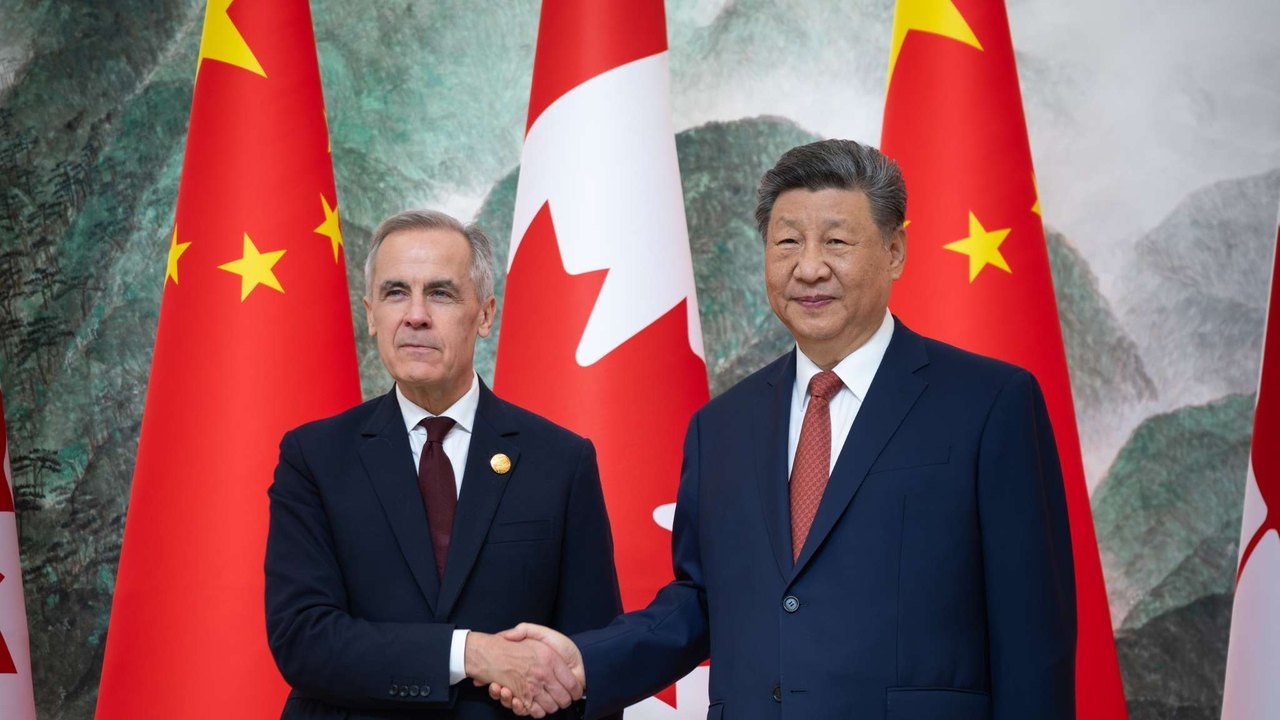
China will stop applying its tariffs to roughly C$400 million of Canadian pork and seafood exports in 2027 and 2028, and Canada will let more Chinese steel and aluminum in with duty refunds, according to a news release and a backgrounder that Prime Minister Mark Carney’s office issued in Shenzhen on Tuesday, Nov. 17. The office says Carney and Chinese President Xi Jinping agreed to extend and expand a preliminary trade arrangement, which the two governments first struck in January, CBC News reports. Xi received Carney on the morning of Nov. 17 local time, ahead of the Asia-Pacific Economic Cooperation leaders’ meeting that Shenzhen hosts on Nov. 18 and 19, according to China’s Foreign Ministry and Xinhua.
The Canadian side spells out the goods. A backgrounder from Carney’s office lists most frozen pork cuts at C$116 million, Greenland halibut at C$96 million, certain frozen cold-water shrimp and prawns, including Pacific spot prawn, at C$87.5 million, certain molluscs, including geoduck, at C$61.4 million and sea cucumber at C$39.4 million. Under the arrangement, it says, “China has agreed to suspend the application of its anti-discrimination tariffs from January 1, 2027, to December 31, 2028.” The Globe and Mail reports that the dollar amounts rest on 2024 trade values and that, according to the Canadian government, the two-year window gives more time to reach a permanent solution on the levies. A separate Global Affairs Canada backgrounder dated Nov. 16 gives the start date as Jan. 1, 2026, which conflicts with the prime minister’s office and the Globe; this desk follows the later, more detailed Nov. 17 document.
In return, according to the backgrounder, Canada will extend to Dec. 31, 2028, existing remission measures for certain Chinese steel and aluminum products that now cover only goods imported by the end of 2026, and will widen coverage to “32 tariff items (23 steel tariff items and 9 aluminium tariff items), for which Canadian supply is insufficient or unavailable.” Remission lets importers claim refunds of Canada’s 25 per cent tariffs on those products, The Globe and Mail explains. The deal builds on a two-year extension of Chinese tariff relief for canola meal, peas, lobster and crab that the two sides announced earlier this month, according to Carney’s office and CBC News.
Videos from X: Shanghai’s ShanghaiEye report on the meeting, CCTV+ footage of Carney’s arrival, and the leaders’ opening remarks.
View the @ShanghaiEye post on X
View the @CCTV_Plus post on X
View the @BeautifulCana1 post on X
“Canada and China have recalibrated our relationship to the benefit of citizens in both countries,” he said in the release. “We have unlocked billions in new export orders for Canadian farmers, ranchers, and fish harvesters – for workers and businesses across the country.” His office says Canada has restored market access for more than 90 per cent of the trade China had hit with tariffs, worth nearly C$7.5 billion in exports. In public remarks before the private talks, Carney told Xi, “We can work together more broadly, pragmatically to solve problems,” CBC News reports, and praised Shenzhen’s growth from “a rustic fishing village to an innovation-forward megacity.”
China’s official account of the meeting does not list the tariff items. The Foreign Ministry quotes Xi calling the improvement of China-Canada ties “a right choice” and laying out four proposals: more political trust, deeper cooperation in trade, energy, agriculture and finance plus newer fields such as e-commerce and the digital economy, more people-to-people exchanges, and joint support for “true multilateralism.” The ministry’s summary has Carney pledging to “reduce the list of irritants, expand the list of cooperation.” Neither that English text nor Xinhua’s Chinese report mentions the pork and seafood figures; those come from the Canadian documents. According to The Globe and Mail, Xi told Carney, “Exchanges and co-operation across various fields between our two countries have fully resumed,” and the meeting lasted about 25 minutes.
The package also carries smaller items. Carney’s office lists a major Canadian trade mission to China in 2027, a Canada-China Year of e-Commerce in 2027, C$850,000 over three years for 850 Canadian students at Chinese universities, and C$8 million over five years for the China Council for International Cooperation on Environment and Development. It also cites new Air Canada flights from Vancouver to Guangzhou starting in May 2027, more than C$15 million in arts and culture deals, among them a plan to bring Cirque du Soleil’s show Kurios to Shanghai in 2027, and a Canada-China CEO Roundtable co-chaired by the Canada-China Business Council and the Bank of China. CBC News and Global Affairs Canada add that the two sides agreed to advance market access for Canadian faba beans, chickpeas and lentils, and to work toward arrangements on pet food and wild aquatic products by the end of the year.
Canadian meat groups welcomed the pork relief while pointing to what remains blocked. Chris White, president of the Canadian Meat Advocacy Office in Beijing, said the move removes about half the barriers facing Canadian pork, and China’s 25 per cent tariff on offal stays in place, The Globe and Mail reports. “We look forward to the next round of negotiations,” White said. The Globe cites industry estimates that Canadian pork exports to China ran about C$450 million in 2024, before the tariffs, and might reach C$250 million this year. Canadian Meat Council CEO Kyle Larkin told reporters in Shenzhen, “We're confident with the momentum that we've had here,” according to CBC News.
The Globe notes that Carney remains locked in trade negotiations with the United States, and its reporter Steven Chase writes that a more relaxed policy on Chinese metals “could anger the Trump administration,” which, the paper says, has portrayed Canada as a back door for Chinese goods. Before the meeting, Carney had said Canada could turn to Chinese automakers if talks with the U.S. fail, CBC News reports. That drew a rebuke from Peter Navarro, a senior trade adviser to President Donald Trump, who wrote on X on Monday: “Are u really threatening to play China off the U.S.? This is offensive in the extreme. You should be far more worried China is going to eat Canada alive--as it is already doing.” The Globe reports that a 25 per cent U.S. tariff now applies to Canadian-made autos, with a carve-out for U.S. content.
Critics of Carney’s China policy also weighed in. Michael Kovrig, a former Canadian diplomat and one of the two Canadians whose detention in China began in late 2018 and, according to CBC News, lasted more than 1,000 days, posted on X on Tuesday: “What Beijing wants from this meeting isn’t trade. It’s America’s neighbour normalizing relations on Xi’s terms while Trump squeezes it.” CBC says Xi’s framing of seeking common ground while setting differences aside “has alarmed human rights activists,” and that Carney said before leaving Canada that he would raise foreign interference with Xi; a Chinese government spokesperson has denied any such activity, CBC adds. Kody Blois, Carney’s parliamentary secretary, told the Globe that guardrails still fence off areas such as critical minerals from Chinese investment.
The numbers around the deal vary by source. Carney’s office puts Canada’s 2025 merchandise trade with China at C$125.6 billion and its merchandise exports to China at C$35.1 billion, while The Globe and Mail reports that Carney told Xi Canada has made headway toward a 50 per cent rise in annual exports to China, which the paper puts at about C$50.2 billion a year from C$33.4 billion last year; this desk could not reconcile the two export figures. The Globe also notes that Canada sold more than C$560 billion of goods to U.S. customers in 2025. On electric vehicles, CBC News cites Carney’s office as saying 16,211 Chinese EVs have entered Canada since March under January’s low-tariff quota of up to 49,000 vehicles.
Carney now moves on to the APEC leaders’ meeting, where, according to his office, he will represent Canada. Shenzhen also hosts the planned first three-way meeting of Trump, Xi and Russian President Vladimir Putin, as Seems News reported; Trump’s own stop in Manila this week produced a trade statement with Thailand, covered in our daily President brief. Foreign Minister Anita Anand, who sat in on the Xi meeting, wrote on X that the two countries “are extending and expanding our preliminary joint arrangement on economic and trade issues.”