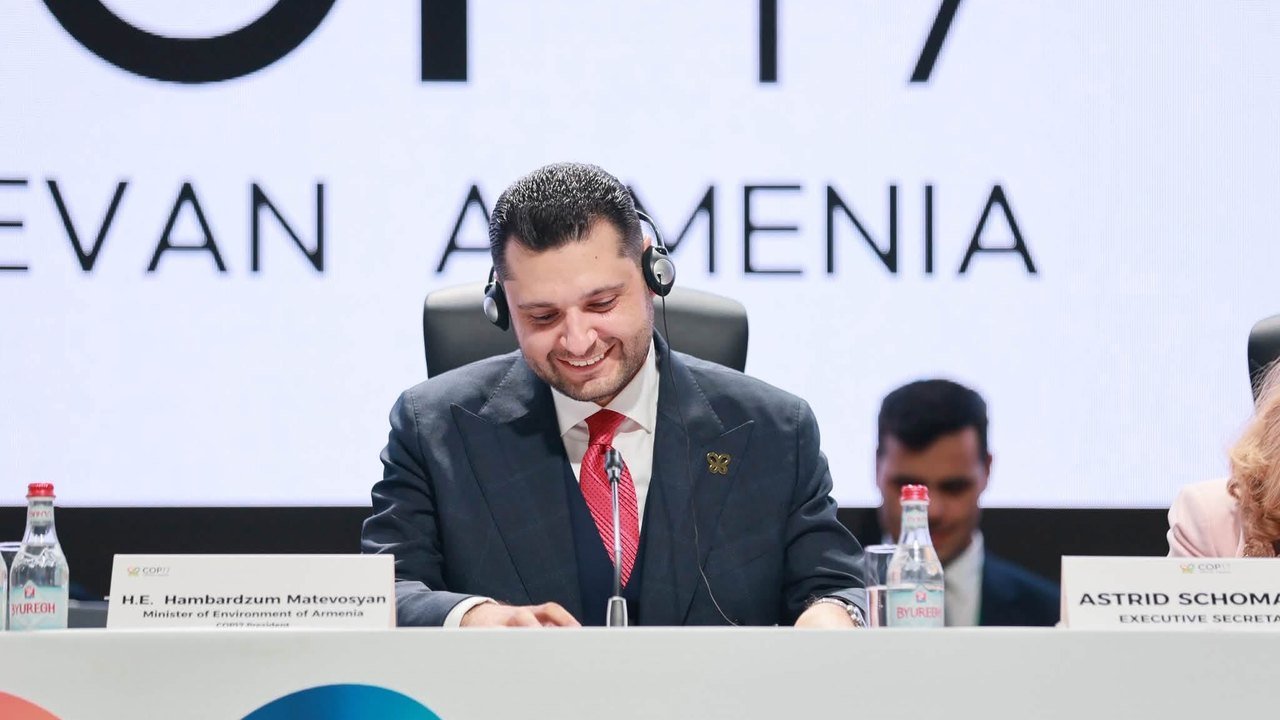
Two weeks of United Nations talks on saving the world’s wildlife ended in Yerevan, Armenia, on Saturday, Oct. 31, with a package of decisions that its host called a success and that many campaigners called too thin on money. The 17th Conference of the Parties to the Convention on Biological Diversity, known as COP17, adopted a plan named the Yerevan Pathway and, for the first time, invited big emerging economies such as China and the Gulf states to step into donor roles, according to Climate Home News and the BBC. The Earth Negotiations Bulletin, which follows the talks hour by hour, reports that the meeting gaveled to a close at 10:20 a.m. local time, about 11:20 p.m. PT on Friday.
The final stretch ran through the night. According to the Earth Negotiations Bulletin, the closing plenary opened late on Friday evening, broke off at 1:10 a.m. over texts on forests and agriculture, adopted them after consultations, held a secret ballot on the next host city, and then fought over decisions on Indigenous Peoples and local communities until about 8 a.m. Saturday. Xinhua describes “marathon negotiations spanning roughly 12 hours from Friday night through Saturday morning.” “And that’s it. Perfect,” said Matevosyan, Armenia’s environment minister and the COP17 president, as countries agreed the key parts of the plan early on Saturday, according to the BBC.
An exhausted Matevosyan told journalists in the early hours of Saturday that “we’ve achieved more than we could’ve expected,” Climate Home News reports. He added: “It was 100% possible that those items did not made it through. 100% possible,” and said the conference had made progress on “all the most important items,” according to the outlet. The official presidency account on X posted at 3:44 p.m. PT Friday that the Yerevan Pathway sets “priorities for collective action, including the implementation of national plans, mobilization of financial resources, stronger science and monitoring, and broader participation.”
The talks set out to check progress on the Global Biodiversity Framework that governments signed in 2022, which includes a pledge to protect 30% of the planet’s land and sea by 2030. The news looks poor. A recent UN progress report found the world off track on 22 of 23 global targets, Climate Home reports, while the BBC counts two dozen targets and says the world stands on track to meet just one. If countries keep only their current national goals, about 26% of land and only about 12% of marine ecosystems would fall under protection by the end of the decade, according to Climate Home.
Astrid Schomaker, the convention’s executive secretary, framed that gap as the reason for the new plan. “It was clearly acknowledged that we are falling behind on all 23 targets, with uneven progress in some areas,” she told a closing press conference, according to Armenpress. “The Yerevan Pathway is a central component of the decision on the global review. We recognise that progress is neither fast enough nor sufficiently comprehensive,” she said, the agency reports. In a clip posted by AFP on Saturday, she says: “We are here at this COP going to adopt decisions that will change the course of this biodiversity trajectory.”
Watch: the convention’s chief on the outcome, via @AFP on X
A short news clip. If the embed does not load, it shows as a plain link to the original post.
View the @AFP post on X with Astrid Schomaker speaking about COP17
Watch: Ecuador wins the vote to host COP18, via @COP17_Arm2026 on X
View the @COP17_Arm2026 post on X about Ecuador hosting COP18 in 2028
The Yerevan Pathway puts a focus on “marine, coastal and inland water ecosystems,” urges the more than 60 countries that have not yet filed a national plan to finish one “as soon as possible,” and calls for “accelerating” the reduction of subsidies for activities that damage nature, Climate Home reports. Subsidy reform shows the least progress of any target so far, according to the outlet. Jill Hepp of Conservation International said singling out subsidies “gives a strong signal,” Climate Home reports. Anna Ducros, a researcher at the International Institute for Environment and Development, told the BBC: “Right now, we have the situation where governments are paying twice.”
The fight over who pays dominated the two weeks. Having missed a goal to channel $20 billion for nature by 2025 and facing shrinking aid budgets, the European Union pushed to widen the list of donor countries so that wealthy emerging economies could contribute, and the group of Arab nations strongly opposed the idea, Climate Home reports. The compromise struck on the last day invites developing countries that want donor status to tell the convention’s secretariat of “their interest in being included in the corresponding list.” Swiss negotiator Gabriela Blatter said that “if we’re mutually unhappy, it’s probably the closest we can get on these very delicate political compromises,” while Saudi Arabia said it had expected “a lot less,” according to the outlet. In a closing statement, the EU called the progress on broadening the donor base “timid,” Climate Home reports.
The deal held together partly because some delegations, including Brazil and China, asked the plenary not to reopen the text at the risk of collapsing the whole agreement, Climate Home reports. The BBC reports that countries pledged more than $1 billion at this meeting, half of it from philanthropists, and that they have put 623 million acres (252 million hectares) of degraded land into protection, against a 2022 promise to put $30 billion toward nature recovery by the end of the decade and to mobilise a further $170 billion from private sources. The Pacific Islands group told the closing plenary that delegates leave Yerevan “with realities not reflected in the official text,” such as a low top-up of the Global Environment Facility, according to Climate Home.
The Cali Fund drew some of the sharpest criticism. Set up so that companies profiting from genetic material found in nature pay into conservation, it could raise up to $3.6 billion a year by one estimate cited by the BBC, or up to $6.9 billion by the expert estimate cited by Climate Home; by the start of this meeting it held just $10,000 in pledges, the BBC reports. The final decision laid out some rules, including how companies can earn “Cali Fund certificates,” but left key technical details to 2028, Climate Home reports. “By punting essential decisions to two years from now, parties have all but ensured the fund remains empty until then,” Pakhi Das of Plant-for-the-Planet told the outlet. Schomaker conceded that the fund “has not been as successful as we had hoped, or as it should have been,” according to Armenpress.
Science also became a flash point. Approving scientific reports on the state of nature had looked like one of the easier items, but a small group of countries, including Saudi Arabia and Russia, reportedly frustrated that process, the BBC reports. “The attacks on science have bothered me a lot,” French Ecological Transition Minister Monique Barbut said, according to the BBC, citing AFP. The Earth Negotiations Bulletin reports that delegates did adopt a decision on the work programme of the science panel known as IPBES, and that several items, including cooperation with other conventions, went to COP18 for lack of time. Xinhua reports that “divisions over biodiversity finance, harmful subsidies and scientific evidence persisted.”
Reactions split along familiar lines. “While not particularly exciting or detailed, it’s good news that countries could reach agreement,” Catherine Weller of Fauna & Flora told the BBC, adding: “We cannot just plod on to 2030 without a course correction.” Craig Bennett, chief executive of The Wildlife Trusts, told the BBC: “We are still seeing an appalling loss, threatening the collapse of ecosystems globally.” Steven Guilbeault, a former Canadian environment minister who helped broker the 2022 framework, called the package “an important step forward” that still “falls short of what is needed to meet our 2030 commitments,” and Greenpeace’s An Lambrechts said its promises “won’t remove major roadblocks to implementation,” Climate Home reports.
The next round goes to South America. In a secret ballot announced at 3:05 a.m. Yerevan time, about 4:05 p.m. PT Friday, Quito, Ecuador, won the right to host COP18 in 2028 with 55 votes to 53 for Panama City, according to the Earth Negotiations Bulletin; the presidency posted a video of the announcement. Schomaker warned, according to Armenpress, that “nature itself will hold us to account. If we fail to fulfil our commitments by 2030 and biodiversity continues to decline, governments will have to pay an incomparably higher price than would have been necessary had we begun acting today.”