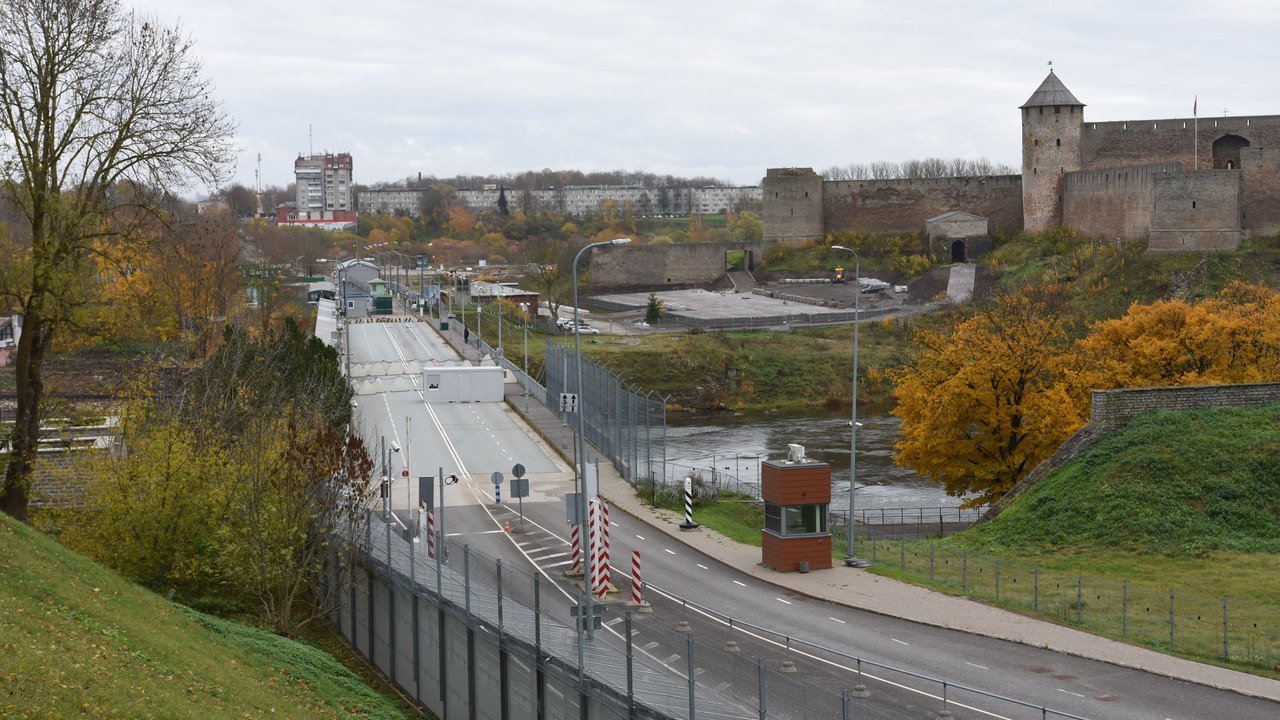
Estonia says it will close its border crossings with Russia from Dec. 1, a step its government ties to a failed arson attack on a drone maker near Tallinn that the country’s security service attributes to Russian military intelligence. Foreign Minister Margus Tsahkna announced the decision on X on Sunday afternoon, Nov. 15, Estonian time, about a day and a half after the attempt.
“Following clear evidence that Russia’s military intelligence service GRU, ordered a sabotage attack against an Estonian defence industry company, Estonia will close all Estonian-Russian border crossing points as of 1 December,” Tsahkna wrote. “Russia must understand that hostile actions against Estonia come with consequences,” he added, saying the closure “will reduce Russia’s ability to conduct hostile activities in Estonia and strengthen our efforts to prevent sanctions circumvention.” He said he had informed his Finnish, Latvian and Lithuanian counterparts. The Estonian Foreign Ministry reposted the decision, adding: “Russia’s attempts to intimidate, destabilise, or undermine our security will come with a price.” Reuters, as carried by The Star, reports that Tsahkna did not say how long the closure would last.
The attack itself unfolded before dawn on Saturday. Prosecutor General Astrid Asi told a press conference on Sunday that someone tried to break into the Threod Systems property in Viimsi, north of Tallinn, to start a fire at 3:06 a.m. on Nov. 14, and that the company’s security team stopped it, ERR News reports. KAPO Director General Margo Palloson said the attackers tried to break the building’s windows and pour flammable liquids inside to set it alight and cause an explosion. “We assess that if this attack had succeeded in the way the attackers planned, it would have caused very significant damage to the company,” he said, per ERR. Palloson said nobody got hurt, the company suffered no significant damage, and its production and deliveries carried on. KAPO’s own post on X gives the same 3:06 a.m. time and adds: “We advise against even considering such job offers from Russia. The consequences are serious!”
Threod makes long-range reconnaissance and attack drones, according to ERR News and Politico Europe; the Estonian Foreign Ministry describes it as a maker of unmanned aircraft systems and electro-optical surveillance and reconnaissance systems.
On who carried it out, the accounts line up on the number but differ slightly on detail. KAPO and the Police and Border Guard Board detained eight people, all residents of Latvia, ERR News reports, quoting Asi: “The Prosecutor's Office submitted an application to the court for the arrest of five suspects.” Politico Europe reports that five “have been remanded in custody.” This desk did not find a court ruling or the court’s own statement to settle which stage the five had reached. Palloson said the GRU recruits EU residents who can move freely in the Schengen Area to carry out sabotage, drawing on criminal circles and people in difficult circumstances, per ERR.
Latvia’s side adds detail Estonia did not. The Latvian State Security Service says it “obtained and provided risk information” to KAPO about possible sabotage plans, after which the two services worked together, and that “a total of eight Latvian nationals were detained on Estonian territory on the night of 14 November,” according to its press release (also posted on X). The VDD says it carried out criminal proceedings at nine sites in Latvia linked to the suspects the same day, and that “explosive devices, pyrotechnic articles and ammunition were seized, as well as a large amount of mobile phones and other data storage devices.”
Prime Minister Kristen Michal asked Interior Minister Igor Taro and the Government Office to “prepare the necessary steps” for a closure, ERR News reports. “If Russia continues its hybrid operations in Estonia, and we know that Russian intelligence services exploit border crossings to exert influence over people, we must be prepared to reduce the risks we face,” Michal said, per ERR. Taro said he would propose closing all road crossings to pedestrians and vehicles from the start of December, that the government would discuss the plan next week, and that it would discuss in the coming days whether the closure stays temporary or open-ended, ERR reports. Estonians in Russia would have two weeks to come home: “After that, the journey home could become long and complicated,” Taro said, according to ERR.
The scope reads slightly differently across sources. Tsahkna’s post speaks of “all” crossing points; ERR News says the Foreign Ministry clarified that the road crossings will close on Dec. 1. Estonia has three open road crossings at Narva, Luhamaa and Koidula, which admit pedestrians and freight 12 hours a day, plus railway crossings at Narva and Koidula, ERR reports; it did not say what happens to rail traffic. Narva, ERR notes, remains one of the few European land crossings with Russia still open to travelers since the 2022 full-scale invasion of Ukraine.
Moscow had not answered as of Sunday morning, Pacific time. Reuters, as carried by The Star, reports no immediate comment from Moscow and notes that Russia regularly denies European accusations of sabotage. Politico Europe says it contacted Russia’s Foreign Ministry for comment. The Russian daily MK wrote that Tsahkna offered no evidence and that Russian officials had not yet reacted (this desk’s paraphrase of the Russian text). When Estonia blamed Russian services for an August arson at Milrem Robotics, Kremlin spokesman Dmitry Peskov said in September: “Such statements are baseless, ill-considered, bear no relation whatsoever to reality, and lack any form of reasoning,” per Reuters via Devdiscourse.
Estonian officials cast the attempt as part of a wider campaign. Tsahkna said in a separate post that the Kremlin “is increasingly resorting to sabotage” and that “Ukraine’s resilience and strategic momentum have clearly rattled Putin.” In a ministry release, he said he planned to raise the case “at Monday’s meeting of EU foreign ministers.” ERR News counts this as the second known attempted arson on an Estonian defense company this year, after the August fire at Milrem’s Tallinn office, which KAPO also attributed to Russian services.
What to watch: the Estonian government’s formal decision next week and whether it covers rail as well as road crossings; whether the closure gets an end date; the court’s ruling on the five suspects; any comment from the Kremlin or Russia’s Foreign Ministry; and whether Finland, Latvia or Lithuania, all informed by Tsahkna, take similar steps.