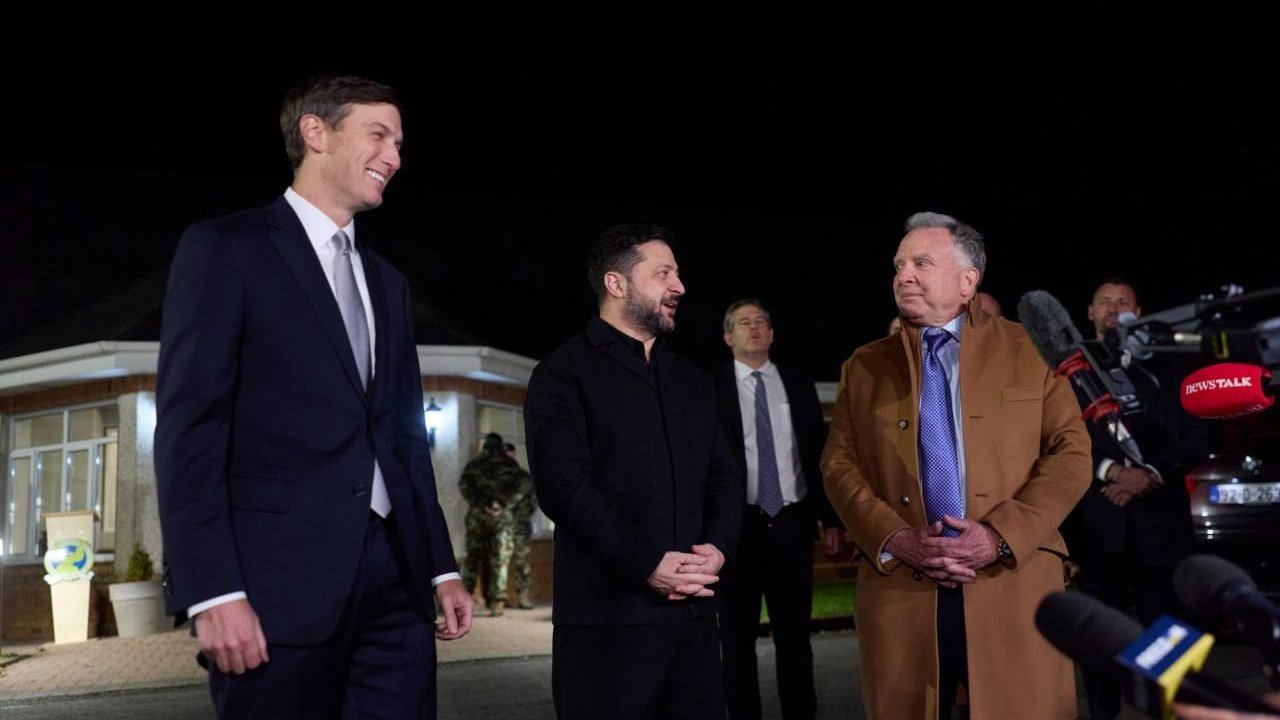
Ukraine’s president says Washington has put a new question on the table. Volodymyr Zelenskyy told reporters that U.S. negotiators asked whether Ukraine would pull out of the eastern Donbas region in exchange for joining NATO, and that nobody had raised the idea before. “The Americans raised a question: ‘What if Ukraine joins NATO? Would Ukraine withdraw from Donbas?’ This was the first time this had been raised,” Zelenskyy said in remarks released by his office on Saturday, Nov. 14, in the English translation carried by the BBC and Politico Europe; Reuters via NBC News carries the question in the same words but paraphrases the first-time line. RFE/RL and the Kyiv Post date the conversation with journalists to Friday, Nov. 13, a day after he met U.S. envoys Steve Witkoff and Jared Kushner near Dublin, according to Politico.
Zelenskyy tied the question to a larger shift. “That is why I believe NATO is back on the agenda. But you have also heard (Russian President Vladimir) Putin’s signals, and this is an extremely difficult conversation,” he said, per Reuters via NBC News. Kyiv has sought membership in the alliance for years, while Russia calls another NATO member on its border unacceptable, the BBC notes. RFE/RL adds that U.S. officials had previously described Ukrainian NATO membership as off the table, offering instead guarantees comparable to membership.
He did not accept the trade. “I have said repeatedly: Ukraine is not retreating and is not giving up its land to terrorists,” Zelenskyy told reporters, according to Politico. Instead he described a “comprehensive security package” under discussion with partners: specific guarantees from NATO and the EU, a strong Ukrainian army with enough troops, weapons and money for a set period, and a recovery plan with clear funding. “If the American side confirms precisely this to us, together with other NATO partners, then I will ask our Ukrainian society what it thinks: do we accept it or not? I have no right to make that decision on my own,” he said, in Politico’s translation. DW and Reuters describe that step as a national referendum.
Zelenskyy drew two firm lines. “Of course, this would be without any recognition of the occupied territories as Russian,” he said, per Politico, and he added that the details do not yet exist: “But we need specifics, and we don't have them yet. All of this is still under discussion.” On the alternative of NATO-style guarantees, RBC-Ukraine reports that the U.S. side described bilateral agreements without U.S. troops stationed in Ukraine, and quotes Zelenskyy: “Enshrining neutrality means changing your country's Constitution, and Ukraine will not agree to that.” BBC News Ukrainian quotes him saying that Washington now suggests guarantees could resemble NATO’s Articles 4 and 5, and that Kyiv needs a clear understanding of what such wording would mean.
The clip below comes from Italy’s RAI Tg3 news program, posted Saturday.
View the @Tg3web post on X
Washington has not confirmed the account. The White House and the State Department did not immediately respond to requests for comment, Politico reports, and RFE/RL says Washington had not commented on the claim when it published. A U.S. official told the BBC: “many ideas continue to be discussed but any final deal will have to be agreed to by both parties.” Hours after the remarks surfaced, Kushner posted on X that he and Witkoff remain in close consultation with Russia, Ukraine and European partners (Kushner on X). The BBC reads that post as an effort to dampen talk of a U.S. NATO offer: it says Kushner urged “confidentiality,” said “maximalist” proposals had surfaced in reports along with “strong political rhetoric,” and referred to “private discussions” meant to explore new ideas.
Moscow’s position, as outlets describe it, points the other way. The BBC reports that Russia has insisted again that it will not agree to a ceasefire until a final peace deal hands it the parts of the Donbas its troops have not captured, along with Crimea, which Moscow annexed in 2014. Russia controls roughly a fifth of Ukraine, including most of the Donetsk and Luhansk regions that make up the Donbas, the BBC says. According to DW, Putin has demanded that NATO pull its troops back from the Russian border, and The Washington Post reports that at this week’s talks Russia returned to hard-line ultimatums the Kremlin issued to NATO and the U.S. before its 2022 invasion. Kremlin spokesman Dmitry Peskov said Nov. 14 that Russia would not set conditions on who represents Europe at the talks, NV reports, citing the Telegram channel Yunashev Live; NV does not report any Kremlin response to the NATO-for-Donbas question.
Zelenskyy also warned against reordering Europe’s security first. “We cannot turn everything upside down and start by talking about changing the security framework in the world or across the continent overall, and only then talk about ending this war. This war must be ended first,” he said, per Reuters via NBC News. He told reporters, according to DW: “Real security in Europe means the EU and NATO. That's it. There is no other security in Europe.” He also rejected Putin’s proposal for a local humanitarian ceasefire in the contested city of Kostiantynivka. “Putin simply wants us to leave Kostiantynivka so that they can move in and occupy the entire city that way,” he said, per Reuters.
The remarks follow the U.S.-hosted talks in Abu Dhabi on Nov. 10 and 11, after which Kushner and Witkoff met Putin in Moscow and then Zelenskyy, RFE/RL reports. The only tangible result so far, RFE/RL says, involves preparations for a large prisoner exchange; RBC-Ukraine quotes Zelenskyy putting it at “more than 1,000 for more than 1,000,” with the final number expected between 1,200 and 1,300. Europe should sit at the same table next time, Zelenskyy said, per RBC-Ukraine: “Next time, Europe will not be in the next room but at the same negotiating table, and we will have a joint agenda.” After an informal EU summit in Dublin on Nov. 13, European Council President António Costa said the EU and Germany, France, the United Kingdom, Italy and Poland would jointly represent Europe, according to NV.
The fighting continues meanwhile. Russian strikes on the southern city of Zaporizhzhia on Nov. 14 injured at least 22 people, including three children, RFE/RL reports, and DW, citing Interfax, says Russia’s Defense Ministry claimed the capture of the settlement of Tersianka in the Zaporizhzhia region. This desk could not independently confirm the battlefield claim.
What to watch: whether the White House or the State Department confirms or denies that U.S. negotiators raised the NATO-for-Donbas question; whether any written proposal reaches Kyiv; how the Kremlin answers; who Europe names to its negotiating team; and whether the prisoner exchange goes ahead. Zelenskyy himself says the specifics do not exist yet, and no agreement has emerged on territory or security guarantees.