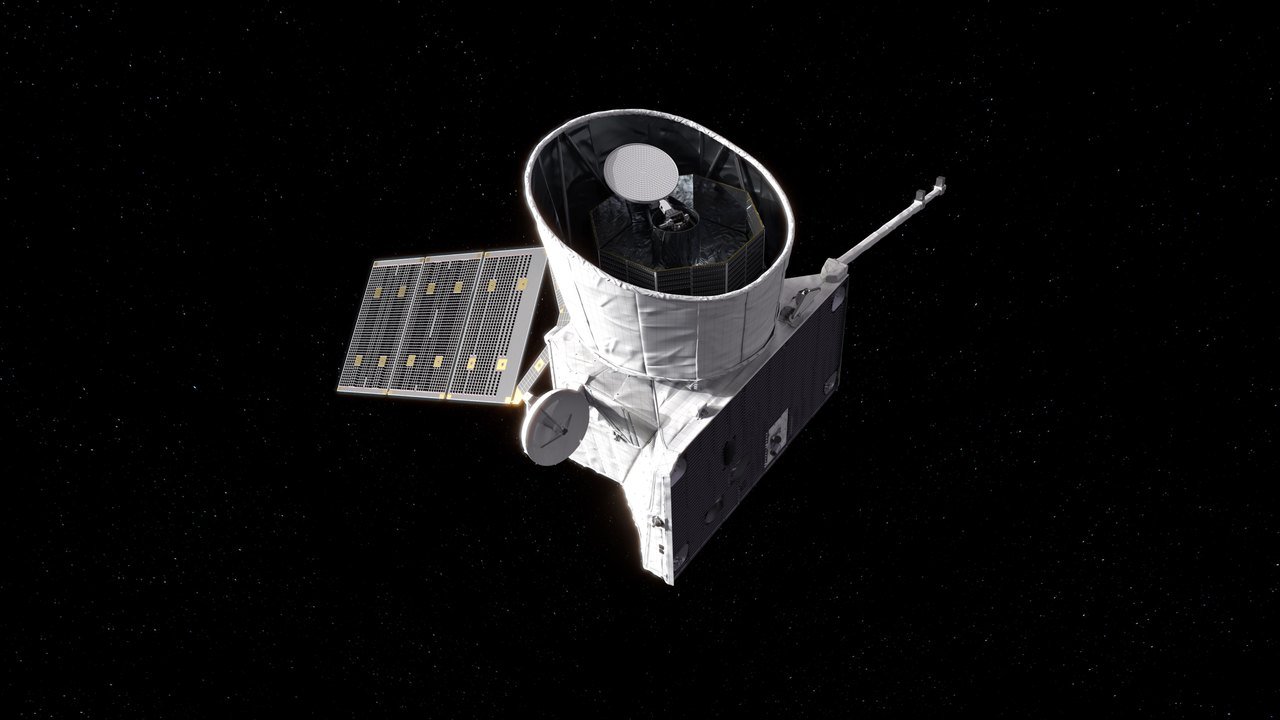
A spacecraft built by Europe and Japan now circles Mercury, according to the European Space Agency. After a 37-minute engine burn on Saturday, Nov. 21, ESA Operations posted on X at 5:00 p.m. PT: “We’ve heard back from Bepi - the spacecraft is now in contact with Ground and the teams at ESOC are busy assessing the telemetry, but Flight Dynamics already has confirmed it achieved orbital capture around Mercury!” (@esaoperations on X). ESA’s mission page places the flight’s mission control team at ESOC (ESA). AFP, quoting the same post, reports that BepiColombo “achieved orbital capture” around the smallest planet in the solar system (AFP), and the Associated Press reports that the pair of spacecraft “slipped into orbit around Mercury on Saturday after an eight-year cruise through the inner solar system” (AP).
The maneuver ran mostly out of contact. At 9:08 a.m. PT, ESA Operations said the spacecraft had turned into the attitude needed for the burn, which brought “the expected loss of signal” (@esaoperations). At 10:25 a.m. PT the account posted that the burn had begun, then edited the post minutes later to say the craft “should have now begun” it, adding that for 37 minutes the Mercury Planetary Orbiter’s four chemical thrusters would fire through closest approach at 635 kilometers above the surface (@esaoperations). At 11:02 a.m. PT it posted that the burn “should have finished by now” and that ESA’s New Norcia (NNO) deep-space antenna stood ready for the signal to return (@esaoperations). The confirmation of capture came about six hours later.
Videos from X: ESA animations posted during the orbit insertion. Seems News did not verify or edit the footage.
View the @esaoperations post on X
View the @esaoperations post on X
Only one mission had orbited Mercury before. Nature reports that BepiColombo becomes only the second, after NASA’s MESSENGER, which circled the planet from 2011 to 2015 (Nature). AFP notes that NASA’s Mariner 10 first flew past the planet in 1974 (AFP). The AP puts the mission’s cost at $2 billion (1.7 billion euros) (AP).
Reaching Mercury took a long, roundabout path. Emma Bunce, a University of Leicester plasma physicist whom Nature identifies as one of the mission’s leading scientists, called the trip a “prolonged affair” and told Nature: “Energetically, it takes more energy to go to Mercury than to go to the outer Solar System” (Nature). The spacecraft launched in October 2018 and had to fall closer to the Sun without picking up so much speed that it overshot the planet, Nature explains (Nature). AFP describes a four-tonne craft that traveled more than 10 billion kilometers (AFP); Orbinauts, a space-tracking site, counts nine planetary flybys (one of Earth, two of Venus and six of Mercury) and 9.9 billion kilometers covered by September (Orbinauts).
The arrival begins a longer sequence, not the end of it. The two science orbiters still travel stacked together. ESA plans to separate them on Dec. 9–10, after which, it says, BepiColombo will become the first mission flying two spacecraft around Mercury; the European orbiter will then make many more burns to reach its final science orbit by March 2027, with science operations for both craft set to begin in April 2027 (ESA). ESA’s mission page lists a separate step on Dec. 16, when a sunshield and interface structure that protects Mio should detach from the European orbiter (ESA). Orbinauts reports that ESA plans 16 burns between Nov. 21 and March 2027, starting with a block of five, about one every three days, that must finish by early December, before Mercury’s long eclipse season (Orbinauts).
The two craft will split the work, according to Nature and AFP. Japan’s Mio, built by the Japan Aerospace Exploration Agency, will fly a long ellipse, reaching as far as about 11,000 kilometers from the planet, to study Mercury’s magnetic field and its interaction with the solar wind; ESA’s Mercury Planetary Orbiter will descend to a much lower orbit to study the surface continuously (Nature; AFP). Nature gives that final orbit as 400 to 1,500 kilometers; AFP says the European orbiter will skim just 480 kilometers above the surface (Nature; AFP).
The sources describe a planet with open questions. AFP notes that Mercury’s temperatures swing from about minus 180 C to 450 C (AFP). Orbinauts reports that craters near the poles appear to hold water ice, which the European orbiter’s instruments aim to measure, and that the planet carries a global magnetic field despite its small size (Orbinauts). Santa Martinez, whom AFP calls ESA’s mission chief, told AFP earlier this year that the mission would “offer humanity never-before-seen views of Mercury and open a new chapter in our understanding of the Solar System” (AFP). On the way in, Nature reports, the team pointed the onboard X-ray camera, MIXS, at the Crab Nebula; Bunce told Nature that MIXS counts as the first X-ray imaging device sent on an interplanetary mission (Nature).
Some details remain open. ESA’s pre-arrival animation describes a planned initial orbit of 590 by 11,640 kilometers (ESA), while Orbinauts, citing ESA’s planning, describes a planned post-burn orbit of about 620 to 53,000 kilometers and notes that ESA has not yet said which orbit the spacecraft actually reached (Orbinauts). ESA Operations said teams continue to assess the telemetry and promised an update with the next steps early next week (@esaoperations). Seems News recently covered Voyager 1’s distance milestone in its Science section.