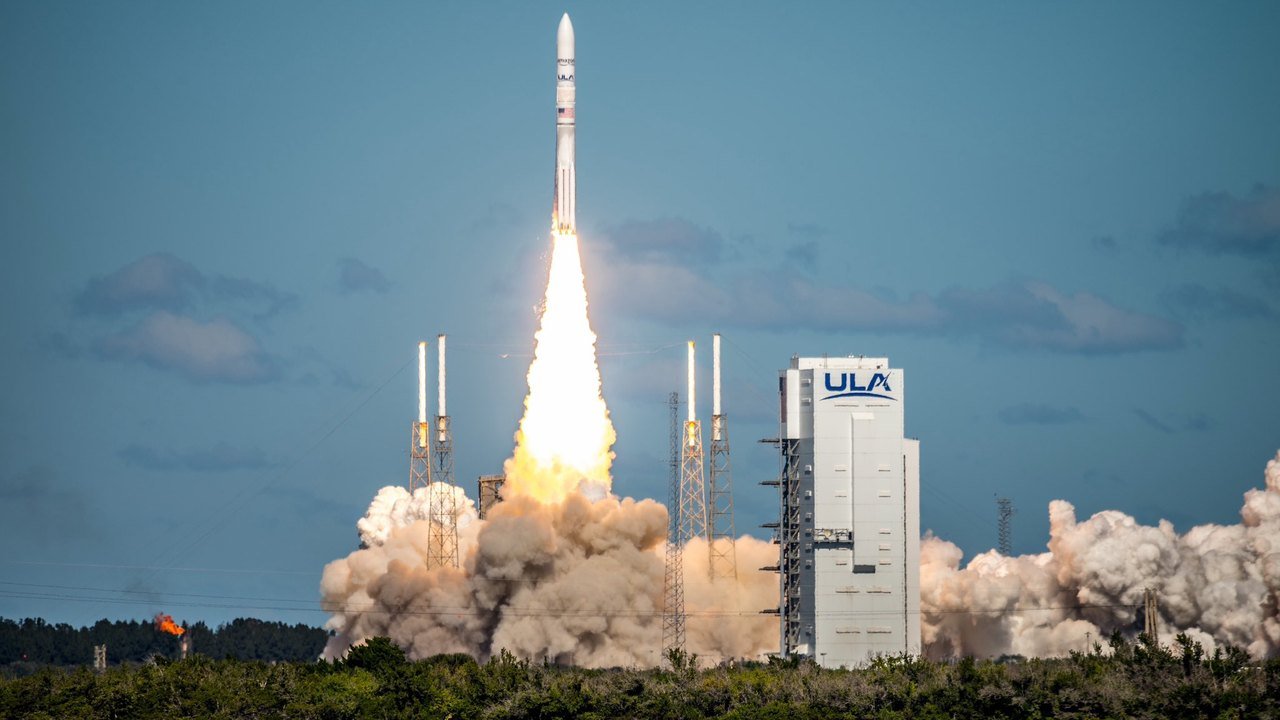
A United Launch Alliance Vulcan rocket failed on Sunday on its first flight in nine months, and the 40 Amazon Leo broadband satellites it carried never reached orbit. “Based on data received by our Launch Director, we confirm that the Vulcan vehicle launched from Space Launch Complex 41 suffered an anomaly 10 minutes into the flight and failed to deliver the Amazon mission to orbit,” ULA said in a post on X at 10:30 a.m. PT, about 50 minutes after liftoff. “Since the anomaly just occurred, we don’t have any specific data yet to understand what occurred today,” the company added.
The rocket lifted off from pad 41 at Cape Canaveral Space Force Station at 12:40 p.m. EST (9:40 a.m. PT), according to Space.com and Spaceflight Now, which describes the 214-foot rocket climbing away on six Northrop Grumman strap-on solid boosters and two methane-burning first-stage engines from Blue Origin. ULA’s own X account posted routine updates at first: it confirmed booster burnout and jettison and said Vulcan kept accelerating on its main engines. The company had posted “And LIFTOFF of the first Vulcan Amazon Leo mission” minutes earlier (ULA on X).
Three clips posted on X: the liftoff from ULA and NASASpaceflight, and a Reuters report on the failure.
View the @ulalaunch post on X
View the @NASASpaceflight post on X
View the @Reuters post on X
Spaceflight Now’s William Harwood reports that the first stage appeared to burn longer than ULA’s pre-launch timeline called for and appeared to separate from the Centaur upper stage later than expected, and that telemetry-driven animation showed the Centaur making unusual orientation adjustments early in its burn. The Centaur had a planned 12-minute, 15-second firing, and something went wrong during it, according to Spaceflight Now, which adds that ULA’s commentators mentioned no problems and the broadcast ended without confirming whether that burn ran its full length. Reuters likewise reports that the failure appeared to occur after the second stage, carrying the satellites, separated from the first-stage booster, which Blue Origin’s engines power.
The loss ends a long streak. Reuters calls Sunday’s flight ULA’s first mission failure in its 20-year history and says the company, formed in 2006 by merging Boeing’s Delta and Lockheed Martin’s Atlas rocket programs, had held a 100% mission success record since then. Spaceflight Now calls it the first outright failure of a ULA rocket since the company’s formation. In its statement, ULA wrote, “Today, we did not meet that standard,” referring to the standard of mission success, and said it would “work closely with our customer and other appropriate organizations to find the cause, determine the appropriate corrective action, and return to flight as quickly as possible” (ULA on X).
Amazon responded within about 90 minutes. “There is risk with any launch, and that’s especially true for inaugural missions like LV-01,” the company’s Amazon Leo account posted on X, using the mission’s name. “ULA has been a trusted partner for Amazon, and we believe they’ll learn from this mission and deliver on their long-term plans for Vulcan.” Reuters and DW carry the same statement. ULA also said its customers “will have visibility into the investigation process” (ULA on X). Blue Origin, which builds Vulcan’s first-stage engines, works with ULA on the investigation, Reuters reports, citing a person familiar with the matter who spoke on condition of anonymity.
The flight had already slipped twice. A Friday attempt got scrubbed after problems knocked out a gaseous nitrogen plant that serves several launch providers, and Saturday’s try got called off over network problems between the rocket and ground systems, Spaceflight Now reports. On Sunday, controllers called a hold at T-minus 20 seconds over an unexplained technical issue, then launched at the end of the window; Spaceflight Now says it remains unknown whether that issue played any role in the failure.
Vulcan had flown only four times before. On its second flight, in October 2024, and its fourth, in February 2026, a solid booster’s nozzle burned through and fell off about 30 seconds after launch, though both missions still reached their target orbits, Space.com reports. ULA said in an Oct. 28 update that it had “identified several potential contributors, which have been mitigated through design and process improvements to the nozzle,” according to Space.com, and ULA CEO Mark Peller told Aviation Week before the flight, “We’ve identified three credible causes (of the nozzle issue), and we have taken positive steps to mitigate all of those,” as quoted by Spaceflight Now. The boosters appeared to work normally on Sunday, both outlets report.
Those engines carried their own history. Blue Origin’s New Glenn rocket, which uses the same engine model, exploded on the pad in May, and an investigation traced that failure to an oxygen valve in one of its engines, according to Spaceflight Now and DW. Peller told Aviation Week that Blue Origin developed a “design improvement” and carried out a “retrofit” on the engines installed on this rocket, Spaceflight Now reports. Reuters says it remains unclear whether those engines played a role on Sunday.
The failure also touches the Pentagon’s plans. The Space Force had paused national security launches on Vulcan over the booster problems, and Sunday’s Amazon mission stood to give it more data before it decided whether to clear the rocket for those payloads, according to DW and Reuters, and Space.com likewise describes the pause; SpaceNews reported in September that a senior Space Force acquisition official said the service would require a separate review before Vulcan resumed national security launches (SpaceNews). Spaceflight Now says Vulcan will face a potentially significant grounding while engineers review telemetry (Spaceflight Now), and DW, drawing on Reuters and AFP, says the failure could ground the rocket for months.
For Amazon, whose constellation went by the name Project Kuiper until its renaming as Amazon Leo, according to Space.com, the failure marks another setback as it races to deploy satellites through outside launch providers, Reuters reports. Before Sunday, Amazon had launched 398 Leo satellites on 14 launches since 2025, about 12% of the 3,236 it needs for global coverage, Reuters reports; Space.com puts the figure at about 400 satellites on 15 launches, and Spaceflight Now says Sunday’s flight would have lifted the total to 436. Spaceflight Now lists Amazon’s other bookings as 24 launches on Blue Origin’s New Glenn, 24 on Europe’s Ariane 6 and 13 on SpaceX’s Falcon 9, plus eight already flown on ULA’s Atlas 5. SpaceX’s Starlink network has more than 11,000 satellites and millions of customers, Reuters reports.
What to watch: ULA’s promised updates as data comes in; whether the investigation points to the Centaur upper stage, as early reporting suggests, or elsewhere; how long Vulcan stays grounded; and whether the Space Force changes its timeline for clearing the rocket for national security missions. This desk found no update from ULA on the cause as of about 12:45 a.m. PT Monday.