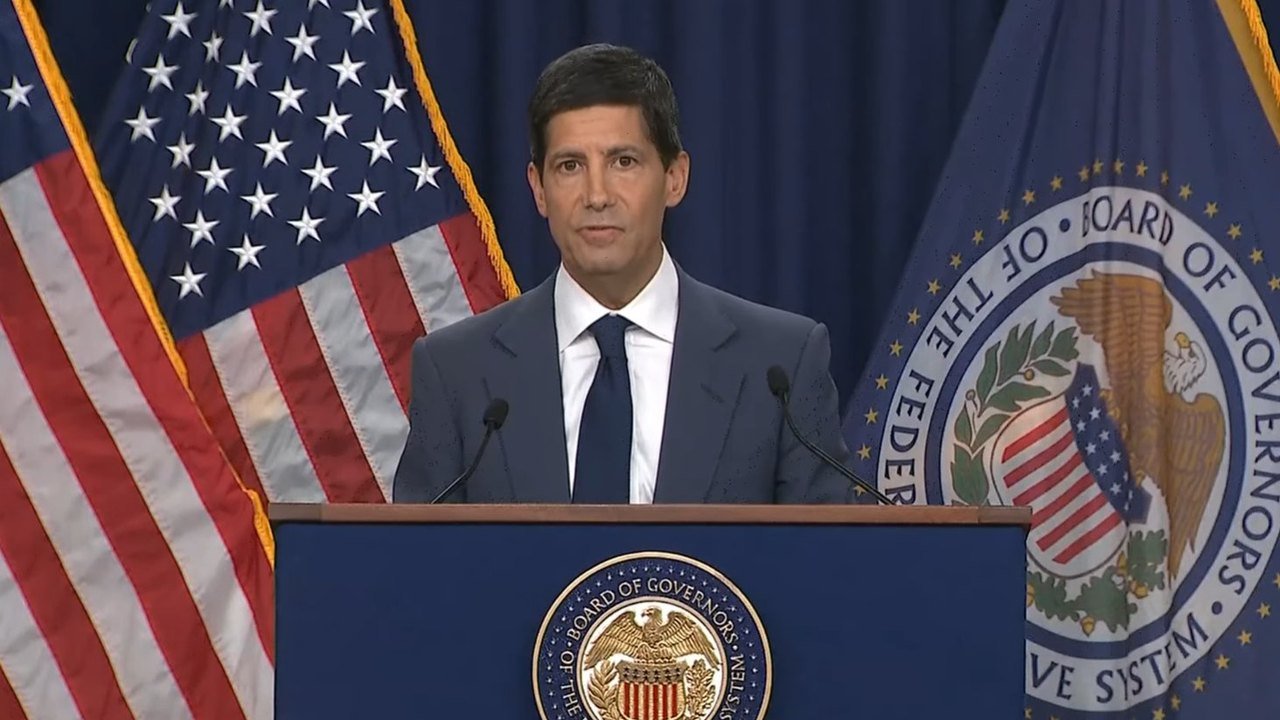
The Federal Reserve left its benchmark interest rate unchanged on Wednesday, Oct. 28, in a split vote. The Federal Open Market Committee kept the target range for the federal funds rate at 3-3/4 to 4 percent by a 10–2 vote, according to the statement it released at 2 p.m. ET, or 11 a.m. PT (Federal Reserve statement; CNBC). Governor Lisa D. Cook and Cleveland Fed President Beth M. Hammack voted against the decision; both preferred to raise the range by a quarter percentage point, the statement says (Federal Reserve statement). CNBC reports that the range has held since the central bank approved a quarter-point increase in September, and it calls Wednesday’s decision widely expected (CNBC).
The statement upgraded the Fed’s view of the economy while flagging prices. It says economic activity keeps “expanding at a strong pace,” that domestic spending has held up and that job gains have kept pace with the workforce (Federal Reserve statement). Reuters and CNBC both note that the word “strong” replaced “solid” from the September statement (Reuters via Investing.com; CNBC). On inflation, the committee wrote: “Inflation remains elevated. The accumulation of more information will help the Committee determine the policy stance appropriate to ensure a timely return of inflation to the Committee's 2 percent goal. The Committee will deliver price stability” (Federal Reserve statement). Reuters describes the wording as a hint of the forward guidance that Chair Kevin Warsh has said he wants to avoid (Reuters via Investing.com).
The two dissents drew attention for different reasons. Reuters calls Hammack a consistently hawkish voice who also dissented in July for the same reason (Reuters via Investing.com). CNBC reports that the vote marked Cook’s first dissent since she joined the Fed in 2022 as an appointee of President Joe Biden (CNBC). President Donald Trump has tried to remove Cook from office; the Supreme Court stopped his earlier attempt, and the administration has restarted the effort, with a hearing scheduled for early November, according to CNBC, which adds that Cook has denied the claims behind it (CNBC; CNBC live blog). Chris Rupkey, chief economist at FWDBONDS, told CNBC that Cook’s vote could amount to a protest vote, a reading that Cook herself had not addressed in the coverage this desk read (CNBC live blog). Trump, who nominated Warsh to the post, has argued that the funds rate should go much lower, CNBC reports (CNBC). Dallas Fed President Lorie Logan and Minneapolis Fed President Neel Kashkari, who voted no at the July hold, joined the majority this time, CNBC reports (CNBC).
Warsh opened his news conference, which began about 11:30 a.m. PT, by repeating the statement and describing how the committee reads the data. He said he and his colleagues assess the economy “by looking out the window,” a practice he called “interrogating reality” (Fed press conference transcript). “Economic growth has strengthened,” he said, adding that a revision lifted the estimate of first-half GDP growth from 1.8 percent to 2.4 percent and that third-quarter consumer spending likely grew above 3 percent (Fed press conference transcript). He said inflation has run above the committee’s objective for close to six years and that the FOMC’s discussion focused mainly on price stability; “Energy and related prices have moved higher again in recent weeks,” he said (Fed press conference transcript). Financial and credit conditions have tightened for some businesses and households since the September increase, he said, though he declined to call overall conditions tight (Fed press conference transcript).
Watch: Warsh at the news conference, via X
Two clips from Wednesday’s news conference, posted on X. This desk viewed a still from each clip before embedding. If an embed does not load, it shows as a plain link.
View the @YahooFinance post on X
View the @cspan post on X
The biggest change Warsh announced concerns the calendar. Warsh said eight meetings a year remains “the right number for the FOMC,” but in 2027 “one meeting will focus exclusively on broad monetary policy strategy, with neither a vote on the federal funds rate nor a policy statement anticipated” (Fed press conference transcript). He said he expects “two meetings dedicated to discussions of strategy, and six for setting policy” in 2028, and he described the change as a way to reserve time for longer-range questions, “focusing, as I say, on the left side of the decimal point” (Fed press conference transcript). The transcript says the change starts “next fall” (Fed press conference transcript). Asked what the Fed would publish after strategy meetings, Warsh said the answer remained unsettled and that more details would follow, CNBC reports (CNBC live blog). He also said he plans to attend a Nov. 16 field hearing of the Fed’s productivity and jobs task force in the San Francisco Bay Area, where he hopes to keep “refining my own views” on artificial intelligence and productivity, Reuters reports (Reuters via Yahoo Finance).
Warsh took up several other topics during questions, according to CNBC. On forward guidance, he said: “I don't believe in forward guidance, absent exigent circumstances, absent a crisis” (CNBC live blog). On the Nov. 3 midterm elections, he said: “I didn't hear an utterance about politics,” and added that he did not believe politics had any role in the decision (CNBC live blog). Some observers had speculated that officials would avoid a hike so close to the vote, CNBC reports (CNBC). On the artificial intelligence investment boom, he said: “Interest rates have had an effect,” pointing to wider credit spreads for some assets (CNBC live blog).
Markets moved modestly. Before the decision, futures pricing implied less than a 10% chance of a hike, according to CNBC, citing the CME Group’s FedWatch tool (CNBC). After Warsh began speaking, the S&P 500 and the Nasdaq Composite each rose 0.2%, the 2-year Treasury yield fell 3.8 basis points to 4.7%, the 10-year yield rose 5 basis points to 5.042% and the dollar index slipped 0.2%, Reuters reports (Reuters via Investing.com). CNBC reports that futures pricing points to a strong possibility of another hike at the December meeting (CNBC).
Analysts split over the pause. “We expect the Fed to resume rate hikes in December,” said Kay Haigh of Goldman Sachs Asset Management, quoted by Reuters (Reuters via Investing.com). Tom Graff, chief investment officer at Facet, told Reuters that “the Fed should have hiked today” (Reuters via Investing.com). Karen Manna of Federated Hermes told Reuters: “By holding rates steady, the Fed has effectively deferred the debate rather than settled it” (Reuters via Investing.com). Ronald Gestiehr of Luttner Financial told Reuters he thought the Fed made the right call, citing energy prices and the risk of a recession if rates rise too far, too fast (Reuters via Investing.com). DoubleLine’s Jeffrey Gundlach asked on CNBC: “What are you waiting for? You just upgraded the economy right here” (CNBC live blog).
The next test arrives on Thursday, Oct. 29, when the September personal consumption expenditures price index comes out, the Fed’s preferred inflation gauge, CNBC reports; it says forecasters expect the headline annual rate to climb to 3.7% from 3.4% (CNBC live blog). September’s consumer price index showed annual inflation at 3.7%, driven by energy costs, according to CNBC (CNBC live blog). The committee next meets in December (CNBC).