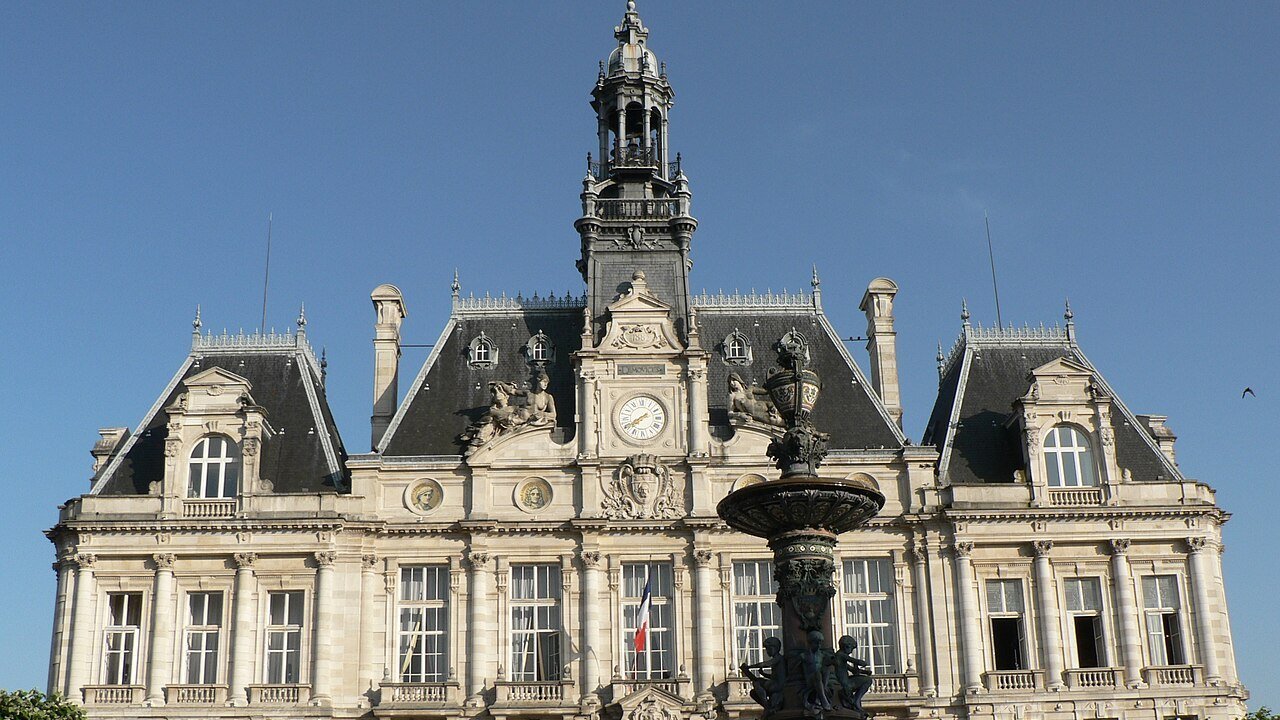
A fire set during Saturday’s nationwide protests in France tore through the city hall in Limoges, in the Nouvelle-Aquitaine region, and destroyed much of the building, according to the region’s top state official. The prefect, Maurice Barate, told AFP that the town hall had become “largely lost,” in a report carried by RFI. “The roof has collapsed onto lower floors, except the west wing, and two-thirds of the exterior has already disappeared,” he said, calling the damage a “catastrophe for heritage” and a “deliberate act by hooligans.” The BBC, citing the same AFP interview, renders the quote with “facade” in place of “exterior” and the phrase as a “heritage catastrophe.”
According to witnesses cited by AFP via RFI, a group of masked protesters who had torched a police car outside the town hall broke windows and entered the building to set the fire. France 3 Nouvelle-Aquitaine reports that firefighters arrived shortly after 6 PM local time (9:00 AM PT), that the flames reached the roof around 7 PM, and that the campanile, the tower the broadcaster calls the emblem of the city, caught fire and collapsed around 8:30 PM (11:30 AM PT). The broadcaster says four police vehicles burned in Limoges and that firefighters reported injured people on both sides without giving a count. Nuñez, speaking to reporters, said: “There is a break-in and arson inside the Limoges town hall. Firefighters are currently responding,” the BBC reports. The BBC says the town hall opened in 1883 and that part of it gained historic-monument protection in 1975.
Limoges mayor Guillaume Guérin, at an evening press conference, called the attack unacceptable and an act of hatred, said the city’s 30 municipal police officers had run out of means to break free when attackers stormed the building, and said he would file a complaint, according to France 3 Nouvelle-Aquitaine. The broadcaster reports that, by its information, just under 20 people had gone into custody in the city, and that local officials plan a march in support of Limoges officials on Sunday, Oct. 18, at 5 PM local time (8:00 AM PT) at the Place de la République. Two local La France Insoumise lawmakers, the broadcaster says, condemned the ransacking and said about 8,000 people had marched in the Haute-Vienne department during the day.
Limoges formed one flashpoint in a day of mass demonstrations against rising living costs and declining public services. Reuters says the unrest grew into “some of the worst violence the country has witnessed for decades,” with violent fringe groups targeting public buildings, looting luxury boutiques and supermarkets and attacking police; in Marseille, black-clad protesters broke into City Hall, and in Lyon protesters torched the tourist office, the agency reports. The Guardian reports that protesters in Marseille rammed the town hall door with street barriers and that one spray-painted an “A” for anarchy before police removed them, and that around the Place de la République in Paris a peaceful march turned violent as police fired teargas at masked rioters who threw fireworks and paving stones; the paper says dozens of shops along Boulevard Magenta got broken into and looted.
Figures for the day differ by source and by hour. Nuñez said about 550,000 people marched nationwide, 110,000 of them in Paris, and that about 400 people had gone into custody, most of them adults not connected to the student movement, according to the BBC (10:51 and 10:54 AM PT updates and a summary of his briefing); Reuters and the Guardian carry the 400 figure and the most-adults detail. The BBC also reports Nuñez saying 60 officers suffered injuries, two of them taken to hospital unconscious. Later, the BBC reports, Lecornu told members of the security forces in Paris that 1,200 people had gone into custody (2:52 PM PT update), and the prefect of Bouches-du-Rhône, Jacques Witkowski, said 107 officers suffered injuries in the Marseille area, three of them “very seriously” (2:21 PM PT update). The CGT union told Reuters it estimated the crowds at 800,000. This desk flags those gaps without resolving them.
Officials blamed the far left. In a post on X at 9:00 AM PT, Lecornu wrote that ultra-left groups had organized violence in several French cities and that delinquents had joined them to loot and destroy; Reuters translates part of the post: “To those who clearly want to use this violence as a ’warm-up’ before the presidential election, I say clearly: We will not let ourselves be intimidated. No one will impose their political agenda through violence.” Nuñez said groups from the “hard left and extreme left” caused the situation to “degenerate” and saw a “clear desire” to target public buildings, the BBC reports. The Guardian quotes him calling the people behind the looting “opportunistic delinquents who had seen a chance to pillage and loot … we will find them and deal with them firmly,” and reports that he said the state had no plan to declare a state of emergency, adding: “I very strongly condemn the violence we have seen.”
Macron, in a post on X at 10:48 AM PT, wrote that violence has no place in the Republic and offered police the nation’s support. Reuters translates his closing line as: “We will all stand united against the sowers of chaos, who only seek to undermine our institutions and prevent those who peacefully express their demands from doing so.” The BBC translation reads “who seek only to bring down our institutions” for the middle clause.
Opposition figures on the left disputed the official account. Clémence Guetté, a vice-president of the National Assembly from La France Insoumise, wrote on social media: “Your men are blocking thousands of people at the protest, which is nevertheless legal and declared,” and said Nuñez sought to “provoke and to make the situation degenerate,” the BBC reports. The BBC says Jean-Luc Mélenchon faulted Lecornu for “playing with fire” by allowing the situation to “fester,” after Lecornu blamed him for “providing excuses” for violent protesters; Lecornu’s X reply to Mélenchon called it a dangerous and cynical inversion of responsibility to blame police chiefs for the violence. Reuters reports that protesters said most people marched peacefully and put much of the violence down to troublemakers.
Protesters and a police union gave their own accounts of the day. “We are fighting because the cost of living is too harsh, because the price of fuel is too high, because high school pupils are being violently attacked and hurt all over the country just for trying to protest and ask for more teachers and decent learning conditions,” Lola, a 19-year-old protester in Paris, told Reuters. The UNSA police union, in a statement Reuters quotes, said: “Today again, in every corner of France, our colleagues are being used as punching bags. Pelted with stones, injured, trapped in real ambushes.” Nuñez said one person lost a hand in clashes with police on Saturday, according to Reuters, which says French media reported he tried to pick up a stun grenade.
The movement began last month at high schools in the working-class northern suburbs of Paris, where anger over teacher shortages and shabby facilities grew into a broader movement over inequality, public spending and living standards, Reuters and the Guardian report. Saturday’s turnout eclipsed crowds at the peak of the Yellow Vest movement but stayed far below the 2023 pension-reform protests, Reuters says. Reuters also reports smaller protests on Saturday in Belgium, Portugal and Italy, and renewed student demonstrations in Albania.
