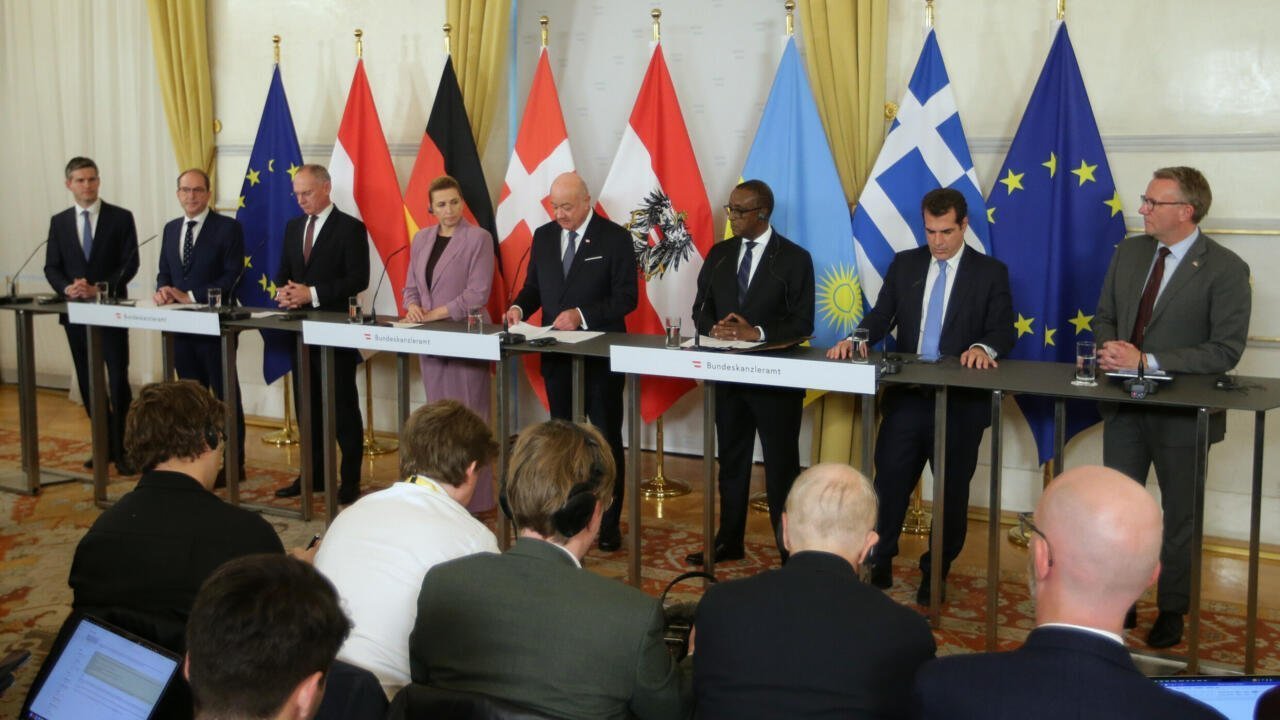
Five European Union governments and Rwanda said on Monday, Nov. 16, that they had begun work on a “return hub” in Rwanda for migrants who have no right to stay in Europe. In a joint statement posted by Denmark’s immigration ministry, Rwanda and the governments of Austria, Denmark, Germany, Greece and the Netherlands describe themselves as “jointly exploring the possibility of establishing a return hub model in Rwanda,” with the aim “to reach an arrangement on establishing a return hub and initiate the first transfers by 2027.” Austrian Chancellor Christian Stocker announced the plan at a press conference in Vienna alongside Danish Prime Minister Mette Frederiksen, ministers from the other countries and Rwandan Interior Minister Vincent Biruta, according to ORF and AFP.
Officials framed the step as the start of formal talks rather than a finished deal. “Starting today, concrete negotiations with partner country Rwanda will begin for the implementation,” Austrian Interior Minister Gerhard Karner said in the joint statement. AFP describes the announcement as a deal to establish the first such facility outside the bloc, and quotes Stocker as saying, “I am pleased that today we have achieved a truly historic paradigm shift in migration policy.” Frederiksen stressed that some technical questions still needed answers, ORF reports, and Karner told the press conference that the center should start operating in the course of 2027.
Three clips posted on X: a Euronews report from Vienna before the announcement, the European Commission spokesman’s remarks, and Danish Prime Minister Mette Frederiksen at the press conference.
View the @euronews post on X
View the @euronews post on X
View the @OffThePress1 post on X
The hub would serve a narrow group, according to the governments. The joint statement says it “will only be used for migrants who are staying illegally in one of the five EU Member States and are subject to an enforceable return or removal decision.” A background paper dated Nov. 15 adds that it targets people whose return home “is not feasible in a timely manner,” for example because their country of origin does not cooperate, and that unaccompanied minors will stay excluded. Unlike Britain’s scrapped Rwanda plan, the hub would not handle asylum claims, the paper says; those would get decided in Europe first. The Dutch government said the five countries had decided to send only single men in the first phase, and that the Netherlands would focus on people from countries in Rwanda’s region, according to its statement and the BBC’s translation, which quotes it as saying the group will “only return single men.”
Under the plan, people sent to Rwanda would get a residence permit and stay briefly in an open “welcome centre” before moving into community housing, with integration support, vocational training and access to the labor market, according to the background paper. They could leave at any time for their home country or any other country that admits them, the governments say. The Dutch statement adds access to education, health care and the courts. “No one will be transferred to a return hub if there is a real risk of inhumane or degrading treatment or punishment,” the background paper says, and it promises an independent mechanism to oversee the plan. Kigali leans toward calling the site a “welcome centre,” a source told AFP.
Accounts of the first phase’s size differ. Diplomatic sources told AFP the hub would initially run as a pilot hosting about 100 people, with each of the five nations possibly sending around 20 migrants; ORF cites negotiating circles with the same figures, and the Guardian says officials hope to send 100 people from early next year. Before the announcement, Euronews cited two people familiar with the matter as saying the pilot would host a few hundred people, starting in spring or summer 2027. The joint statement itself gives no number.
Rwanda presented the deal as a partnership. “Rwanda is a welcoming country for refugees and migrants, and we are committed to working with European partners to provide a safe, legal and dignified solution for migrants,” Biruta said in the joint statement, adding that the partnership would “contribute to correcting the global imbalance in economic opportunities, which is a key driver of irregular migration, including among Africans.” At the press conference, he said the plan would offer “a second chance to people who no longer have the right to remain in the partner country,” according to AFP. The background paper says the five EU countries would cover the hub’s direct costs and fund integration and welfare projects that also benefit Rwandans; Euronews reported that no estimate of the total cost existed and that what Kigali would get in return remained unclear. Austria has budgeted 15 million euros for preparatory measures for return centers, ORF reports, citing the newspaper Der Standard.
International agencies took part in the talks. UN refugee chief Barham Salih joined the Vienna meeting and noted the five countries’ commitment that any arrangement must comply with EU and international law, according to a UNHCR statement, which says the agency has offered its good offices to advise on those standards. “These are complex issues, but dialogue is essential,” Salih said. An International Organization for Migration spokesperson told the BBC that “IOM has a long history of providing assistance to migrants in situations of transit, including in complex contexts.” European Commission spokesman Markus Lammert welcomed the plans and described the EU as “closely following the preparatory work of the five member states for such a return hub,” according to AFP.
Rights groups and some politicians condemned the plan. Clementine de Montjoye, a senior Africa researcher at Human Rights Watch, said paying Kigali to host a deportation program would cause suffering and harm to those deported and would hand money and political leverage to Rwanda’s government, according to the BBC. French Green lawmaker Mélissa Camara called it “an agreement of shame” and “a grave moral failing,” the Guardian reports, and Chiara Catelli of the undocumented-migrants network Picum said “no euphemism can hide the violence of uprooting people from the life they’ve been building in Europe.” In Austria, international law expert Manfred Nowak called the plan legally very doubtful in an interview with the APA news agency, and Doctors Without Borders Austria called it shameful, ORF reports. About 100 people protested in Vienna, according to AFP and ORF.
Criticism also came from the other side. Gernot Darmann, security spokesman for Austria’s far-right Freedom Party, said sending a few rejected asylum seekers to Rwanda for the cameras while many more keep arriving amounts to managed surrender rather than a turnaround, ORF reports. Migration researcher Gerald Knaus warned that the plan offers only a small solution that will achieve nothing, according to the same report.
The plan rests on a new EU returns law. The Guardian says the five countries became the first to seek to use it, since it lets countries send people who have exhausted their appeals against removal to a third country; AFP says the EU approved the reform earlier this year and notes that fewer than 30 percent of people ordered to leave the bloc currently get returned to their country of origin. Irregular crossings into the EU fell to almost 110,000 in the first 10 months of 2026, 29% fewer than a year earlier, according to European Border and Coast Guard Agency figures cited by the BBC.
Rwanda has hosted such plans before. Britain struck a deal in 2022 to send asylum seekers to Rwanda before their claims got heard, but London later scrapped it, AFP reports; the BBC says legal challenges kept it from taking off and the Labour government junked it in 2024, and ORF notes Britain’s top court ruled the plan unlawful in 2023. Rwanda also signed a 2025 agreement to accept third-country nationals expelled from the U.S. in exchange for roughly $7.5 million in financial support, according to Euronews. Downing Street has not ruled out joining the European scheme and says it will watch it “with interest,” the BBC reports.
What to watch: whether the six governments sign a formal arrangement, and when; the final size of the pilot and its cost; the independent oversight mechanism the governments promise; legal challenges, which officials expect, according to the Guardian; and whether other EU countries or Britain join. This desk could not read AP’s report, which returned an error, as of about 9:15 a.m. PT Monday.