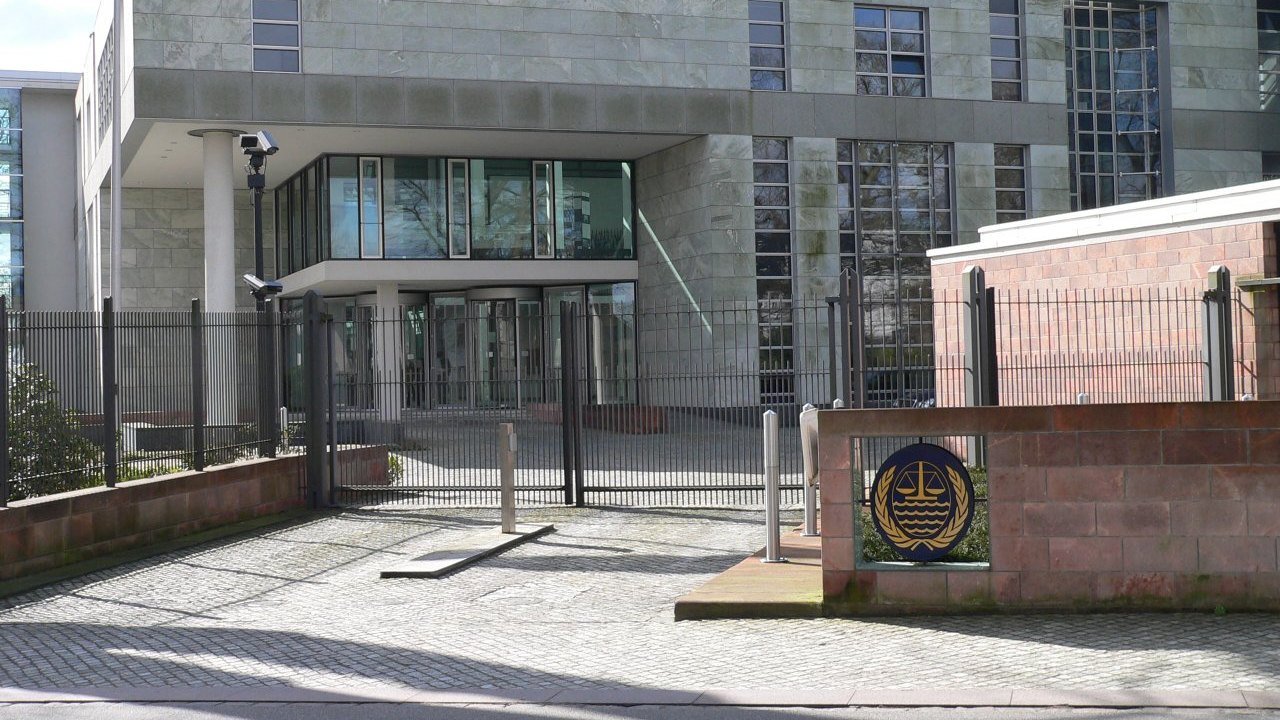

An international court in Hamburg on Saturday declined to stop work on Sea Lion, a British-authorised oil project in the waters north of the Falkland Islands, in what Reuters calls a setback to Buenos Aires’ effort to stop economic activity around the disputed islands (Reuters). The International Tribunal for the Law of the Sea voted 18 to 3 to reject Argentina’s request for provisional measures, according to the tribunal’s press release and the text of its order (ITLOS press release; Order). The tribunal, an independent judicial body set up under the United Nations Convention on the Law of the Sea (UNCLOS), can order such interim steps while a separate arbitral tribunal gets formed, UN News explains (UN News).
Argentina had asked the judges to order the United Kingdom to make sure that “no new drilling for exploitation, and no installation of production infrastructure” took place in connection with Sea Lion, to stop using exploration data “to the detriment of the rights of the Argentine Republic,” and to grant no new authorizations to exploit the disputed continental shelf, according to its final submissions as quoted in the press release (ITLOS). The UK asked the tribunal “to reject all the requests,” the release says.
The ruling turned on jurisdiction. Interim measures require that the future arbitral tribunal appear, at first look, to have authority over the dispute, and the judges found that none of Argentina’s four claims cleared that bar (ITLOS). Ruling on the first claim “requires the identification of the coastal State that has sovereignty over the Falkland Islands (Malvinas), and presupposes the determination of a question of territorial sovereignty,” the order says, and such a dispute “may not be regarded as a dispute concerning the interpretation or application of the Convention” (Order, paragraphs 60 and 79). The judges applied the same reasoning to claims on unilateral resource development and marine-environment duties, saying a ruling on the latter “would necessarily entail a decision on sovereignty” (ITLOS). A fourth claim, on not aggravating the dispute and acting in good faith, could not stand on its own, the tribunal found.
Argentina had argued that it “has not requested the Arbitral Tribunal to settle the territorial sovereignty dispute,” while the UK said Argentina had brought “a dispute which concerns Argentina’s claim to land sovereignty,” according to the press release (ITLOS). The tribunal’s president, Maurice Kamga, said the order “in no way prejudges” whether the arbitral tribunal has jurisdiction over the merits, Reuters reports; paragraph 133 of the order contains the same wording (Reuters; Order).
The order also records commitments from London. The tribunal “places these assurances on record”: the UK agent’s statement that “extraction will not commence before March 2028; and indeed drilling will not commence before 21 March 2027,” and the UK’s statement that “[n]o further licenses will be granted as the licensing regime is suspended” (ITLOS). The judges encouraged both sides to set up the arbitral tribunal swiftly and said they expect the parties to act on the basis that “the Convention is applicable in the maritime areas in dispute” (ITLOS).
President Maurice Kamga, 16 other judges and judge ad hoc Lowe formed the majority, according to the tribunal’s vote list; Judges Horinouchi and Patel and judge ad hoc Vinuesa dissented, and seven judges in the majority attached declarations or separate opinions (ITLOS). This desk did not read the dissenting opinions.
The project sits in a field within 200 nautical miles north of the islands. Navitas Petroleum operates it with a 65% stake and Rockhopper Exploration holds the other 35%, according to the order, which also cites a UK figure of roughly 500 kilometres from the South American mainland coast (Order). The two companies took a final investment decision in December 2025 and in August reported phase 1 “on track for first oil in Q1 2028,” the order notes. Navitas trades in Tel Aviv and Rockhopper in London, and both companies previously said they did not expect Argentina’s actions to derail the project, Reuters reports; the US oil-services company Halliburton said last month it would not work on Sea Lion, according to the same report (Reuters). This desk found no company statement on Saturday’s ruling.
London welcomed the result. In a joint statement, Foreign Secretary Ed Miliband and Attorney General Ellie Reeves called it “a vindication of the UK’s robust legal defence and strategy” and said Argentina “sought to stop the Falkland Islanders making their own sovereign decisions and failed in this attempt” (GOV.UK). They urged Argentina “to end its wider economic pressure against the Falkland Islands,” the statement says; Miliband posted it on X at 4:30 a.m. PT (@Ed_Miliband).
Videos from X: an Argentine TV segment on the ruling and TN footage of a member of Argentina’s legal team. Claims in each post belong to the poster. Seems News has not independently verified the posts and did not edit them.
View the @A24COM post on X
View the @elcancillercom post on X
The two governments’ statements as posted on X. Claims in each post belong to the poster. Seems News has not independently verified the posts and did not edit them.
View the @Ed_Miliband post on X
View the @pabloquirno post on X
Buenos Aires read the order differently. “Today we have taken a historic step,” Quirno wrote on X at 5:05 a.m. PT, in Spanish, arguing that the tribunal had acknowledged “before the eyes of the world” a sovereignty dispute that the UK denies, and saying the decision “does not legitimise the plundering of our resources” (this desk’s translation; @pabloquirno). In a bilingual post about two hours later, he called the UK’s account “one-sided,” said the tribunal had “formally placed on record” the UK’s assurances, and added: “These proceedings are far from over. Argentina will pursue its lawful claim under UNCLOS” (@pabloquirno). The order itself does not decide who holds sovereignty; it says Argentina’s claims would require that determination (Order).
Argentina plans to keep up the pressure on the companies. Its government has opened administrative proceedings against 60 people and companies tied to oil activity around the islands, the Argentine news channel TN reports, noting that opening a case does not equal imposing a final penalty; an Office of the President statement said new sanction proceedings against five people or companies began on Friday, according to TN (TN). President Javier Milei’s office asked the lower house to pass a national sovereignty defense law next week, according to TN (TN). Quirno said Argentina would use “every diplomatic, legal and economic means” to stop what it calls unlawful exploitation, and that it remains willing to resume bilateral talks, as the UN has urged (@pabloquirno).
The ruling lands amid sharper friction. Reuters reports that tensions grew after Milei’s government presented legislation to crack down on companies involved in oil exploration off the islands, days after US President Donald Trump suggested Washington could reconsider its traditionally neutral stance on the sovereignty dispute (Reuters). The islands appear on the UN list of 17 non-self-governing territories; in 1965 the General Assembly invited the two countries to negotiate, and they fought a war over the islands in 1982, UN News notes (UN News).
Argentina began the arbitration under Annex VII of UNCLOS on Sept. 28 and filed its request for provisional measures on Oct. 13; the tribunal held hearings on Nov. 10 and 11 (ITLOS). Quirno said the arbitral tribunal should take shape by January 2027 at the latest (@pabloquirno). Under the UK’s recorded assurance, drilling cannot begin before March 21, 2027.
This desk read the ITLOS press release in full and the order’s key paragraphs (37–38, 59–60, 79, 129–134), the UK government statement, UN News, Reuters’ report (via ThePrint), two TN reports and Quirno’s two X posts. The Associated Press story did not load, and this desk did not read the dissenting or separate opinions or watch the tribunal’s webcast.