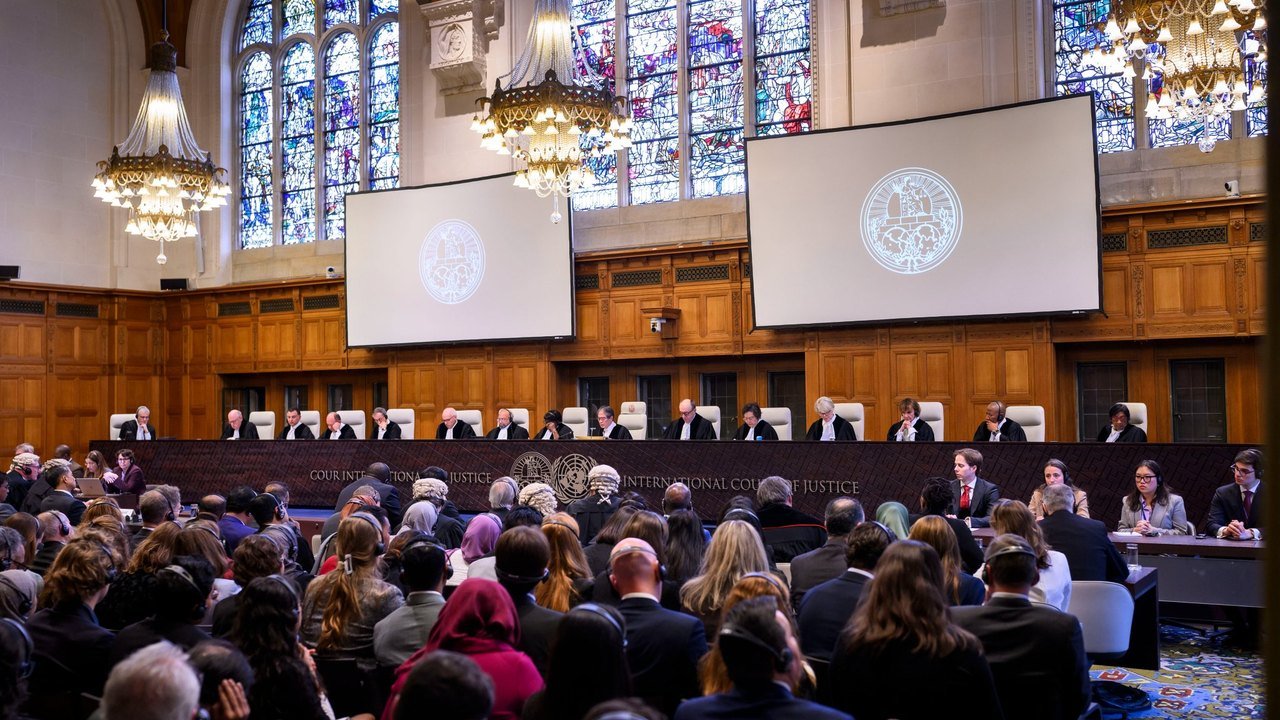
The United Nations’ top court ruled on Thursday that Myanmar committed genocide against its Rohingya minority during the military’s 2017 “clearance operations” in northern Rakhine State, according to the International Court of Justice’s press release and UN News. The judges reached the core finding by nine votes to six, the BBC and Radio Free Asia report. UN News calls it “the first such ruling against a State,” and the BBC says the verdict “marks the first time a state has ever been found to have committed genocide by an international court.”
ICJ President Yuji Iwasawa of Japan delivered the ruling in The Hague at the end of a three-hour sitting, UN News reports. “The Court finds that Myanmar’s security forces killed thousands of Rohingya civilians, perpetrated widespread acts of sexual violence as well as acts of extreme violence against children and attacked fleeing Rohingya as they sought to flee in large numbers to Bangladesh,” Iwasawa said, according to Radio Free Asia. The court found that “genocidal intent is the only reasonable inference that can be drawn from the evidence” it had seen, the BBC reports.
According to the court, an estimated 10,000 Rohingya died in the clearance operations, UN News reports; the BBC says the court found that the operations targeted about 815,000 people in some way. Reports differ on how many fled: UN News puts the number at some 700,000, the BBC at more than 700,000, and Radio Free Asia at more than 730,000. The court heard that nearly 400 villages, about 40 percent of the almost 1,000 villages in three northern Rakhine townships, suffered partial or total destruction, UN News reports.
The judgment ties the finding to three acts listed in Article II of the 1948 Genocide Convention: killing members of the group, causing serious bodily or mental harm, and imposing measures intended to prevent births, according to UN News. The operations also involved the murder of infants, which “supports the inference that Myanmar’s security forces acted with the intent to prevent births among the group,” Iwasawa said, according to UN News. Antonia Mulvey of Legal Action Worldwide told the BBC that the court had found for the first time that rape and sexual violence counted as an act of genocide.
The court did not accept every claim The Gambia brought. The judges found by 14 votes to one that Myanmar did not “directly and publicly” incite genocide, while they found by nine votes to six that Myanmar failed to prevent genocide by individuals acting alongside its forces and by 11 votes to four that it failed to punish genocide, according to the BBC’s recap of the 12 votes. The court also found that Myanmar broke a January 2020 order to preserve evidence, the court’s press release says; Iwasawa described “extensive destruction of evidence,” the BBC reports.
Videos from X: the reading of the judgment and reactions. Seems News did not verify the footage.
View the @Reuters post on X
View the @AJEnglish post on X
View the @UNHumanRights post on X
The court also ordered Myanmar to pass laws giving full effect to the convention, to take “immediate and effective steps” to investigate everyone reasonably suspected of genocidal acts and, “if warranted,” to prosecute and punish them, to give guarantees of non-repetition, and to allow “the safe, voluntary and dignified return” of displaced Rohingya and the reunification of families, UN News and the ICJ press release say. Myanmar must also compensate the Rohingya group and its members; the court will set the amount in a later phase and gave Myanmar two years to report on restitution and compensation, according to the same sources. UN News calls the judgment “final, binding on the parties to the case and without appeal.”
Myanmar has long rejected the case. “So far there has been no official response from Myanmar about today’s historic verdict,” the BBC reported on Thursday, adding that Ko Ko Hlaing, Myanmar’s representative, answered “No comment” as he left the court. Myanmar has maintained that its 2017 operations responded to attacks on police posts by the Arakan Rohingya Salvation Army, Radio Free Asia reports. In January, as hearings opened, Myanmar’s foreign ministry said “the allegations made by The Gambia are flawed and unfounded in fact and law,” a statement Al Jazeera also reported.
The Gambia, a mostly Muslim West African country, filed the case in November 2019 with the support of the Organization of Islamic Cooperation, according to its law firm Foley Hoag. “This victory belongs to the Rohingya. They survived, they testified, and today they were believed,” Gambian Attorney General Dawda Jallow said, according to the firm’s statement. In refugee camps in Bangladesh, crowds watching on screens “immediately leapt up, cheering, applauding and shouting gratitude for the Gambia,” the Guardian reports.
UN Secretary-General António Guterres called the judgment a “powerful recognition of the Rohingya victims of genocide,” UN News reports. UN human rights chief Volker Türk said the “suffering, misery and humiliation” inflicted on the Rohingya formed a “stain on the conscience of humanity,” according to the BBC. UK Foreign Secretary Ed Miliband said Britain would expel Myanmar’s defence attaché and summon its chargé d’affaires, the BBC reports, and Radio Free Asia quotes him saying, “Myanmar must comply fully with the judgement.”
Others point to limits on enforcement. “The court has no means of enforcing this ruling,” Richard Horsey of the International Crisis Group said, according to Radio Free Asia, which notes that Min Aung Hlaing, who commanded the military during the 2017 crackdown, now serves as Myanmar’s president. The ICJ “cannot send military officials to prison” and relies on the UN Security Council and political pressure, the BBC reports, adding that the ruling carries implications for other pending genocide cases, including South Africa’s case against Israel. Horsey added that the Arakan Army, an ethnic Rakhine armed group, now holds most of the land the Rohingya fled, and nearly 1.2 million Rohingya remain in camps in Bangladesh, Radio Free Asia reports.