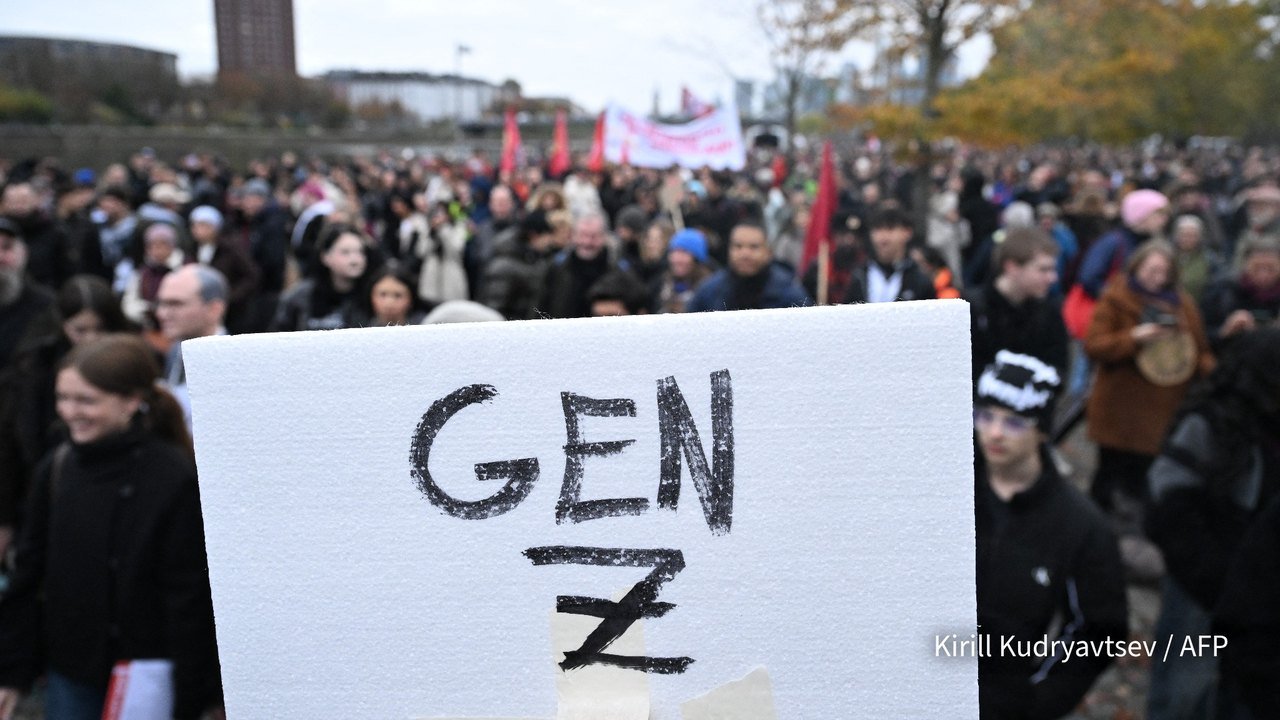
Masked groups looted shops in central Frankfurt late on Saturday, Oct. 31, and clashes with police broke out in Cologne, Hamburg and Berlin, after a day of mostly peaceful youth-led protests across Germany over school funding, living costs and military service, according to the BBC, AFP and DW. The campaign group Gen Z regelt, which the BBC translates as “Gen Z takes charge,” called the demonstrations in more than 30 cities. Police used water cannon after protesters targeted emergency workers with fireworks, stones and bottles, the BBC reports. “Violent riots” took place in Frankfurt, police said in a statement quoted by AFP. “Windows have been smashed at several shops. Molotov cocktails are also being thrown at emergency personnel.”
Frankfurt police narrated the night in a string of posts on X. At 6:22 p.m. local time (10:22 a.m. PT), the force wrote that stones kept flying at its officers and a water cannon, and that it had dissolved the march after repeated warnings. At 9:32 p.m. (1:32 p.m. PT) police reported smashed shop windows and Molotov cocktails thrown at officers. Shortly before 10 p.m. the force said rioters had broken the windows of a gun shop on Berliner Straße, that officers had detained a suspect and seized two weapons, and that police had secured the guns inside the shop. Minutes later police closed the Zeil, one of Germany’s busiest shopping streets, between the Hauptwache and Konstablerwache squares. “Anyone not involved who is still on the Zeil can leave. Access to the Zeil is no longer possible,” Frankfurt police said, in the translation DW published.
Journalists from the German news agency dpa watched people break into stores on the Zeil and carry away trainers and other goods, DW reports. A trainer shop and a perfume store came under attack, the Bild daily reported, according to AFP. By 11:35 p.m. local time (3:35 p.m. PT) police counted more than 30 people provisionally detained and said special-forces officers had joined from other parts of Hesse. With help from federal police, officers at the Hanau train station later detained four minors who, Frankfurt police said, appeared to carry stolen goods from Frankfurt; police said they would hand the minors over to their parents. After 1 a.m. on Sunday police reported holding a group of about 100 people in the city centre for identity checks. The situation calmed overnight, police told the BBC.
Hesse interior minister Roman Poseck said that “around 100 clearly identified left-wing extremists” had infiltrated the Frankfurt protest, according to the BBC and AFP. “It is shameful how this event here in Frankfurt has ended,” he said, as quoted by AFP. The BBC quotes him comparing the night with recent unrest across the border: “We all have those images from France in our minds - looting, burning houses, burning police vehicles, and attacks on police officers... France must not be held up as a model in this regard.” Hesse premier Boris Rhein said he felt shocked by what he called excesses of violence in Frankfurt and promised consequences, ZDF reports in German.
In Cologne, about 200 people took part in disturbances near the cathedral, where officers faced bottles and bicycles, DW reports, citing dpa. Police said one person suffered injuries and that they detained five people; in a side street, an electric scooter smashed a window. Earlier in the day Cologne police had called off the planned march after some participants covered their faces and set off pyrotechnics, turning it into a stationary rally on the Rhine, DW reports. Cologne police chief Johannes Hermanns said it felt “deeply saddening that young people who wanted to peacefully demonstrate for their future were infiltrated today by extremists who had nothing but violence in mind,” the BBC reports. Hermanns also said police had seized Molotov cocktails and emergency hammers from masked people, according to Der Spiegel, which reports his remarks in German.
Hamburg police estimated 6,700 people at that city’s demonstration, DW reports. Near the end, groups dressed in black, some wearing face masks, pulled apart construction-site barriers, threw them into the street and set some of them alight; police pushed the crowd back with pepper spray, and a water cannon put out the fire, according to DW. Public broadcaster NDR reported that police took 120 people into custody in the city, the BBC reports. In Stuttgart, police counted five officers lightly injured and about 50 offences, according to Der Spiegel, and in nearby Bonn an officer suffered minor injuries in a confrontation with a group, AFP reports.
Watch: the day’s rallies, burning barricades in Hamburg and crowds near Frankfurt’s Zeil, via posts on X
Viewer note: the second and third clips show street disorder at night, with fires, riot police and running crowds. The stills this desk viewed show no injured people. If an embed does not load, it shows as a plain link to the original post.
View the @TRTWorldNow post on X about protests in more than 30 German cities
View the @NotifNews1 post on X about burning barricades in Hamburg
View the @NotifNews1 post on X about crowds on Frankfurt’s Zeil
Berlin saw two different protests. At the Gen Z regelt rally by the Brandenburg Gate, police counted around 5,000 people, while organisers claimed some 11,000 in the afternoon, according to a post by Euronews; DW gives the organisers’ figure as 10,000. A separate evening march, not organised by Gen Z regelt, followed, AFP and Der Spiegel report. Police first reported isolated egg and bottle throwing from a crowd of around 500 and later said it had grown to around 3,000, DW reports. Berlin police said 27 officers suffered injuries and up to 56 people faced temporary detention, according to the BBC; Der Spiegel attributes the same figures to a video the force posted on X and describes the injuries as light.
The organisers frame the day around money and the future. “What matters most to us is better support for the health and education systems. We are against compulsory military service and we are in favour of a fairer distribution of the burden,” Gen Z regelt spokesperson Lina Friedrich said, according to the BBC. The movement objects to rising living costs, poorly maintained schools, spending cuts, sharply higher military spending and a new voluntary service model that it fears could lead back to conscription, AFP reports. Some marchers, with the day falling on Halloween, wore outfits ranging from dinosaurs to Batman, and some waved signs reading “Merz must go,” aimed at conservative Chancellor Friedrich Merz, AFP reports. “I think it’s really important to show solidarity with all the other protests currently happening across Europe, including in France,” Milla, a 20-year-old student, told AFP in Berlin.
The size of the day remains in dispute. Organisers put turnout at 100,000, according to DW, and a spokesman for the group put it at more than 100,000 with figures from several cities still missing, Der Spiegel reports, while AFP reports that the group counted some 120,000, below the roughly 180,000 it had expected. DW notes that more than 182,100 people had signalled online interest in attending. Authorities in Frankfurt, Munich and Berlin reported as many as 18,000 protesters, roughly half the organisers’ estimate for those cities, the BBC reports. Senior police union representative Andreas Rosskopf told the Rheinische Post that “The Gen Z protests have turned out to be very peaceful,” in DW’s translation, and blamed the later clashes on “individuals acting independently, some of whom were masked.”
The organisers distanced themselves from the violence. “Extremist groups, anti-constitutional symbols, racism and hate speech have no place with us -- no matter from which side,” the movement said, according to AFP. A press-team spokesman who gives only his first name, Amadeo, said the group had no influence over what happened after the rallies ended, and that it plans to join Europe-wide protests on Nov. 20, Der Spiegel reports in German. Protest researcher Florian Staudt told ZDF that small groups may deliberately seek out riots, but that placing all demonstrators under general suspicion would send the wrong signal. Education researcher Nina Kolleck, a University of Potsdam professor, told RBB Inforadio that excluding young people “creates the impression that there is a policy for the old, but not for the young,” according to DW.
The German protests came on the same day that more than 320,000 people marched in France for a third straight weekend over living costs and public services, the BBC reports, with clashes there too. Mostly young protesters have recently taken to the streets in France, Belgium, Ireland, Spain, Portugal, Italy, Greece, Serbia and Albania, according to the BBC. The German government had kept in contact with officials in France and Italy over fears that radicals from abroad might try to join the German protests, AFP reports.