Luiz Inácio Lula da Silva won Brazil’s presidential runoff on Sunday, Oct. 25, defeating right-wing Senator Flávio Bolsonaro to secure a fourth, non-consecutive term, the country’s electoral authority said, according to Reuters (Reuters). The Superior Electoral Court’s own results file, stamped 22:45 Brasília time (6:45 p.m. PT) with 99.99% of polling sections counted, gives Lula 64,255,891 votes, or 51.79% of valid votes, against 59,825,984, or 48.21%, for Bolsonaro (TSE results file). That leaves a margin of about 4.43 million votes by this desk’s arithmetic; the Guardian, writing with nearly 99% counted, put it at 4.3 million (the Guardian). O Globo reports that Lula had the win secured at 21:09 Brasília time (5:09 p.m. PT) (O Globo).
The win reverses the first round. On Oct. 4 Flávio Bolsonaro, the son of former president Jair Bolsonaro, finished ahead with 47.03% to Lula’s 45.16%, a gap of 2,224,965 votes, O Globo reports, citing TSE data (O Globo). The last Datafolha and Quaest surveys before the vote, O Globo reports, both showed Bolsonaro on 51% of valid votes and Lula on 49%, a technical tie within the margin of error. The Guardian writes that no first-round runner-up had won the second round since Brazil returned to democracy in the 1980s (the Guardian). “Eu nunca ganhei eleição no primeiro turno, mas nunca perdi no segundo turno,” Lula said in his victory speech — roughly, I have never won an election in the first round, but I have never lost in the second — BBC News Brasil reports (BBC News Brasil).
Turnout appears to explain much of the swing. The TSE file shows 128,235,666 people voting, or 80.78% of the electorate, with abstention at 19.22%, blank ballots at 1.12% and null ballots at 2.12% (TSE). G1 and the Guardian report that abstention fell from 21.08% in the first round, a figure the Guardian calls a record; G1 calls the runoff rate the lowest in a presidential vote since 2006 (G1; the Guardian). The Guardian writes that first-round abstention fell hardest on Lula voters, who tend to live farther from polling stations, and DW reports that pollsters said higher-than-expected turnout appeared to help Lula (the Guardian; DW).
The day turned on buses and a late court order. In the afternoon, Lula’s coalition, Brasil Pronto Pra Mais, asked the Supreme Federal Court (STF) to act against reduced public transport in Salvador, Feira de Santana and Lauro de Freitas, in Bahia, citing an earlier STF ruling that requires free public transport on election days, the court’s own news service reports (STF). G1 reports that the coalition’s filing described cuts or failures in at least nine states, including a claim that only about 60% of São Paulo’s buses ran despite a court order for the full fleet (G1). Lula asked for more time for voters “effectively barred from voting, due to the dirty tactics of mayors,” according to AFP via DW (DW). Bolsonaro’s campaign, for its part, asked the TSE for a two-hour extension in rain-hit municipalities of Minas Gerais, Rio Grande do Sul, Paraná, São Paulo and Santa Catarina, G1 reports (G1).
Justice Cristiano Zanin then extended voting until 19:00 Brasília time, two hours past the scheduled close. The STF says he granted the injunction because both runoff campaigns had reported problems with voter transport, and that the extension applied only where polling stations had not yet closed at 17:00 (STF). G1 reports that Zanin first ordered the extension for every section in the country and later clarified its scope, and that the vote totalization, already under way, paused because of the order (G1). DW notes that Lula’s team blamed hampered bus services while Bolsonaro’s team cited the weather (DW).
Watch: the night in São Paulo and Brasília
Three video posts on X from Brazilian news outlets show the celebration on Avenida Paulista, Lula’s first statement after the result and Flávio Bolsonaro speaking afterward. This desk has not frame-checked the clips. If an embed does not load, it shows as a plain link.
View the @folha post on X
View the @GloboNews post on X
View the @CNNBrasil post on X
Bolsonaro rejected the outcome. “O que aconteceu no dia de hoje não foi algo normal. Foi algo inaceitável. Pela primeira vez na história um ministro do STF dá uma canetada e muda a regra do jogo,” he said, G1 reports — in English, roughly, that a Supreme Court justice changed the rules of the game with the stroke of a pen (G1). “As eleições deveriam ter sido anuladas. É impossível reconhecer o resultado,” he added, saying the courts should have annulled the elections and that he could not recognize the result. He argued that voters in different states received unequal treatment: “Eu nunca vou saber em estados que as urnas não foram reabertas, quantos votos eu poderia ter” — he will never know how many votes he might have won in states where polls did not reopen. G1 notes that his own campaign had requested an extension in five states that afternoon (G1).
Election officials defended the count. TSE president Kassio Nunes Marques, whom Jair Bolsonaro appointed, said he has “absoluta segurança de todo o processo eleitoral” — full confidence in the whole electoral process — G1 reports (G1). “Não houve nenhuma alteração advinda da decisão judicial,” he said, according to BBC News Brasil, meaning the court order produced no change in the result; he also said the transport failures would face investigation and that Zanin’s order created “dificuldade no processo” (difficulty in the process), and he acknowledged Lula’s “expressiva vitória nas urnas” (a significant win at the ballot box) (BBC News Brasil). Before the result, allies of Bolsonaro criticized the extension and floated challenges, Estadão reports; Deputy Marcel van Hattem announced an impeachment request against Zanin (Estadão).
Lula spoke from a hotel near Avenida Paulista in São Paulo, BBC News Brasil reports. “Este país tem uma Constituição. Ninguém é obrigado a gostar do presidente eleito, mas ele foi eleito para governar para todos,” he said — no one has to like the president-elect, but he won election to govern for everyone. He called the vote “uma derrota do negacionismo” (a defeat for denialism) and said digital platforms need regulation: “Crime digital tem que ser tratado como crime na vida real” (BBC News Brasil). Vice President Geraldo Alckmin told him: “O senhor pela segunda vez salvou a democracia brasileira” — for the second time you saved Brazilian democracy. Mexico’s president, Claudia Sheinbaum, posted on X: “Viva a democracia, ganhou o povo do Brasil. Parabéns presidente Lula” (BBC News Brasil).
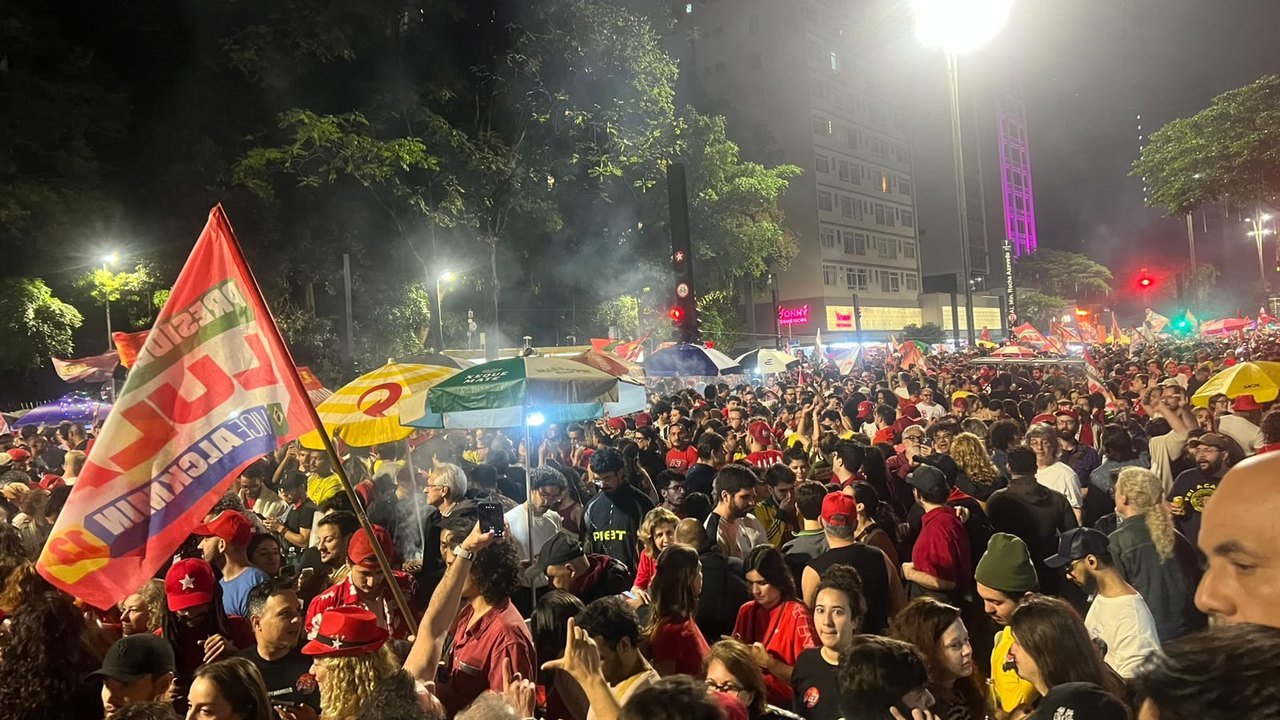
Crowds gathered on Avenida Paulista, at Cinelândia in Rio de Janeiro and at Marco Zero in Recife, according to video posts by Folha de S.Paulo on X (São Paulo; Rio; Recife), and the Guardian describes joyous scenes in São Paulo and anger and bewilderment in Brasília, where Bolsonaro watched the count (the Guardian). “This is democracy,” Camilo Buarque, 35, told the Guardian on Paulista as he watched Lula take an early lead. The Guardian also reports that Jair Bolsonaro, who lost to Lula in 2022, now serves a 27-year sentence for what the paper calls a botched power grab, and remains confined to his home in Brasília (the Guardian).
What comes next: Lula takes office for the new term on Jan. 1, 2027, O Globo reports (O Globo). Bolsonaro’s promised annulment request would go to the courts; this desk has seen no filing yet. Abroad, the result matters to Washington: Flávio Bolsonaro had campaigned on closer cooperation with the United States, DW reports, and the Guardian calls the outcome a blow for Donald Trump, the Bolsonaro family’s most important international ally (DW; the Guardian).