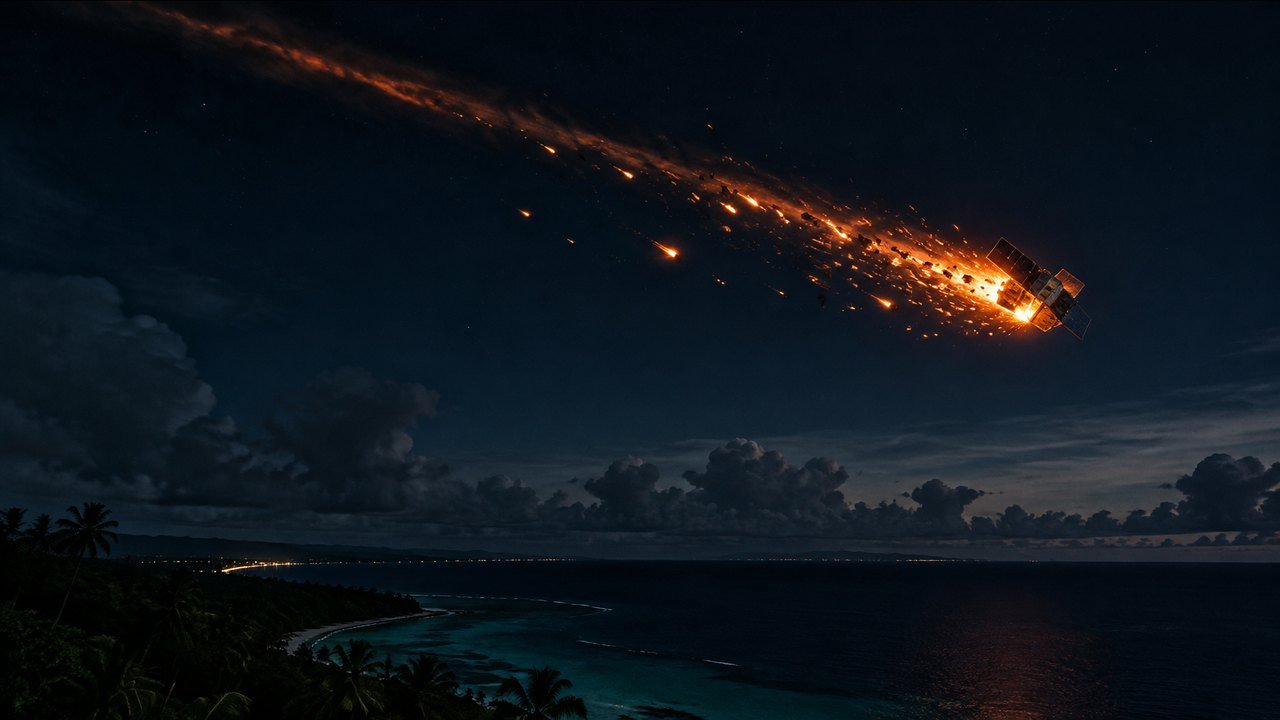
NASA’s Neil Gehrels Swift Observatory, a satellite built to catch the universe’s most powerful explosions within about a minute of their first flash, fell back into Earth’s atmosphere on Wednesday, Nov. 4. The spacecraft reentered at 7:39 a.m. EST, or 4:39 a.m. PT, over the North Sumatra region of Indonesia, at approximately 3.4 degrees north latitude and 98.6 degrees east longitude, NASA said in an update to its Swift mission blog. Spaceflight Now put the moment at 1239 UTC, near the middle of a U.S. Space Force prediction window that ran from 6:42 to 8:42 a.m. EST, and satellite tracker Jonathan McDowell posted on X that “Space Force reports SWIFT reentered at 1239 UTC Nov 4 over 99 deg E, 3 deg N over Northern Sumatra.” On the ground in western Indonesia, local clocks read about 7:39 p.m.
How much of the observatory reached the surface remains unknown. “NASA expected most of the spacecraft to burn up as it traveled through the atmosphere, but some components may have survived re-entry,” the agency wrote. The Associated Press, in a report carried by PBS NewsHour, said it “was not immediately known how much of the 1 ½-ton spacecraft burned up in the atmosphere” and that NASA anticipated some of the denser pieces surviving. Ahead of the fall, NASA had estimated the chance that surviving debris would injure anyone at about 1 in 2,100, according to Spaceflight Now and Space.com. As of this desk’s check on Wednesday evening PT, none of the outlets reviewed here reported recovered debris or damage on the ground.
Swift rose from Cape Canaveral aboard a Delta 2 rocket on Nov. 20, 2004, Spaceflight Now reported. NASA designed it for a two-year prime mission; it stayed productive for almost 22 years, the agency said, a run the AP described as 11 times longer than planned. The name “Swift” referred to the observatory’s agility rather than an acronym, Space.com noted. “Swift needed to detect and locate gamma-ray bursts, communicate their position to other observatories, and then swing its telescopes around to image the burst locations before their afterglows faded out,” S. Bradley Cenko, Swift’s principal investigator at NASA’s Goddard Space Flight Center, said in an Oct. 23 statement quoted by Space.com. “This typically took Swift about a minute to do.” NASA renamed the spacecraft in 2018 for its first principal investigator, Neil Gehrels, who died the previous year, according to Space.com.
The science record runs long. Swift observed more than 2,000 gamma-ray bursts and more than 1,400 supernovae, Space.com and Spaceflight Now reported, and Spaceflight Now counted about 7,000 scientific papers drawing on its data. Its targets also ranged from feeding black holes to comets and asteroids in our own solar system, Space.com wrote. “Swift delivered an incredible, lasting return on investment for the nation, designed for a two-year primary mission but productive for more than 10 times as long,” Shawn Domagal-Goldman, director of NASA’s Astrophysics Division, said in the Oct. 23 statement, as quoted by Space.com. The AP described the observatory as a first responder for other telescopes that could probe deeper.
Drag brought Swift down. Like every satellite in low Earth orbit, it felt the thin upper atmosphere, and recent solar activity increased that effect until Swift “began to sink rapidly,” NASA wrote on Oct. 23. Swift carried no thrusters of its own to push back, Space.com noted. On Oct. 20, the spacecraft reached 171 miles (275 kilometers), could no longer compensate for the increased drag and entered safe mode, NASA said; the operations team at Penn State then sent a command that effectively ended Swift operations ahead of reentry.
A commercial rescue had aimed to prevent that. NASA awarded Katalyst Space a contract in September 2025 to mount a robotic servicing mission for Swift in less than a year, NASA said, and Spaceflight Now and Space.com put the price at $30 million. Katalyst’s LINK spacecraft, which Space.com described as refrigerator-sized with three arms, launched July 3 on a Northrop Grumman Pegasus XL rocket from Kwajalein Atoll, according to NASA. Weeks later it developed attitude-control trouble; EarthSky reported that two of LINK’s three reaction wheels failed about three weeks into the mission. On Aug. 19, NASA announced that LINK would not capture or boost Swift. “NASA should be willing to move quickly and take smart risks when the potential return is worth it, and that is exactly what we did with this mission,” NASA Administrator Jared Isaacman said then. “This is not the outcome we were working toward, but it does not change why this mission was worth attempting.”
LINK still flew rendezvous and proximity operations to gather data. It got within about 7 to 9 miles (12 to 15 kilometers) of Swift and took images of the observatory before it reentered on Sept. 25, the Guardian reported. “From the beginning, this was a high-risk, high-reward mission,” Domagal-Goldman said that day, according to Space.com, adding that the effort would prove worthwhile either way by advancing U.S. spacecraft servicing technology and testing how NASA operates satellites to extend their time in low Earth orbit. Swift, meanwhile, resumed science after the boost ended and observed hundreds of targets before its final observation on Oct. 20, NASA said.
Hubble now faces the same physics on a longer clock. NASA issued a Request for Information on Oct. 29 to gauge industry interest in boosting the Hubble Space Telescope to a higher altitude, servicing it, or performing a safe, controlled reentry at the end of its mission, NASA said; responses remain open until 3 p.m. EST on Monday, Nov. 30. Analysis predicts Hubble will likely reenter in the 2033 to 2034 timeframe, so any mission would need to take place by 2032, the agency wrote. “Hubble still has important science ahead of it, and we should be looking at every reasonable opportunity to keep it delivering for as long as possible,” Isaacman said in that release. The AP reported that, unlike the rush job with Swift, the agency has more time to explore options for Hubble, citing Nicky Fox, NASA’s science mission chief.
Watch: clips that may show Swift’s fiery fall over the Strait of Malacca region, posted on X
This desk viewed the clips’ preview frames before embedding. Neither the poster nor this desk has confirmed that the streak shows Swift. If an embed does not load, it shows as a plain link to the original post.
View the @mohd_escobar post on X
Videos shared on social media after dark in the region may show the fall. EarthSky embedded several clips it described as “possibly showing the fiery reentry,” including one posted by @mohd_escobar from Mersing, Pulau Tioman and Batam, embedded below. The poster himself described the streak as debris from a satellite or a meteor. This desk has not verified the time or place of filming for those clips, and McDowell cautioned on X about a separate set of sightings, writing that he would need a statement on when viewers saw them “before tying this to SWIFT.” Readers should treat the clips as unconfirmed.
This desk checked NASA’s Nov. 4 Swift blog update, its Oct. 23 end-of-mission post, its Aug. 19 boost-mission release and its Hubble Request for Information; Spaceflight Now, Space.com, the AP via PBS NewsHour, EarthSky and the Guardian; and X posts read on X. AP’s own site returned a 403 block to this desk’s reader, so the AP text comes from the PBS NewsHour copy carrying Marcia Dunn’s byline; Reuters’ site returned a 401, so its report went unused. Eastern and UTC times appear here converted to PT (UTC−8).