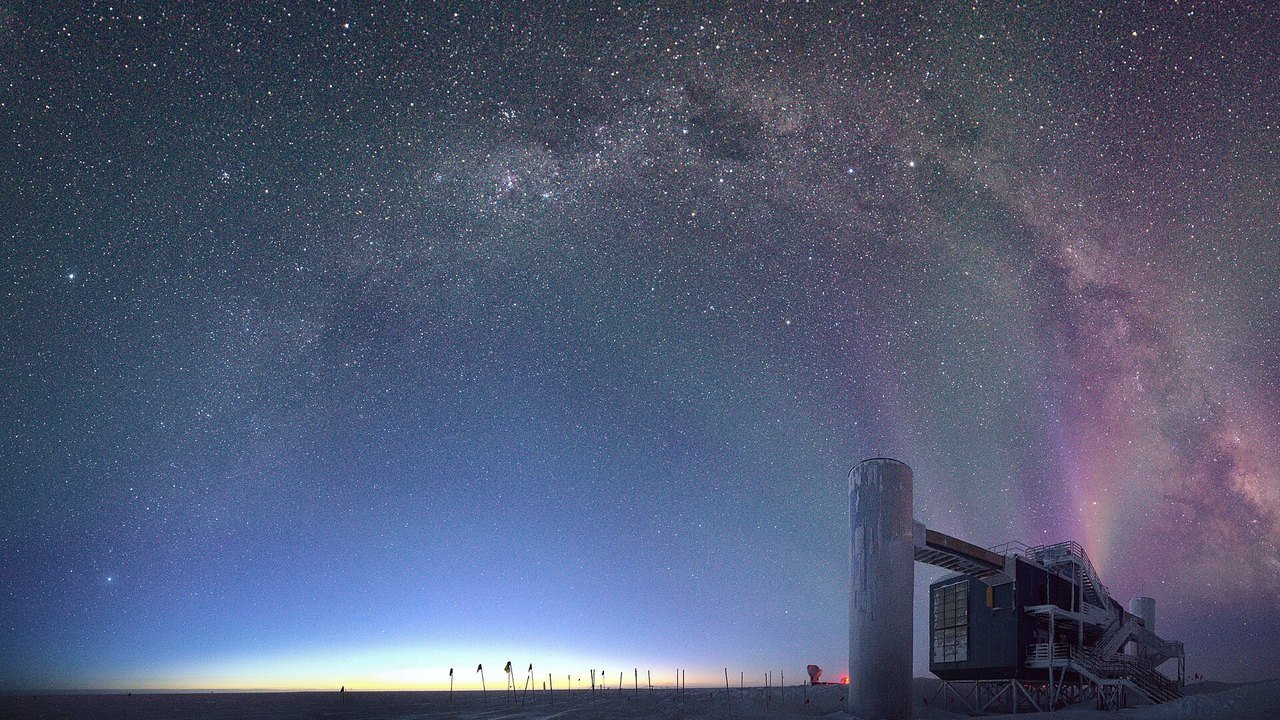
Francis Halzen, the physicist who talked a generation of colleagues into burying light sensors deep in the ice at the South Pole, won the 2026 Nobel Prize in Physics on Tuesday, October 6. The Royal Swedish Academy of Sciences announced the award in Stockholm shortly before 3 a.m. PT Tuesday and cited Halzen alone, “for decisive contributions to the IceCube Neutrino Observatory and the discovery of high-energy neutrinos of astrophysical origin.”
Halzen, 82, grew up in Belgium, earned his PhD at KU Leuven in 1969, and moved soon after to the University of Wisconsin–Madison, where he holds a professorship and serves as IceCube’s principal investigator. The Associated Press said its efforts to reach him had not immediately succeeded. The prize carries 12 million Swedish kronor, about $1.2 million, and Physics World reports that Halzen will receive it in Stockholm on December 10.
“Francis Halzen has led an international team of researchers and engineers who have provided us with a fantastic instrument. His tenacity and scientific vision has paved the way for a new kind of astronomy,” Mark Pearce, chair of the Nobel Committee for Physics, said in the academy’s press release. DW reports that the committee described neutrinos as “ghostly messages from space.”
The prize rewards a hunt for one of the hardest particles in nature to catch. Neutrinos carry no electric charge and almost no mass, and they pass through planets and people almost without a trace. The academy’s popular-science background notes that 65 billion neutrinos from the Sun stream through a person’s fingernail every second. Very rarely, one hits an atomic nucleus, and that collision gives a well-equipped observer a chance to see it.
Physicists want the rare, extremely energetic neutrinos that come from far outside the solar system. The cosmos fires off particles with up to a million times more energy than any laboratory on Earth can produce, and nobody knows for certain what launches them. Cosmic-ray protons bend in magnetic fields on their way here, which hides their origin. Neutrinos travel in straight lines and slip past dust and radiation, so their paths can point back to the sources, the academy explains.
Halzen’s idea took shape in the 1980s. The academy says he heard that Soviet researchers planned to use radio receivers in Antarctica to catch neutrino signals, and he realized that light sensors frozen into glacial ice might work better. When a neutrino strikes a nucleus in clear ice, it produces a charged particle that gives off a faint blue flash. Halzen teamed up with John G. Learned, who worked on DUMAND, a similar plan to catch such flashes in deep ocean water off Hawaii. The two presented the South Pole concept at a conference in Poland in 1988.
The site offered real advantages, according to the academy: an existing research station with regular supply runs, constant darkness at depth, no marine life or earthquakes, and very little background radioactivity. It also brought hard limits. The cold blocks travel for much of the year, so field work can happen only during the brief Antarctic summer, from November to February. Glaciologists showed the team how to melt kilometer-deep holes with a kind of hot-water shower head, and the crews lowered strings of sensors that Halzen describes as “a lightbulb in reverse,” the academy writes.
The early results disappointed. A first group of researchers began lowering sensors into the South Pole glacier in 1992, and Halzen has described waiting at his dinner table on Christmas Eve 1993, computer on his lap, for word that the first cable had gone in. Bubbles in the upper ice scattered the light. Below about 1,400 meters, though, the ice turned out remarkably pure, and light from collisions traveled some 300 meters before fading. That predecessor detector, AMANDA, kept growing until January 2000 but lacked the volume to catch the rarest cosmic neutrinos.
So the team built bigger. IceCube reached its full size in 2011, with 5,160 sensors spread along 86 cables through a cubic kilometer of ice, the academy says. The detector must pick its targets out of a flood of noise: more than 100 million particles from cosmic rays striking the atmosphere reach it every day, along with a few hundred atmospheric neutrinos that travel up through the Earth from the Northern Hemisphere. In 2013 the collaboration reported first evidence of neutrinos from deep space, and a couple of years later it had gathered enough data to make the discovery certain.
The search for specific sources has only begun. Of the neutrinos IceCube has recorded, 79 appear to come from the direction of NGC 1068, also called M77, an active galaxy, but the academy cautions that the evidence does not yet suffice to call that galaxy a confirmed source. IceCube has also detected high-energy neutrinos from the Milky Way, which researchers think arise when cosmic rays strike the thin gas between stars. In a 2026 conference abstract, Halzen wrote that the first identified sources point to supermassive black holes at the centers of active galaxies.
The award continues a long Nobel thread. Raymond Davis Jr. and Masatoshi Koshiba shared the 2002 physics prize for detecting neutrinos from the Sun and from a supernova, and Takaaki Kajita and Arthur B. McDonald won in 2015 for showing that neutrinos change type as they travel. Halzen has collected other honors along the way, including the American Physical Society’s 2026 Medal for Exceptional Achievement in Research. In an APS profile last December, he recalled that the project once looked like a “cute” idea and said of the skeptics: “Many people thought we wouldn’t, but we did.”
IceCube keeps growing. In February 2026, the collaboration said crews had finished the IceCube Upgrade, adding five densely instrumented strings and more than 600 new and enhanced sensors and calibration devices, the first major expansion since 2011. “This upgrade will secure the nation’s continued leadership in neutrino physics for years to come, paving the way for new cosmic discoveries,” said Marion Dierickx, the U.S. National Science Foundation’s program director for IceCube. The collaboration counts more than 450 scientists at 58 institutions, and the NSF funds the observatory mainly through an award to UW–Madison. A proposed successor, IceCube-Gen2, would cover eight cubic kilometers of ice, though for now it remains a proposal.
The physics prize follows Monday’s medicine award to Karl Deisseroth, Peter Hegemann, and Georg Nagel for optogenetics. The chemistry prize comes Wednesday, October 7, followed by literature on Thursday, peace on Friday, and economics on Monday, October 12, The Hindu reports. As of about 3 a.m. PT Tuesday, the sources this desk read carried no comment from Halzen himself and no statement from UW–Madison.
