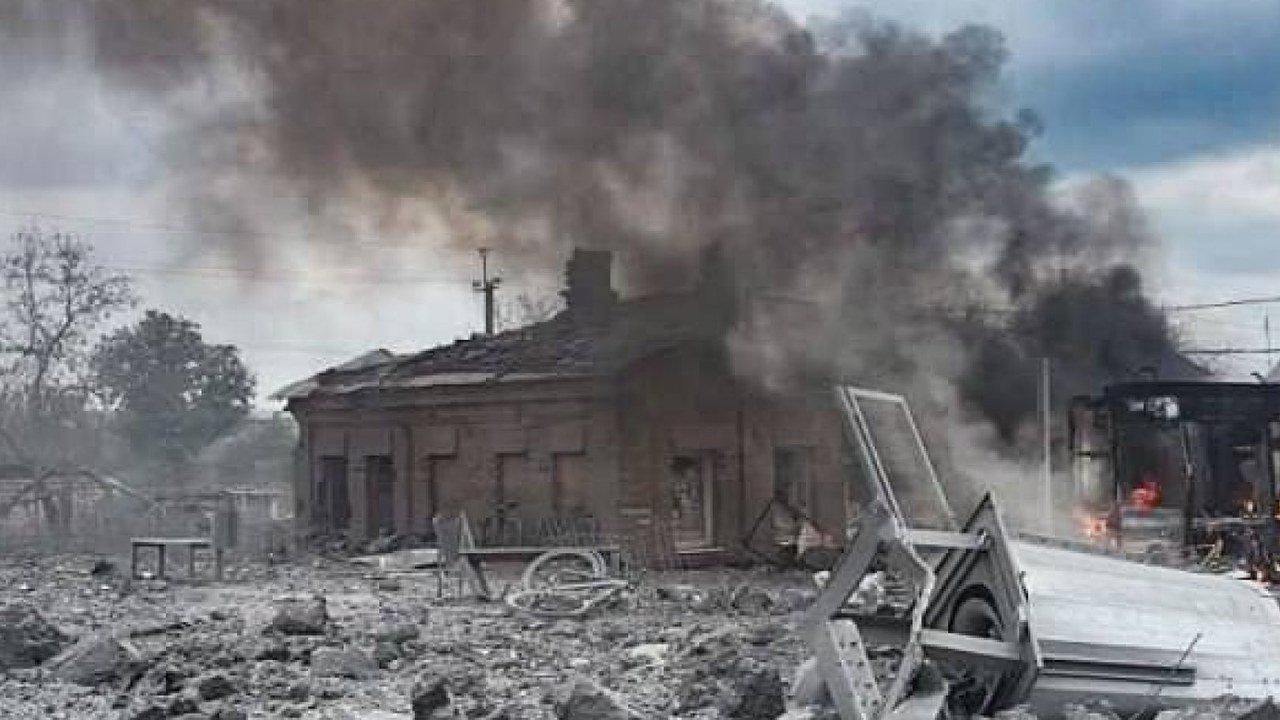
Russian aerial bombs hit a village school in southeastern Ukraine that residents used to collect humanitarian aid on Monday, Nov. 2, and then hit the shelter where people had gone for cover, killing at least 26 people, according to Ukrainian President Volodymyr Zelensky and the country’s State Emergency Service, known as the DSNS. The attack struck Komyshuvakha, a village in the Zaporizhzhia region, The Guardian and BBC News reported. Zelensky called it “an utterly horrific Russian attack” in a post on X at 9:03 a.m. PT (7:03 p.m. in Kyiv). Two rescuers and four police officers died among the victims, and five people went to hospital, including two rescue workers, according to the Guardian, citing the emergency service.
Ukrainian officials described two waves of bombs. “The strikes targeted a school used for humanitarian purposes – people were receiving humanitarian aid there,” Zelensky wrote on X. “After the first aerial bomb strike, there was a double-tap strike with nine more bombs, specifically targeting the shelter where people were taking cover.” In his nightly video address, he said, “The Russians struck first just as people were arriving – a few aerial bombs,” according to the Guardian, which drew on Reuters, the Associated Press and Agence France-Presse. “Then there was a second strike – more air bombs, this time on the shelter. A vile terrorist strike.” The school held no classes because the village lies too close to the front line, Zelensky said, according to the Guardian.
Watch: footage from Komyshuvakha posted by President Zelensky on X
If an embed does not load, it shows as a plain link to the original post.
View the @ZelenskyyUa post on X
The reported toll rose through the day. Zelensky first said 18 people had died; the DSNS later reported 24 confirmed dead; and in his late-evening address he said 26 people had died, according to the BBC. Mykhailo Semikin, whom the BBC described as the regional head and the Guardian as a military official in Zaporizhzhia, said “at least nine 3,000kg aerial bombs” hit the village and that 27 people had initially gone missing, according to the BBC. Semikin called the attack a “terrible tragedy” for the village and said “people are still under the rubble,” the BBC reported. The Guardian attributed the figure of 27 missing to Regina Kharchenko, secretary of the Zaporizhzhia city council. Ivan Fedorov, whom Euronews identified as the regional governor, said Russian forces had fired “at least nine KAB-3000 bombs” on the settlement during the day.
Rescuers came under threat themselves, according to Ukrainian officials. Rescue workers and police officers had reached the scene when the threat of another strike emerged; the rescuers took shelter, but Russian forces struck the same site again, the DSNS said, according to the Kyiv Independent. The emergency service named the two rescuers killed as Denys Konovalenko and Oleksii Sushchevskyi, both 44, the Kyiv Independent reported. Konovalenko had served in Ukraine’s civil protection service for nearly 12 years, and Sushchevskyi had worked in fire and rescue units in Zaporizhzhia since 2013, according to the DSNS as cited by the same outlet. Russian drone attacks in the area forced rescue teams to pause their work several times, Semikin said, according to the BBC and the Guardian.
Damage reports came from officials and photos. The attack destroyed a gymnasium, an outbuilding and a fire truck and damaged the school building, according to the DSNS as reported by the Kyiv Independent. Images the DSNS shared from the scene show “a building reduced to a pile of rubble and what appears to be a burned-out bus,” Euronews reported. As night fell, responders used torches to search the rubble of collapsed buildings, according to photos and video posted by local officials, the Guardian reported. Officials declared a day of mourning for Tuesday across the Zaporizhzhia region, according to the BBC.
Zelensky argued that Russian forces knew about the aid handouts. “The Russians could not have been unaware that every week, local residents who had remained in Komyshuvakha received humanitarian aid at that very location,” he wrote. “And this is further proof that Russia wants no de-escalation and no real justice.” Ukraine’s foreign ministry wrote on X that “Russia knew that civilians had gathered there to receive humanitarian aid” and called for “stronger pressure on Russia and continued support for Ukraine.” This desk could not independently verify the toll, the sequence of strikes or what Russian forces knew; those accounts come from Ukrainian officials as reported by the outlets cited here.
Moscow had given no public response by Monday night. “The Russian military has not publicly commented,” the BBC reported. This desk found no Russian Defence Ministry or Kremlin statement on Komyshuvakha in the reports checked for this story as of about 7 p.m. PT. The Kyiv Independent noted that Russia frequently uses guided aerial bombs, known as KABs, against front-line areas; fitted with wing kits, they can travel tens of kilometers, letting aircraft release them from beyond the reach of air defenses, the outlet reported.
The village sits near the fighting. Komyshuvakha lies about 20 kilometers from the front line and has counted as a front-line settlement since November 2025 amid repeated guided-bomb attacks, according to the Zaporizhzhia Investigation Center, as cited by the Kyiv Independent. The village lies southeast of the regional capital, also called Zaporizhzhia, according to the Guardian.
The strike followed a rare pause in fighting elsewhere in the south. Last week’s local ceasefire around the Russian-occupied city of Oleshky, in the Kherson region, brokered by U.S. first lady Melania Trump, allowed an evacuation of civilians, according to the Guardian, which called it the longest pause in fighting in the war. “After the humanitarian operation in Oleshky, there was a moment when the next steps could have shown that progress toward peace was possible,” Zelensky wrote. “With these killings, Russia is sending an entirely opposite signal: Russia is counting on more killings.” Authorities in Kherson said Russia resumed attacks on that region on Monday, according to Euronews. The Kremlin said it planned no other similar missions “at the moment,” according to the Guardian.
Diplomacy continues on a separate track. U.S. special envoy Steve Witkoff said on Monday that talks among Ukraine, Russia and the United States would resume next week in Abu Dhabi, according to the BBC; the Guardian reported the dates as Nov. 10 and 11. Witkoff said the discussions would focus on “post-war security arrangements, de-escalation, humanitarian efforts, and next steps toward peace,” the BBC reported. The broadcaster added: “No major breakthrough is expected at the talks.” Later on Monday, Zelensky wrote on X that “we have intel that Russia is preparing a new massive attack on our country – primarily targeting energy and logistics,” saying Moscow assumed that “tomorrow the world will be watching the American midterms.” This desk could not verify that intelligence claim.
For background on the Oleshky truce, see Seems News’ earlier report; for the planned talks, see this report. Seems News will update the toll if Ukrainian officials revise it or if Russia comments.