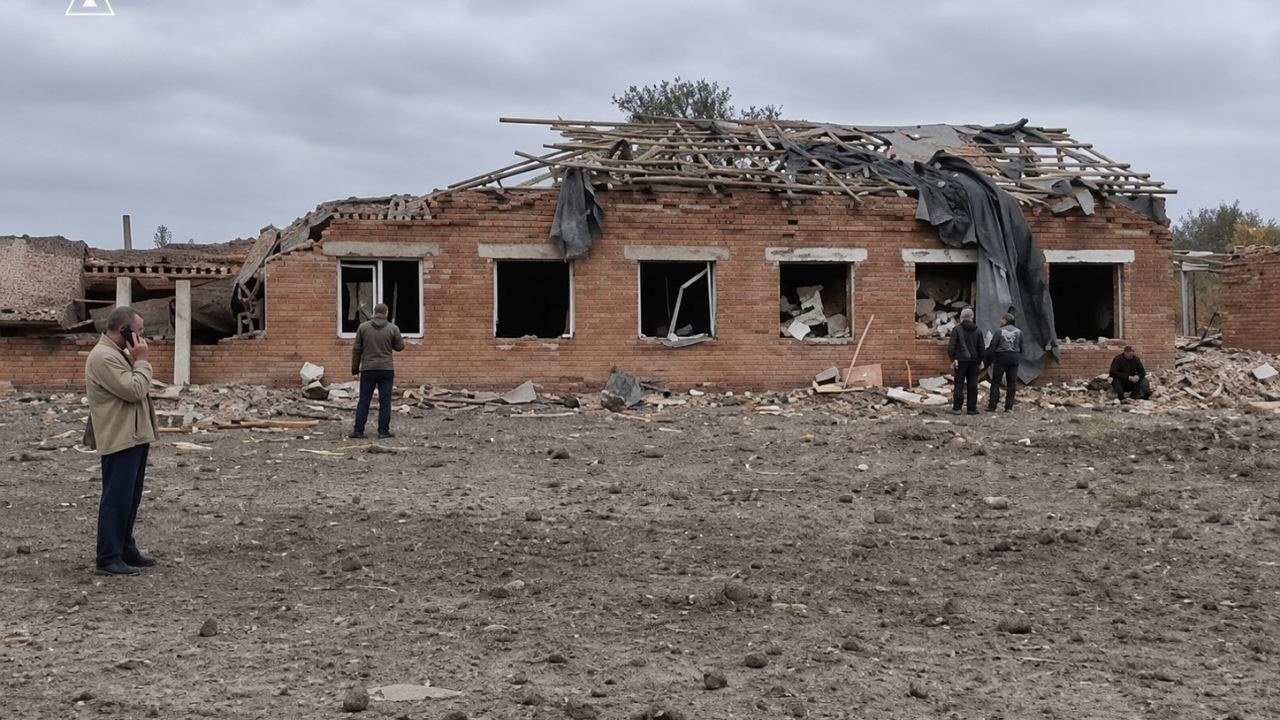
A Russian air attack on a small village in southern Ukraine killed at least 31 people who had come to a school building to collect humanitarian aid, Ukrainian officials said on Tuesday, Nov. 3. The strike hit Komyshuvakha, in the Zaporizhzhia region south-east of the regional capital, on the morning of Monday, Nov. 2, according to the UN Human Rights Monitoring Mission in Ukraine (HRMMU). Mykhailo Semikin, acting head of the Zaporizhzhia Regional Military Administration, wrote on Telegram: “According to the latest data, the figure has increased – 31 people are currently considered dead, five are injured, and nearly 50 people remain missing,” according to Interfax-Ukraine. The BBC, in a report by Laura Gozzi, put the count at “at least 33” and quoted President Volodymyr Zelensky as saying that more than 50 people could remain trapped under the rubble. Zelensky called the strike “one of the largest mass killings committed by Russia during this war,” according to the BBC. Semikin said the region declared three days of mourning, from Nov. 3 to Nov. 5, according to Ukrinform.
The UN mission described how the village had advertised the handout. “Local authorities had announced the distribution of humanitarian aid the day before on a social media channel with nearly 5,000 subscribers, stating that the distribution would take place at the school between 10 AM and noon on 2 November,” HRMMU said in its statement, also published by the United Nations in Ukraine. “Either the Russian armed forces knew that there was a humanitarian distribution taking place, or they failed to take the most basic steps to find out what was happening in this village they were planning to attack,” said Danielle Bell, head of HRMMU. “In either case, this attack seems to have violated the most fundamental principles of international humanitarian law.” The mission said it had reviewed photos and videos of the aftermath and found the destruction “consistent with the use of powerful aerial bombs,” and that it continues to work to verify the exact number of civilian casualties.
Watch: Komyshuvakha after the strike, posted on X
If an embed does not load, it shows as a plain link to the original post. Some footage shows destruction.
View the @VitalyBBC post on X
View the @nexta_tv post on X
Local authorities described an attack in two waves, according to the UN mission. “Nine 3,000kg aerial bombs hit Komyshuvakha as residents were gathering to receive humanitarian aid at a distribution centre, authorities said,” the BBC reported, adding that, according to local media, people took refuge underground when the attack began, and the roof then collapsed and trapped many of them. Semikin said in a televised interview: “They started with KAB-500 guided aerial bombs and then used FAB-3000 bombs,” adding that “a FAB-3000 contains 1.5 tonnes of explosive material,” according to Ukrinform. He said that “following a direct hit, the concrete structure inside the building collapsed and a fire broke out.” Interfax-Ukraine, citing Semikin, reported “at least nine airstrikes” and a follow-up strike on the shelter. One English-language report, by NV, names the first bombs as FAB-500 rather than KAB-500; this desk relies on Ukrinform’s direct quote from Semikin. “The scale of the tragedy is difficult to comprehend,” Semikin said, according to the BBC. Rescue work on Monday evening ran into further Russian drone attacks on the bombed area, Semikin said, according to the Guardian.
Several of the dead had come to Komyshuvakha to work. Semikin said four police officers and two rescue workers died, and that 48 people remained missing, according to the Guardian. Ukraine’s National Police named the officers as Majors Mykhailo Buzhenko and Mykola Balanda and Captains Mykhailo Romanov and Dmytro Besiedin, according to NV, which also reported that the State Emergency Service named its two dead rescuers as Denys Konovalenko and Oleksii Sushchevskyi, both 44. NV, citing Suspilne Zaporizhzhia, reported that Olha Tverdenko, an employee of an administrative services center who traveled to the village every Monday to sort and hand out bread and food packages, also died. The National Police said one of the bombs hit a humanitarian aid hub that also served residents as a shelter, according to NV.
Moscow offered a different account. Russia’s defense ministry said the attack had targeted Ukrainian military units and killed 25 servicemen, according to the BBC. BBC News Russian defence correspondent Ilya Abishev reported finding no credible evidence that the Ukrainian military used the site and no major military or industrial facilities in the settlement, while noting that the village holds high military importance as part of Ukraine’s defensive and transport network on the approaches to the regional capital, according to the BBC.
The Komyshuvakha attack came during a wider overnight barrage. Russia launched 289 attack drones, 17 ballistic missiles and 59 cruise missiles across nine regions, Zelensky said in an online post, according to the Guardian. Strikes killed at least 38 civilians across Ukraine over 24 hours, according to the BBC. In Dnipro, a Russian missile destroyed a hospice, and nearly 50 terminally ill patients, the oldest aged 90, moved to other facilities, the BBC reported. In Kharkiv, a combined missile and drone attack wounded at least 62 people and damaged a medical facility, and more than 200 patients moved elsewhere, according to regional head Oleh Syniehubov as quoted by the Guardian; Zelensky put the Kharkiv wounded at 73, according to the BBC. Kyiv’s main water supplier, Kyivvodokanal, said the capital’s water supply had stopped entirely “due to enemy attacks and damage to the capital's energy infrastructure,” and the city suspended its whole metro network on Tuesday, the BBC reported.
The strike followed a local ceasefire last week, according to the BBC. Zelensky said Ukraine had proposed to extend and expand last week’s ceasefire around the Russian-occupied town of Oleshky, in the Kherson region, which allowed residents to evacuate, and he described the attack on the aid center as Moscow’s response, according to the BBC. The Guardian reported that U.S. first lady Melania Trump brokered that ceasefire, and the BBC reported that she plans to host representatives of Russia and Ukraine at the White House on Thursday. “If Russia genuinely wanted de-escalation, there was an opportunity following the situation in Oleshky to continue taking humanitarian steps. We proposed this. But Russia continues to kill people,” Zelensky said, according to the Guardian. He added: “The Russians think America won’t notice this signal of theirs,” and then: “But we need to notice and stop such terror.”
Diplomacy continues on a parallel track. The Kremlin said it would take part in three-way talks with Ukraine and the United States in Abu Dhabi on Nov. 10–11, according to the BBC, and the Guardian reported that Vladimir Medinsky will lead the Russian delegation. Zelensky, speaking to reporters in Berlin, said he had not yet seen “any indication” that Russia wants to negotiate seriously on a ceasefire, according to the BBC. The UN mission said that, before Monday’s attack, aerial glide bombs had killed at least 478 civilians and injured 2,667 in Ukraine in 2026, or 16 per cent of all verified civilian casualties, according to its statement. This story will update as officials revise the toll and as the UN mission completes its verification.