Storm Boelo claimed a life in southwest Scotland on Sunday, Oct. 25. A 60-year-old man died after a tree struck him on a minor road at Mid Kelton, near Castle Douglas in Dumfries and Galloway, at about 10:30 GMT (3:30 a.m. on the U.S. West Coast), according to Police Scotland statements carried by BBC News and ITV News. Police said the man “was pronounced dead at the scene,” ITV reports, and a spokeswoman told the BBC: “There are no suspicious circumstances and a report will be submitted to the procurator fiscal in due course” (BBC News; ITV News). In Scotland, the procurator fiscal reviews sudden and accidental deaths; neither outlet has named the man.
The death came as the second named storm of the season swept across the north of the UK, a day after Storm Austen hit south-west England. The Met Office issued amber wind warnings for Saturday night and Sunday covering mainland Scotland, parts of Northern Ireland and the far north of England. “Storm Boelo will be felt across the UK this weekend, with the strongest winds and greatest potential for disruption in the north,” chief forecaster Jason Kelly said in the forecaster’s release, which predicted “widespread gusts of 60-70mph” and up to 80mph on exposed coasts (Met Office). ITV News reports that the amber warnings remain until 9pm Sunday (2 p.m. PT) across the far north of England and all of Scotland, and that the amber warning for the north coast of Northern Ireland lifted around lunchtime (ITV News). This desk covered the warnings for both storms on Thursday; see that earlier report.
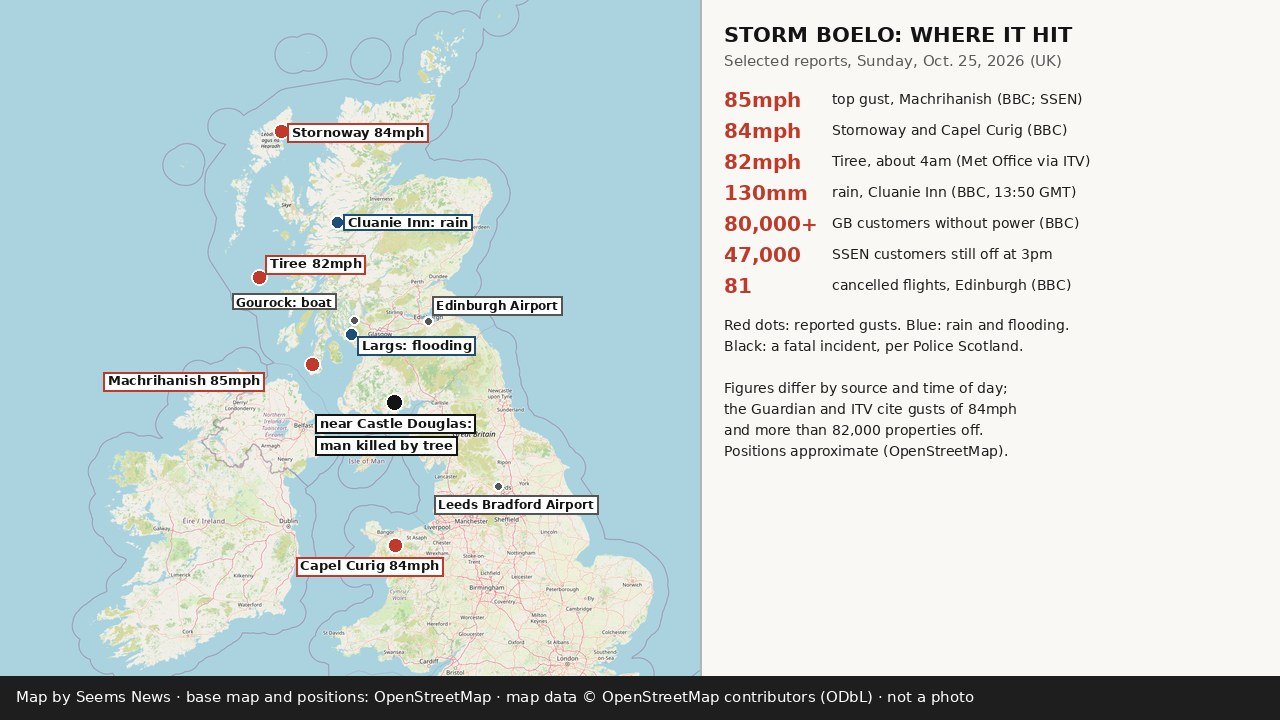
Some gusts topped the forecaster’s 80mph upper estimate. The BBC lists the highest Sunday readings as 85mph at Machrihanish, in Argyll and Bute, and 84mph in both Stornoway, in the Outer Hebrides, and Capel Curig, in north Wales (BBC News). The network operator Scottish and Southern Electricity Networks (SSEN) also reports 85mph at Machrihanish, which it spells “Machrahanish” (SSEN). The Guardian, citing the Met Office, gives 84mph in Argyll and Bute and 83mph in Snowdonia (Eryri), and says Tiree, in the Inner Hebrides, recorded 82mph; ITV puts the Tiree gust at about 4am Sunday (the Guardian; ITV News). Rain piled up in the Highlands: the BBC reports 130mm at Cluanie Inn and 111mm at Affric Lodge, while the Met Office, posting on X earlier in the day, gave Cluanie Inn 121.6 mm over the previous 24 hours, a figure that the later BBC total overtook (BBC News; Met Office on X).
Power cuts spread widely. The BBC reports that more than 80,000 customers across Great Britain lost power by Sunday morning, with further cuts across the island of Ireland (BBC News). The Guardian, citing the Energy Networks Association (ENA), says engineers had restored power to 344,900 customers, with more than 82,000 properties still disconnected, including more than 30,000 homes across Scotland (the Guardian). The Guardian’s body text prints the figure as “82,6000,” an apparent typo; this desk follows its headline, “More than 82,000.” The ENA said that “the continuing severe weather in some regions is limiting network engineers’ opportunities to safely start the work of restoring customers’ power today” (the Guardian). By 3pm, SSEN said “just over 47,000 customers are awaiting restoration,” after it had restored supplies to more than 32,500 since the storm began, with Argyll and the West, Skye and the Western Isles hit hardest (SSEN). ITV reports at least 6,000 homes off in SP Energy Networks’ area of central and southern Scotland (ITV News).
Watch: Boelo on the Clyde coast and from space
Three video posts on X from Sunday. STV News and BBC Scotland News show flooding and storm debris on the Firth of Clyde; the Met Office shows the storm from orbit. This desk has not frame-checked any of the clips. If an embed does not load, it shows as a plain link.
View the @STVNews post on X
View the @BBCScotlandNews post on X
View the @metoffice post on X
The Clyde coast took some of the worst flooding. In Largs, North Ayrshire, “high winds and heavy rain quickly turned the Main Street into a river,” ITV News reports; Toni Dawson, who runs an ice cream and gift shop there, told ITV the water reached its “highest level ever” (ITV News). North Ayrshire Council said it would drop off around 300 sandbags to the Main Street and train station, according to ITV. A BBC reporter in Largs wrote that businesses called it “the worst storm here in decades,” with some losing “tens of thousands of pounds in stock” (BBC News). The BBC also reports a boat washed onto Cove Road in Gourock and a flooded phone shop on Dumbarton High Street. Sky News interviewed Dawson as well; its post says she “voiced her frustration at the lack of preparedness from authorities,” a criticism this desk has not seen any official answer to so far.
Travel suffered across the north. Edinburgh Airport told the BBC it had 81 cancelled flights and 11 diversions since the warnings began on Saturday, including one flight from Faro diverted to Oslo; a spokesperson explained that while pilots can land in gusts of up to 50mph, passenger steps can work only in gusts of up to 45mph (BBC News). The Independent counts more than 1,500 delayed flights across the UK (The Independent). Leeds Bradford Airport said it faced “disruption to arriving and departing flights,” ITV reports. Network Rail listed a dozen disrupted operators, with Northern advising passengers not to travel across its network and LNER advising against travel between Edinburgh and Aberdeen (ITV News). Traffic Scotland reported the A1 closed at Ayton because of power cables on the carriageway and the A75 and A82 shut by fallen trees, and the BBC says the Dornoch Bridge closed to all vehicles (ITV News; BBC News). Transport Scotland’s Stuart Wilson said “there will be significant recovery work required before we have the network back to normal” (BBC News).
Flood warning counts shifted through the day. The Independent earlier reported that the Scottish Environment Protection Agency (SEPA) had issued 29 flood warnings; by 1.45pm, SEPA listed 17 warnings and 11 alerts, ITV and the Guardian report, while the Environment Agency had six warnings and 50 alerts in northern England (The Independent; ITV News; the Guardian). Northern Ireland’s Department for Infrastructure says it received reports of around 350 incidents, according to the BBC. Weekend events fell away too: Visit Liverpool cancelled its River of Light trail “in the interests of safety,” London’s Diwali on the Square did not go ahead, and Edinburgh Castle and the Fountains Abbey estate closed for the day (the Guardian). Scottish ministers held an emergency meeting on Sunday afternoon, the BBC reports.
Relief may prove brief. The Met Office posted on X Sunday afternoon that winds should ease in the evening as Boelo pushes east (Met Office on X), but ITV reports a yellow warning for strong winds from 3am Tuesday to midnight covering Scotland and the north coast of Northern Ireland (ITV News). Met Office forecaster Aidan McGivern told ITV: “It's a very similar situation to Boelo on Monday and Tuesday.” Storm Chloe stands next on the 2026/27 list shared by the UK, Ireland and the Netherlands, though ITV notes that a name comes only if the system triggers amber or red warnings. Open questions as of this update: how fast SSEN and other networks reconnect the remaining customers, how much the Largs businesses lost, and whether Tuesday’s system earns a name. This desk read ITV through an automated text fetch because ITV’s site blocked a direct download.