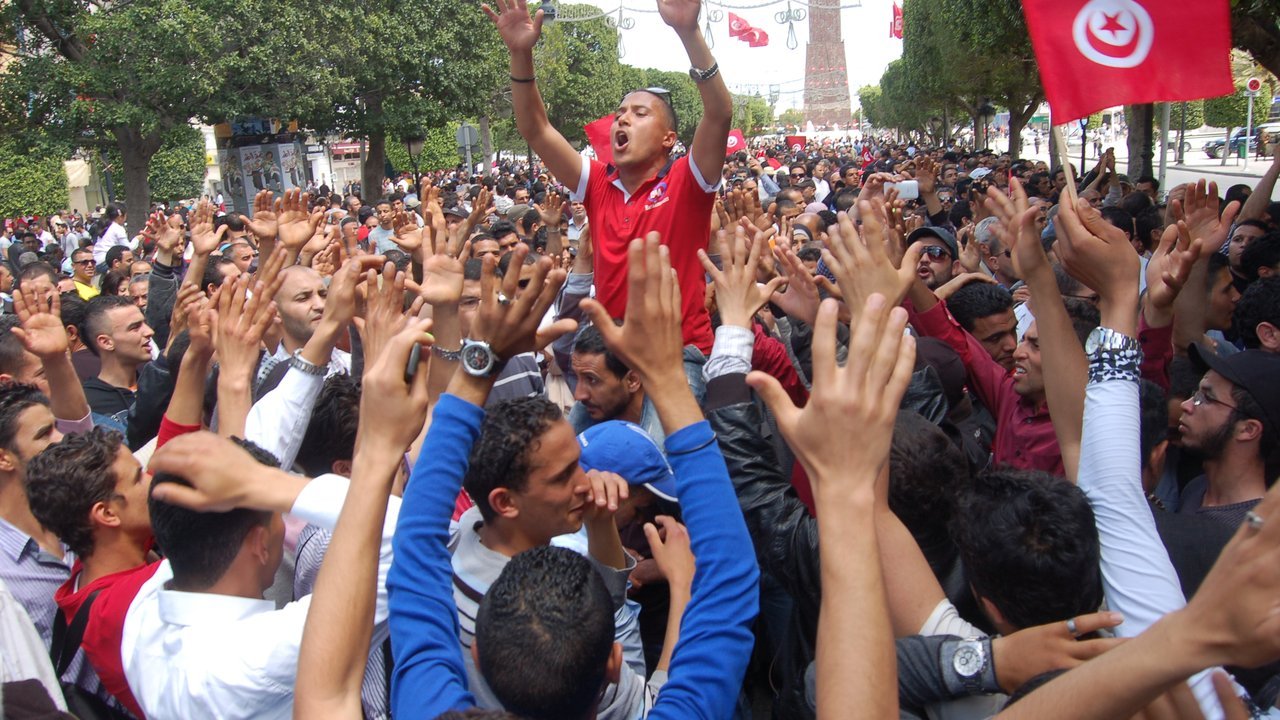
Thousands of Tunisians marched through central Tunis on Saturday in what Reuters calls the largest protest against President Kais Saied in years, a demonstration led by the Tunisian General Labour Union (UGTT) and civil society groups. Al Jazeera, drawing on AFP and Reuters, also calls it the largest protest against Saied in years. Al Jazeera writes that AFP put the march at more than 3,000 people but that the total “could not be independently confirmed”; BBC News Arabic cites the same AFP figure. This desk found no police or organiser crowd count, so it treats AFP’s number, and a similar Business News count that Assahifa cites, as the only estimates on hand.
Protesters gathered in Mohamed Ali Square, which BBC News Arabic describes as the UGTT’s stronghold, before moving through the capital toward Habib Bourguiba Avenue, the BBC Arabic service reports (desk translation). Assahifa, citing the Tunisian outlet Business News, says more than 3,000 participants had assembled at Mohamed Ali Hammi Square before the march began. Reuters calls Habib Bourguiba Avenue a focal point of the 2011 protests that helped trigger the Arab Spring uprisings. Lawyers, doctors, journalists and unemployed people joined the march, Reuters and Al Jazeera report, and Reuters says opposition parties from across the political spectrum took part “in a rare show of unity.” Hundreds of police deployed across the capital, according to Reuters and Al Jazeera; Al Jazeera adds that authorities closed several surrounding roads.
Assahifa says nine national organizations and civil society groups called the demonstration, among them the UGTT, the journalists’ union, the national bar association and the Tunisian League for Human Rights; BBC News Arabic lists the same four plus the Tunisian Organization of Young Doctors. Assahifa, citing the outlet Kapitalis, says organisers asked participating activists to avoid displaying partisan affiliations, and it reports that the Free Destourian Party separately announced its participation. Assahifa also says the mobilization followed a September 29 coordination meeting at the UGTT’s headquarters.
Addressing the rally, UGTT head Slah Eddine Salmi said “Silence will no longer be acceptable,” Reuters reports, and he argued that no state can rest on concentrating all powers in the hands of one person, according to the Reuters account. Al Jazeera, which spells his first name Salah, says he criticised the concentration of political power in the presidency. BBC News Arabic carries an Arabic rendering of the same remarks, crediting Reuters.
Protesters chanted “No fear, power belongs to the people!” and “The prisons are full, people are hungry!”, Reuters reports, and revived the 2011 uprising slogan “The people want the fall of the regime!” Al Jazeera describes that slogan as one demanding the government’s removal. Placards read “No democracy without freedoms” and “No dignity with poverty,” according to AFP as carried by NAMPA and Al Jazeera. Reuters says marchers called for the release of Saied’s critics and an end to what they described as attacks on trade union rights; Al Jazeera says they demanded the release of detained government critics and an end to restrictions on trade union rights.
Al Jazeera says the political demands came alongside mounting frustration over the cost of basic goods and declining purchasing power. Reuters says Tunisia grapples with an economic crisis, worsening public services, recurring water and power cuts, and shortages of medicines and essential goods; Al Jazeera lists similar problems. AFP’s lead, as carried by NAMPA, says the marchers protested soaring living costs and a rollback of rights and freedoms. “Enough is enough! The country is collapsing. We suffer from power and water cuts, and one crisis after another,” said Yassine Gharseli, a protester from Sfax, about 250 km (155 miles) south of Tunis, Reuters reports. He added, “I came from Sfax to stand up for my freedom and I'm not about to give up, even if I become the last voice in the country.” Al Jazeera carries the shorter version of his remark. BBC News Arabic says a 32-year-old employee, Karim Majri, told AFP he feels suffocated by injustice, repression and the high cost of living (desk translation).
Saied seized broad powers in 2021 and 2022, dissolving parliament, dismissing dozens of judges and ruling by decree, moves that opponents described as a coup, Reuters reports. Al Jazeera says that in 2021 he suspended parliament and dismissed the government, saying he set out to confront corruption and political deadlock, and that a new constitution increased presidential powers in 2022. Rights groups say he has intensified a crackdown on civil society, journalists and opposition figures, according to Reuters. Saied rejects that picture, denies acting as a dictator and blames his opponents for engineering economic crises to fuel social unrest, Reuters reports. BBC News Arabic adds that he says he will press on with purging the country of people he calls traitors, the corrupt and conspirators (desk translation). None of the outlets this desk read carried a response from Saied’s office to Saturday’s march.
Saturday’s march followed other protests over similar grievances, Al Jazeera reports: on August 20, protesters in Tunis rallied against rising prices and shortages of basic goods, and last month fuel transport workers held a two-day strike over wages and working conditions, led by a union federation affiliated with the UGTT. Reuters says the protest poses a significant challenge to Saied after years of divisions weakened the opposition’s ability to mobilise large crowds. BBC News Arabic says opposition figure Sihem Ben Sedrine, former head of the Truth and Dignity Commission, told AFP that protesters want respect for fundamental freedoms and, in particular, the release of political prisoners (desk translation).
