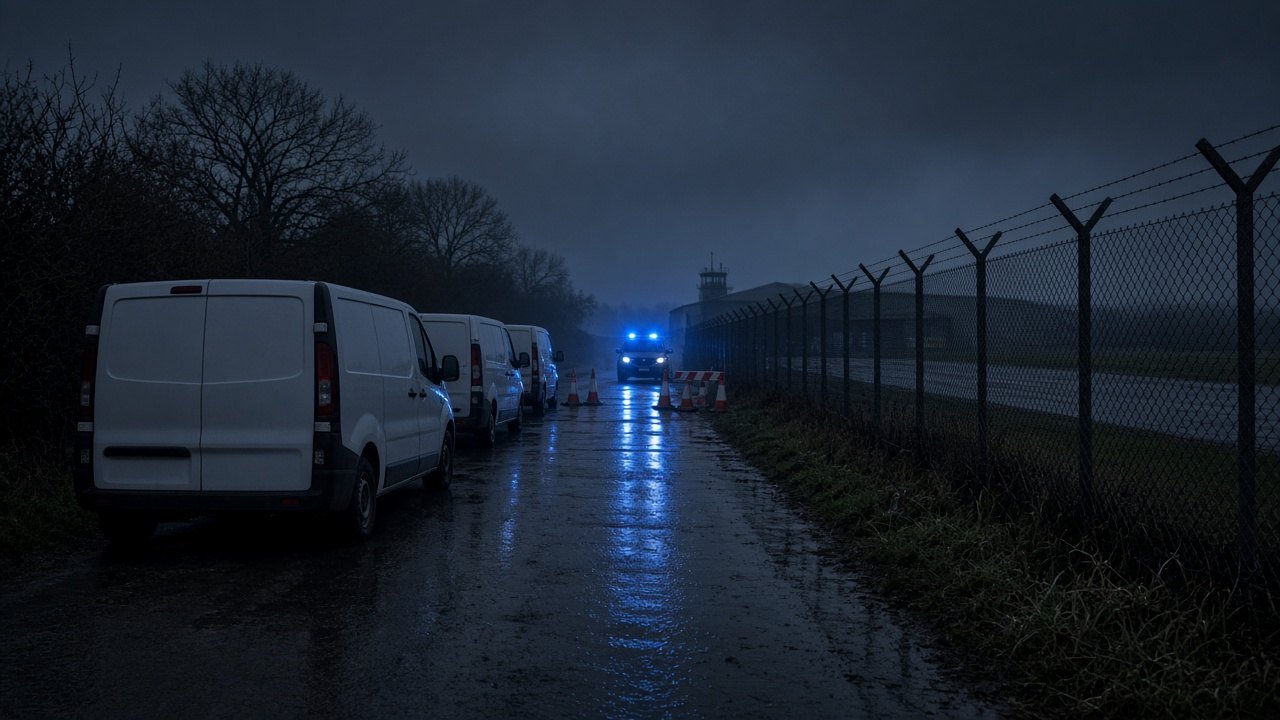
Federal prosecutors in New York on Tuesday, Nov. 10, unsealed an eight-count superseding indictment against three men they describe as Iran-backed operatives, tying them to nearly 20 attacks and attempted attacks across Europe and the United States and to the September incident at RAF Fairford, a British air base in Gloucestershire that hosted U.S. bombers, according to the BBC and NBC News. The Justice Department names the defendants as Mohammad Baqer Saad Dawood al-Saadi, 32, a citizen of Iraq and Iran; Mohsen Mohajeri, 48, a citizen of Iran; and Mohammad Ali al-Hassani, 35, a citizen of Iraq. The department posted the indictment as a scanned court document; the desk relied on the department’s written summary for the details below.
“Anyone who plans a terrorist plot on a military base housing American servicemembers will be prosecuted by the United States government,” Attorney General Todd Blanche said in the release. U.S. Attorney Jamie McDonald of the Southern District of New York said: “Even after one of their co-conspirators was arrested and placed in federal custody, the defendants allegedly continued coordinating terrorist activity through coded communications and a network of associates overseas.” He added: “The threat presented by Iran and Iran-backed terrorist groups to America and our allies is not hypothetical — it is very real.” The department also posted the announcement on X, and the FBI shared it from its New York and Washington field offices.
The department’s account of the Fairford plot runs as follows. In August, it says, al-Hassani “allegedly directed and paid associates in the United Kingdom to conduct preparatory steps and arrange logistics,” and on Aug. 22 he paid one person, identified as Individual-1, to survey the base’s perimeter, then received videos of the area. In September, the release says, he paid several people to procure vans and barrels of fuel, research the purchase of what the department calls chemical accelerants, including large quantities of potassium chloride (the release does not say how the potassium chloride would have served the plot), and buy metal objects that could serve as explosive shrapnel. At his urging, the department says, they fixed custom decals to the vans so the vehicles looked like those of a fuel delivery business and a swimming pool supply business.
On Sept. 26, according to the department, al-Hassani tasked people to drive three vans, some later found to hold barrels of fuel, toward the base, and stayed in frequent contact with the drivers. “At least two of the three vans, while en route to the perimeter of RAF Fairford, encountered a security roadblock and were not allowed to proceed on their intended route,” the release says. British police recovered three white vans bearing the fuel-business logos in the early hours of Sept. 27 and arrested the occupants, it adds. The department says al-Hassani and Mohajeri sat in Iran during the plot and relied on contacts in Britain. The BBC reports that a local farmer heading home from a party spotted the vans and called police, and that officers found no explosive materials in the vans but seized a quantity of petrol.
View the @AJEnglish post on X
View the @TRTWorldNow post on X
Prosecutors place al-Saadi in a New York jail throughout. The department says he has stayed in federal custody since U.S. authorities received him after his arrest abroad on or about May 1, and that he used calls with his mother and sister in Iraq to pass coded messages to his co-defendants. In one call, the department says, he asked his sister: “What are they doing about all our old work?” She replied that “it isn’t cancelled.” On or about Sept. 24, three days before the vans turned up, the release says he asked after al-Hassani, whom he called “Ali,” and told relatives to “give him [al-Hassani] money so we can do it.”
Outlets summarize the roles differently. CBS News writes that al-Saadi “directed and paid” the British associates beginning in August, while the release assigns that step to al-Hassani, as do the BBC and NBC News. CBS also says the indictment alleges the fuel-filled vans would explode at the base; the release itself speaks of fuel, accelerant research and shrapnel but does not describe a planned explosion in those words. NBC quotes the sister call as “What are we doing about all our old work?” and dates it to July, while the release uses “they” and places calls about Mohajeri in June and July. The Guardian calls al-Hassani “another Iranian”; the department lists him as an Iraqi national.
The indictment also reaches back to a wave of attacks in Europe this spring. According to the department, the attacks ran under the name Harakat Ashab al-Yamin al-Islamiya, or HAYI, which it calls a front for Kata’ib Hizballah; of 18 attacks HAYI claimed in Europe, seven took place in Britain, involving “arsons, explosives, and in one instance, a near-fatal stabbing in London of two Jewish men, including a dual U.S.-British citizen.” The release says Mohajeri and al-Hassani met in Iraq around April 6 with a map of London on a screen, where al-Hassani said, “we need to get focused on London,” and that on or about April 18 al-Hassani guided a person attacking a London synagogue over a video call. The BBC says two Jewish men suffered stab wounds in Golders Green in April and that a suspect faces trial next year. Prosecutors earlier accused al-Saadi of trying to target a synagogue in Manhattan, the department says.
In Britain, the BBC reports seven arrests over the Fairford incident, while NBC News, the Guardian and DW describe five people detained near the base on Sept. 27. DW adds that British prosecutors separately charged two men, both 24, under the National Security Act in October, one accused of assisting Iran’s intelligence service and one of entering a prohibited place during an alleged reconnaissance visit to Fairford in August. The BBC says the Iranian embassy in London earlier rejected “unfounded and malicious speculations” linking Iran to the incident. The desk found no new comment from Tehran or from lawyers for the defendants on Tuesday’s charges.
The U.S. withdrew all its bombers from Fairford after the September incident, with President Donald Trump citing “some threats,” the BBC reports, and in July Iran said any base used for aggression against Iranian territory counts as a legitimate target, the BBC says; the Guardian attributes that July statement to the Revolutionary Guards. The charges landed a day after U.S. tankers left RAF Mildenhall, another British base, over what the Wall Street Journal called an Iran threat, according to Reuters and earlier Seems News coverage; no source the desk read links Tuesday’s indictment to the Mildenhall move. FBI Director Kash Patel said in the release that one defendant “allegedly sent coded messages to assist in future acts of violence” from behind bars. The department’s release closes with a chart of charges and penalties; it lists maximum terms from 15 years to life in prison across the eight counts, with life possible on Count Five, attempted acts of terrorism transcending national boundaries (al-Saadi only), and Count Six, conspiring to bomb a place of public use (all three men); only Count Seven carries a minimum, five years.