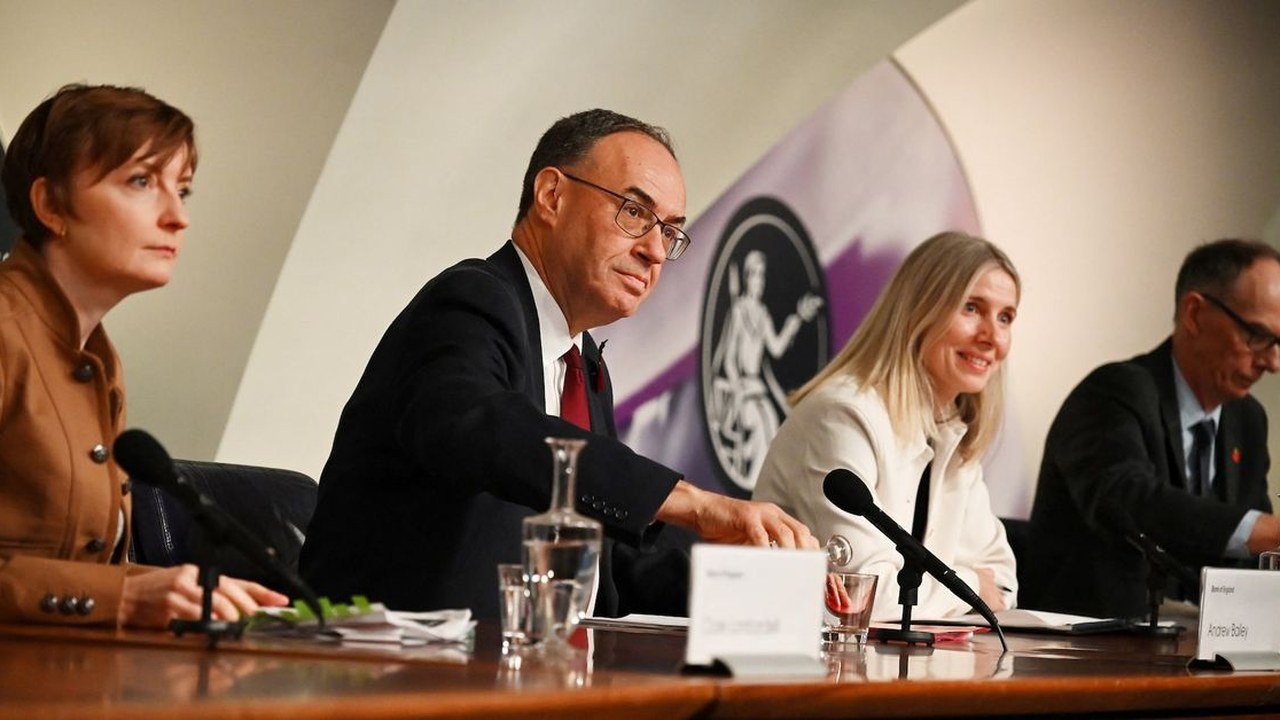
The Bank of England raised its main interest rate on Thursday, Nov. 5, for the first time in more than three years. The Monetary Policy Committee (MPC) voted by a majority of 8–1 at its meeting ending 4 November to lift Bank Rate by 0.25 percentage points to 4%, according to the Bank’s Monetary Policy Summary and minutes, published at noon London time (4 a.m. PT). Eight members — Andrew Bailey, Sarah Breeden, Swati Dhingra, Megan Greene, Clare Lombardelli, Huw Pill, Dave Ramsden and Alan Taylor — backed the quarter-point move. The ninth, external member Catherine L Mann, voted for a half-point increase to 4.25%, the minutes say. The BBC (Michael Race and Kevin Peachey) wrote that the Bank last raised rates in August 2023, and CNBC (Chloe Taylor) described Britain as the last major central bank to start tightening since the U.S. and Israel went to war with Iran eight months ago. This desk read the Bank’s own document plus BBC, Guardian, CNBC, Reuters (via Euronews’ live feed and a Devdiscourse reprint) and Dow Jones/MarketWatch copies, and agency posts on X.
The Bank blamed energy. “The conflict in the Middle East is now in its ninth month,” the summary says, and adds: “Global energy prices have continued to rise from an already elevated level.” Over the 15 UK working days to 27 October, front-month Brent crude futures averaged $108 a barrel and UK front-month gas futures 216 pence per therm, around 38% and 81% above the levels assumed in the Bank’s July report, according to the minutes. UK consumer-price inflation reached 3.5% in September, and the Bank now expects it “to rise to around 5% by the middle of next year,” the summary says. The Guardian (Heather Stewart) wrote that the forecast peak of 4.9% compares with 3.2% in the Bank’s July projections; the BBC added that the Bank does not see inflation back at its 2% target until 2028, and that in an “adverse scenario” of further escalation, inflation could reach 6.2% in 2027.
The Bank also flagged the cost of living. It expects the Ofgem energy price cap to rise from the equivalent of £1,723 a year for an average household to £2,150 in January, and food price inflation could hit 4.75% by mid-2027, the Guardian reported from the Bank’s analysis. Yet the summary says “there remains limited evidence of knock-on effects on other prices and wages,” and the BBC noted the Bank found some firms absorbing cost increases and accepting lower margins. The Bank also wrote that activity data in recent months “have generally been stronger than expected, adding to the case for modestly tighter monetary policy.”
Bailey pinned the outlook on the war. In his statement in the minutes, the governor wrote: “Put simply, it requires real progress towards settling the conflict in the Middle East.” He added: “Without news which softens the risks to inflationary pressures, I can see the argument for a further increase in rates and thereafter taking a more conditional approach, dependent on the evidence on energy prices and inflation dynamics.” According to the BBC, Bailey also said the decision “shouldn't be seen as the first in an inevitable long sequence of hikes”, but warned “unless the conflict in the Middle East is resolved, neither does it seem likely to be the last increase”. The Guardian quoted the same remark with “sequence in hikes”; this desk could not consult a Bank transcript to settle the one-word difference.
At the press conference, Bailey welcomed the sharp fall in energy prices over the previous 48 hours but said it would need to last to change his view, the Guardian reported. “This is positive news, but there is already a significant amount of inflationary pressure in the pipeline,” he said, adding: “What is the best thing that can happen? It is to resolve the conflict in the Middle East.” The Guardian tied the oil drop below $100 a barrel to the Democrats’ wins in the U.S. Congress, which some investors read as potentially constraining President Donald Trump’s capacity to prolong the conflict.
Watch: the decision explained, posted on X
If an embed does not load, it shows as a plain link to the original post.
View the @SkyNews post on X
View the @Reuters post on X
The minutes show a split over what comes next. Alan Taylor, whom the Guardian described as “dovish”, wrote in the minutes that “this is a risk-management ‘one-for-now’ insurance hike” and that “it is essential to communicate, and for markets to understand, that, as of now, this is not the start of a hiking cycle.” Clare Lombardelli wrote that “there is likely to be a case for a further increase in rates in the near term.” Huw Pill, the Bank’s chief economist, said “a single 25-basis point hike is unlikely to be sufficient.” Megan Greene wrote that “a rate hike now is appropriate,” after noting underlying wage growth “stuck around 3.5%.” Swati Dhingra wrote that the rise “provides additional insurance against upside risks,” while noting that “broad-based price pressures remain subdued.” Mann, explaining her dissent, wrote that “projected CPI inflation reaches 4.9% by mid-2027” and that “a 50-basis point hike in Bank Rate is ‘good policy’.” The committee’s next decision falls on 17 December, the Bank and the Guardian said.
Markets moved modestly. Reuters, in a markets file compiled by Dhara Ranasinghe, reported rate-sensitive two-year gilt yields up around 3 basis points at 4.77%, the FTSE 100 up 0.7%, and sterling little changed at around $1.3468. Traders raised bets on more hikes, pricing in around 76 basis points of further tightening by the end of 2027, compared with roughly 67 before the decision, Reuters said. Reuters also noted that a Reuters poll had expected the dissent to come from a member wanting to hold rates, not one seeking a bigger increase. Figures for the 10-year gilt differed by source and time stamp: MarketWatch/Dow Jones put it at 5.148%, still down 1.2 basis points on the day, while CNBC later had it 2 basis points higher at 5.1546%. A separate Reuters sterling report, carried by Devdiscourse, said the trade-weighted pound rose to 86.37, its highest since the 2016 Brexit vote.
Analysts quoted by Reuters split on the path. Michael Metcalfe of State Street called it “a relatively hawkish outcome.” Neil Wilson of Saxo said market odds for a December hike rose “from 1 in 4 to closer to 50/50.” Vivek Paul of the BlackRock Investment Institute said “we think markets are pricing in too many rate hikes,” and David Rees of Schroders said “we think UK interest rates will peak at 4.25% - well below the path currently priced by markets.” Felix Feather of Aberdeen, quoted by MarketWatch/Dow Jones, said: “But we do see at least one further hike, probably coming in February next year.”
For households, the BBC cited UK Finance figures showing that 510,000 tracker mortgage-holders face a £31 monthly jump in repayments; fixed-rate borrowers see no immediate change. The BBC profiled Brighton guitar teacher Patrick Bryson, 51, whose five-year 3.51% fix ends soon; the best deal he found, a 5.17% HSBC loan, lifts his repayments from £1,420 to £1,680 a month from February, the BBC reported. (The BBC article also refers once to “Peter” in that profile; this desk follows the name the BBC uses throughout, Patrick.) Savers, the BBC noted, may see higher returns.
Politics followed the decision. The hike lands a week after Chancellor John Healey used his first budget to promise “breathing space” for consumers, the Guardian reported. The Bank said budget measures should shave about a quarter of a percentage point off inflation by mid-2027. Responding, Healey said: “The Iran conflict is reaching deep into the pockets of families and businesses here at home,” and pointed to a £100 energy payment for 20 million households, a fuel duty freeze and an extended tax cut on electricity bills.
This desk checked the Bank of England’s published summary and minutes, the BBC report, the Guardian report, CNBC, the Reuters markets file via Euronews, the Reuters sterling report via Devdiscourse, and the Dow Jones report via MarketWatch, plus X posts from @SkyNews, @Reuters, @ReutersUK, @business, @AP and @BBCBreaking read on X. AP and a StreetInsider reprint of Reuters returned HTTP 403 to this desk and went unused. Times convert from GMT to Pacific Time (UTC−8). Several X posts claimed a 9–0 vote; the Bank’s minutes record 8–1, though all nine members backed some increase.